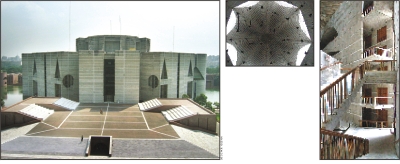
Sangsad Bhaban: Will it open to visitors?
Tawfique Ali
Despite great interest of the visitors from home and abroad to know about the history and architectural splendour of the Jatiya Sangsad Bhaban, the government has not made any arrangements for the visitors' easy access to the majestic building. The government's lack of enthusiasm frustrates many from learning about the Jatiya Sangsad Bhaban, a world famous architectural marvel by great architect Louis I Kahn, said noted architects of the country. There is enormous interest among the general public, students of architecture and tourists to know not only about the grandeur of Kahn's work but also the history and tradition of Bangladesh embodied in the building's architectural features. The government does not offer the visitors easy access to the building, though such establishments across the world are projected in an organised manner, said the architects. Architect Mubasshar Hussain, ex-president of the Institute of Architects Bangladesh (IAB), said: "Modern study of architecture is incomplete without studying Bangladesh's parliament building by Louis I Kahn." "During my tenure as the IAB president, I found thousands of architects from across the world interested to visit the Sangsad Bhaban," he said. "But unfortunately, while the whole world recognises the grandeur of the building, our government is not ready to recognise it," he said. There are prosivisons to visit the parliament building of Germany for commoners round the clock just buying a ticket. They also witness the parliemntary proceedings. The Sangsad Bhaban of Bangladesh is very popular in Japan for its architectural value and some Japanese architects even wanted to charter a plane to see the building, Hussain said. The building is esteemd as a pilgrimage for the architects across the world, he added. Architect Iqbal Habib of Bangladesh Paribesh Andolon (Bapa) said the aesthetic aspects incorporated into the building's design are meant to inspire the people's representatives to think and speak for the peoples. Absence of arrangements for easy access to the parliemant buildng is contrary to the concept and practices of the parliamentary democracy. Even the White House and Capitol Hill have provisions for arranged visits. The house is meant for the public and they have a right to see it, said architect Saif Ul Haque. "Considering the architectural significance, we should have made use of this majestic building as the symbol of Bangladesh like the Eiffel Tower of Paris," he said. According to Haque, internal architectural features of the building are just unique. Great number of foreign visitors often shows interest to visit the building but they do not know how to have access to it. An independent visitor centre for the parliament building can be run with the ticket money if arranged, he said suggesting introduction of guided tours. "It's a grand concept of architecture," said IAB President Khadem Ali. "One Danish architect and a group of architecture students led a professor of Massachusetts Institute of Technology (MIT) sought help from me in getting access to the parliament building and I had to seek help from another architect to arrange access," he said. In another instance, a team of architecture students along with a professor of University of Bern, Switzerland are eager to visit the building but do not know how to have access. Architect Sayeda Sultana Annee, who works for the physically-challenged people, said the managers of the building must ensure provisions and convenience for entry and movement of the physically-challenged in the parliament building. Administrative Officer Shahid Ullah at the Parliament Secretariat said an aspiring visitor has to apply to the parliament secretary at least a week ahead to obtain permission. The process requires consent of the speaker. Any group of architects or students have to apply through an organisation of architects if they have some academic purposes. But there is no organised system to arrange regular guided tour because "This is neither a zoo nor a museum, it is a government office," said Shahid Ullah. Joint Secretary of Jatiya Sangsad Dewan Zakir Hossain said that they have some mechanism to facilitate the visitors under the Visit Cell. One senior assistant secretary and sergeant-at-arms are assigned to conduct visits, he said. Asked why an instituted arrangement is absent that would facilitate easy access of visitors, Hossain said a UNDP-funded project called Strengthening Parliamentary Democracy (SPD) has a component on how to make the parliament building more people-oriented. Additional Secretary Abu Naqi Rezwanul Haque, currently in-charge of the parliament secretary, said, "Actually, we are conducting a study on how to address the issue under the SPD on making the establishment more people-oriented." The Jatiya Sangsad Bhaban is a part of the entire Jatiya Sangsad complex, which includes lawns, lake and residence for the members of parliament. The key design philosophy was optimum use of space but clearly representing Bangladeshi heritage and culture through the architecture. The architecture evolved from the basic human requirement of protection from the glare and fury of nature. The lake on three sides of the building, extending up to the MP Hostel not only adds to aesthetics but also portrays the riverine beauty of Bangladesh. Construction of the Jatiya Sangsad Bhaban began in 1961 and ended in 1982.
|