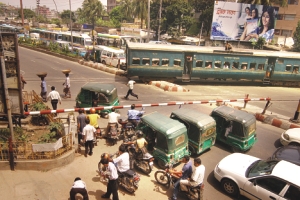
Level crossings play havoc on traffic
City Correspondent
With 72 trains arriving at and departing from Kamalapur Railway Station every day, each of the 18 level crossings in the city experiences a traffic halt for over six hours a day, Bangladesh Railway (BR) sources said. The BR officials said on average five minutes are lost when a train passes a level crossing. "If we calculate the time lost for passing of 72 trains, it would be 360 minutes," said Asok Kumar Dey, station manager, Kamalapur Railway Station. According to city traffic managers, level crossings on the major roads are mainly responsible for causing traffic tailbacks. The traffic situation further aggravates when motorists lock themselves in overtaking violating traffic rules. Moreover, rickshaws, small vehicles and pedestrians are often found crossing the level crossings when a train is about to pass. They ignore the red signal and cross the rail tracks even when the bar is lowered. Successive governments have pledged to relocate the rail tracks to address city's perennial traffic problem but none has so far acted positively on the issue. Dhaka Transport Coordination Board (DTCB) had a plan to construct partial grade separation (bridges over the rail crossing) at existing level crossings of the city to ease traffic congestion. But experts opposed that plan. The government is not interested to shift Dhaka's main rail station from Kamalapur outside the city considering that it would increase the cost of carrying goods into the capital. The communications minister in February 2005 in an interview with the Star City had assured to conduct a study to relocate the rail tracks from the city. So far no step has been taken and there is no sign of taking such steps in the near future. The minister now says that a study might be conducted if the ongoing Strategic Transport Planning suggests relocation of the rail tracks. "If Strategic Transport Planning suggests we can change the routes of the rail tracks so that trains can reach Kamalapur without touching the city's many roads. Until the relocation is done, we could build elevated rail lines at places where the lines still intersect a road," said Communications Minister Nazmul Huda. The officials who manage traffic at intersections near level crossings expressed their helplessness in maintaining traffic during the passing of a train. Jahurul Haque, traffic inspector of Dhaka Metropolitan Police (West) said unless the level crossing problem is solved it is not possible to improve the traffic situation. "For example, at Moghbazar intersection we have to stop all the four roads when a train passes the nearby level crossing. After a train's passing it is very difficult to decide which road should be opened first. Before we bring the situation under control, it's time to passing of another train that further worsens the situation," he said. Asked about the relocation, the high officials of BR said they could undertake such a project soon. "The problem could be solved after the Strategic Transport Planning (STP). We will do whatever the STP suggests," said Saleh Ahmed, BR's chief planning officer. The proposed rail tracks would be constructed bypassing the city centres. The level crossings located at Khilgaon, Malibagh Bazaar, Moghbazar Wireless Gate, Moghbazar, FDC (Karwan Bazar), Tejgaon, Nakhalpara, Old DOHS and Staff Road create traffic snarls throughout the day.
|