Dhaka: Home away from home
Channa R Jayasekera, Research Fellow, International Centre for Diarrhoeal Disease Research, (ICDDR,B), who has been in Dhaka for the last one month, shared his feelings about the city. I came to Dhaka three weeks ago. Along with overcrowding and traffic, what struck me most were the disparities in wealth and resource distribution. Dhaka appeared to be a booming city - with wide roads chock full with vehicles, construction all over and other signs of economic development, but still leaving behind vast portions of its population in poverty. Among other first impressions, I noticed the ban on polythene and plastic bags, and on 2-stroke gasoline engines in baby taxies, which were heartening. The media coverage of cities in developing countries, especially those as big as Dhaka, is usually not very flattering. So my preconceived notions were of a crowded, polluted city, with a large proportion of its inhabitants in, or near poverty. While this may not be far from the truth, it is also biased towards the negative aspects of the city. I am a medical student at Duke University in the US, and I chose to come to Dhaka because my interests are in international development and global health. So I was actually very keen about spending a year at ICDDR,B in Dhaka, facilitated by the National Institutes of Health and Harvard University in the US. I was, and still am, very enthusiastic about conducting research on cholera here, and experiencing Bangladesh. I enjoy my work at ICDDR,B and the people I work with. This is a rare example of a world-class research institution in a developing country. I also think there is a good social life here. For example, there seems to be a culture of artistic expression and creativity, and I have been to a few very interesting art and photography exhibitions and galleries. Certainly, one does not even need to go to such places to see creativity - I find that every rickshaw is a work of art in itself! The differences between wealthy parts of the city and those that are less well off, are staggering. In fact, at first glance there does not appear to be much difference between wealthy parts of Dhaka and wealthy parts of cities in developed countries. From housing and sanitation conditions in poorer parts of Dhaka, to young children and mothers carrying infants begging to no avail outside the windows of BMW's, the sights are depressing. I have not seen this much disparity in other developing countries I traveled to. Lives of expatriates, especially those from developed countries, are very comfortable here. And there are some moral challenges involved with that. The remunerations from NGOs, MNCs and embassies are high. Luxuries which are beyond the reach of most people in the home countries are affordable here because of excess supply of labor. For example, people can employ drivers and house maids, which are quite unimaginable for most people in developed countries. Dhaka's physical and built environment is an interesting lens through which the city's history, present, and future can be seen. On one hand there is the colonial architecture in places like Old Dhaka, and Mughal style buildings such as Curzon Hall, which harkens back to a vastly different sociopolitical era - both locally and in South Asia. Then on the periphery of these areas are buildings like the Parliament and other imposing structures built in the 70's that so boldly express the birth of a nation, patriotism, independence, and optimism. And in still newer parts of the city, shiny new mega-structures express the burgeoning modernism and capitalism in which direction the city seems to be headed. Of course one hopes that this future will hold promise for the impoverished masses as well.
|
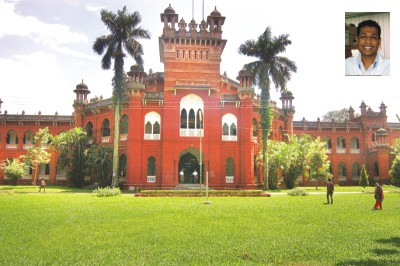
Curzon Hall intrigues Channa as it is a British structure with Mughal imprint. PHOTO: STAR |

