Developing states retool NAM for new era
Afp, Havana
Not aligned with whom? Developing countries in the Non-Aligned Movement (NAM) are working to make their Cold War-era group a united front with a sharper focus: countering not two superpowers, but one. Created in 1961, the NAM was meant to help members stand apart from the tense standoff between the Soviet Union and United States. But participants insist the movement is just as important in a new geopolitical context. "We believe it is indispensable for us to close ranks in defending our rights. The risks, threats and difficulties that we are facing are similar and with a common origin," Cuban Foreign Minister Felipe Perez Roque said in his opening speech to the NAM summit here Monday, alluding to the United States. "We must show our strength to the world, our ability to collectively cope with the enormous challenges imposed on us by a world governed by the most powerful," Perez Roque argued. The six-day gathering brings together leaders from about 50 developing nations, and high-level representatives from dozens more, including some of the most outspoken foes of the United States, such as Iran, North Korea, Venezuela and Syria. Heads of state and government were slated to start their talks on Friday, after four days of preparatory meetings. Monday, Haiti and St Kitts and Nevis joined the movement, boosting its ranks to 118. In a draft final summit document, NAM members appear determined to prove their movement is not out of date. Members "stated their firm belief that the absence of two conflicting blocs in no way reduces the need to strengthen the NAM as a mechanism for the political coordination of underdeveloped countries," the draft says.
|
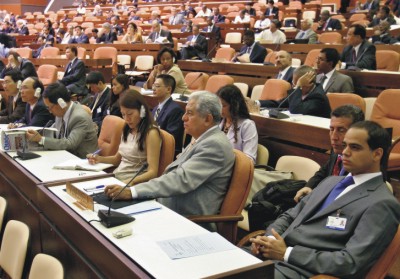
General view of the Convention Palace in Havana during the opening ceremony of the high officials' meeting in the framework of the XIV Non-Aligned Movement summit in Cuba on Monday. Representatives from most of the globe's developing nations began talks Monday at the summit that brings together leaders from about 50 developing nations, and high-level representatives from another 50, including some of the most outspoken foes of the United States, such as Iran, North Korea, Venezuela and Syria. PHOTO: AFP |

