Bare facts
Food crisis in the offing?
M Abdul Latif Mondal
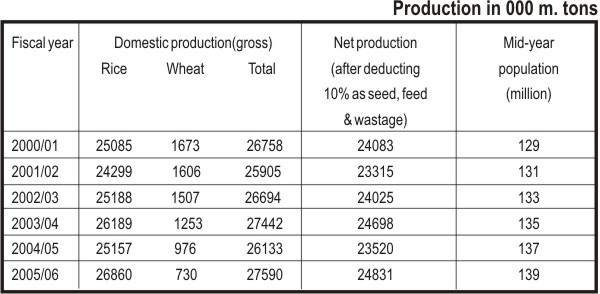
The northern districts of the country suffered from prolonged drought during the rainy season of the current year. According to reports, Rajshahi division, comprising of 16 northern districts, recorded markedly low rainfall in the rainy season. Whereas the rainfall recorded there last year was 862 mm in June and July, it was a meagre 314 mm during the same period this year. Reports further reveal that Rajshahi division did not experience such a prolonged drought during the rainy season in the last twenty-five years. This drought will seriously affect the aman production in Rajshahi division. It may be mentioned that the northern region of Bangladesh, Rajshahi division to be particular, is the largest contributor in overall agriculture production. Rice is the staple food of Bangladesh, providing about 93 percent of the country's total cereal intake and about 75 percent of the calories in our diet. The production of food grains (rice and wheat) stood at 100.46 lakh metric tons in 1971-72. The sustained efforts by the successive governments had a salutary effect on the production of food grains that reached 267.58 lakh tons in 2000-2001, which was till then the highest production of food grains in the country. Based on the Household Income & Expenditure Survey (HIES) calculation of 476 grams per capita per day intake of food grains, domestic production of food grains for the first time could marginally meet the requirement for food grains for a population of 129 million. But the increase in the production of food grains could not be sustained. The following table, based on food ministry sources shows the domestic production of food grains between 2000-2001 and 2005-2006, as well growth in population during the same period. It would appear from the above table that total gross production of domestic foodgrains in 2005-06 has exceeded the highest production of 2003-04 by 1.48 lakh tons only, while the net population during the period increased by at least 6 million. The net production available for human consumption stood at 24,831 lakh tons. This could marginally meet the requirement of 139 million people at 476 grams per capita per day. Among the three major rice crops (aus, aman, and boro), aman continued to top the list until 1997-98. Available statistics show that in 1998-99, aman was replaced by boro as the highest producing rice. Since then boro has continued to top the list. The most important advantage is that the aman variety requires little irrigation since it is typically sown when the monsoon is in full swing. There is thus little requirement for supplementary irrigation. But the drought in the rainy season in the northern districts has come as a serious threat to aman production this year. Information available from the field-level officials of the department of agriculture extension (DAE), farmers and the media suggest that aman production in the northern districts will be seriously hampered this year. Quoting the DAE sources, the Daily Star on August 28 carried a report which said that over 124,000 hectares of land in 16 northern districts of the country could not be utilised for aman cultivation due to lack of rainfall this year. According to a report, published recently in another Dhaka daily, the aman crops would be 40 per cent less this year. A food ministry source reveals that its preliminary field-level survey shows that aman production this year (2006-2007) would be 20 percent less in comparison with last year's (2005-06) production of 110 lakh tons. This means that the next aman production would be around 80 lakh tons, and that means a shortfall of 30 lakh tons, or so, compared to the production last year. The production figures of aman in the past six years show that the highest production of aman stood at 112.49 lakh tons in 2000-2001. The low production at the national level is of grave significance to Bangladesh, and especially to the northern districts that are prone to seasonal famine known as monga. It is aptly said that the aman crops are the only cushion for a large section of agrarian households in the northern region and they suffer from a severe food crisis due to lack of employment. A bad aman harvest would mean low employment in the north. It will only aggravate and hasten monga this year. Now, the question that arises is: what are the measures that the government should take to avert the drought-driven aman production loss? First, the government should immediately finalize a crash program that will provide necessary support and incentives to the farmers to produce non-cereal products in the lands that could not be utilised for aman production due to lack of rainfall. The problem here is that the government has got one and a half months to hand over power to the caretaker government (CTG). The government is fully involved in activities pertaining to the forthcoming election and has little or no time to look into the vital problem of food shortage. Second, a larger area has to be brought under boro cultivation to offset the loss in aman production. Since boro is primarily an irrigation-based crop, measures have to be taken in advance to ensure timely and regular supply of diesel, electricity, and fertilizer. Although the CTG's main responsibility is to render all possible aid and assistance to the Election Commission for holding general elections, it may have to undertake a crash program to increase the generation and distribution capacity of electricity and make it available to the farmers for significantly increasing boro yield in the interest of the nation's food security. It may be mentioned that 100 MW or so of electricity were added to the generation capacity in the 4 years 10 months of alliance rule against growing demand for electricity at above 10 percent annually. Consequently, the last boro season saw the killing of farmers when they demanded electricity to help irrigate their boro crops. Third, the main source of import of rice is India. Other important sources are Thailand and Vietnam. The price of coarse rice in the international market has been on the increase since the start of 2005-06. In an attempt to increase domestic supply, and to bring down prices, the government may allow duty free rice import by private traders till the start of the next boro harvest. Fourth, wheat is the second most important cereal in the country. The demand for wheat is growing day by day, particularly in the urban areas. Our annual requirement of wheat is more than 30 lakh tons. In 1999-2000, wheat production stood at 1,840,000 tons. The production of wheat has declined to only 730,000 tons in 2005-06. The price of wheat in the international markets has been on the increase from the middle of 2005. The price reached $203 per ton by the end of June, 2006. The entry of India, so long an exporter of wheat, into the import market has further pushed the wheat price up. The government should, therefore, allow duty free wheat import by private traders for a certain period to increase domestic supply and bring down prices. Last, but not the least, the government must maintain satisfactory food security stocks through internal procurement, and, if necessary, through imports in public sector. In the late nineties, the then AL government decided to maintain security stocks of food grains at a minimum of 10 lakh tons at all times, and though this decision still remains in force the stocks often go below that level. The government must maintain satisfactory security stocks for distribution of food grains under PFDS, as well as for selling food grains at fair price through OMS to help stabilise the price of food grains in the market. To conclude, a concerted effort is needed to offset the estimated loss of aman production this year due to prolonged drought during the rainy season in the northern region. The main thrust should be on the next boro crop. All possible facilities and assistance must be rendered to farmers to attain a production target that will surpass all previous records of boro production in the country. M. Abdul Latif Mondal is a former Secretary, Ministry of Food.
|