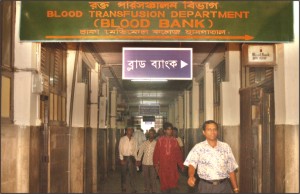
Unlicensed blood banks pose threat to public health
Tawfique Ali
Private blood banks and transfusion centres in the capital and elsewhere are running without licence, according to official sources. Almost none of these unauthorised blood transfusion centres in the capital has facilities to screen blood to test five deadly diseases -- HIV/AIDS, Hepatitis-B, Hepatitis-C, Syphilis and Malaria -- let alone carrying out blood components preparation. These unauthorised blood banks without fundamental arrangements of screening five lethal diseases pose a serious hazard to public health with high risk of spreading deadly diseases through transfusion of infected blood, said the Health Directorate officials. "No blood banks and transfusion centres, except the government-run ones, has licence which they must have," said Assistant Director (Medical Board and Private Clinics) Dr ASM Aminul Mowla of the Directorate General of Health Services. Blood transfusion also requires, among other crucial prerequisites, blood grouping and cross matching, the tests without which blood transfusion is just deadly, Dr Mowla said. The blood banks mushrooming at every nook and cranny including the premises of private hospitals and clinics may result in an outbreak of fatal diseases if the deadly business goes unabated, experts said. As per government's ongoing Safe Blood Transfusion Programme (SBTP), any transfusion centre must carry out blood screening to detect those five diseases before collection and transfusion of blood. The government enacted the Safe Blood Transfusion Act in 2002 that came into force on August 1, 2004. It also framed a detailed set of rules in April 2005 to ensure safe blood transfusion. The Safe Blood Transfusion Rules aim at collection and transfusion of safe blood, encouraging relations and voluntary donors and discouraging professional donors. According to the act, blood collection and transfusion is illegal if blood is not collected and preserved as per rules; if date-expired blood is transfused and if cold chain is not maintained. Cold chain means blood collection, preservation, carrying and delivery to the user (recipient) in 2 to 8 degrees centigrade temperature. The law makes it mandatory for a private entrepreneur of blood transfusion centre to obtain licence from the Health Directorate which is renewable every three years. Owner of an unlicensed blood bank or transfusion centre is punishable with two years' rigorous imprisonment or a fine of Tk 1 lakh, or both. Those who had set up blood banks before this law was enacted, have to obtain licence within 30 days from the day the law came into force. One who prescribes or facilitates wrong blood transfusion and causes severe damage, disability, death and transmission of blood-born diseases to the recipient will be punished with five years' rigorous imprisonment or a fine of Tk 5 lakh, or both, according to the law. A private blood transfusion centre that collects 10 to 15 units of blood every day has to have one blood transfusion expert, two medical officers, three lab technologists, one counsellor, two registered nurses, four lab attendants, one administrative officer and two office staff. A mobile court led by magistrate Narayan Chandra Debnath on August 30 fined an illegal blood bank 'Donor Blood and Pathology Centre' in the city's College Gate area Tk 30,000 and sealed it off finding the centre collecting blood from heroin addicts. The same court on August 28 fined the six owners of Sandhani Blood Diagnostic Centre on Green Road, Dhaka Tk 30,000 each for running illegal blood trade. Besides, Mahanagar Diagnostic Centre on Mirpur Road was fined Tk 30,000 for the same offence. The court also fined Medisair Diagnostic Centre on Green Road Tk 50,000 for illegal business in blood transfusion. Magistrate Narayan Chandra Debnath said, "During our drives against illegal blood transfusion centres, we found unscrupulous people doing business with contaminated blood collected from drug addicts and professional donors without carrying out screening. " A mobile court official said blood is being collected from drug addicts, professional criminals and vagabonds infected with deadly diseases at Tk 70 to 80 per bag and then is sold at Tk 600 to 700 or more. The manager of Gastroliver Hospital and Research Institute on Green Road along with five ward boys had raised Tk 60,000, bought an ordinary refrigerator and had been running the blood bank, he said. When asked, Director of Gastroliver Hospital Bazlur Rahman Chowdhury said, "We were not aware that the ward boys and a manager of our hospital were carrying out the illegal blood trade." Another mobile court headed by magistrate Rafiqul Islam on April 6 fined two illegal blood centres. The mobile court led by magistrate Sarder M Keramat Ali on August 31 found around 50 bags of blood collected from professional donors at an illegal private blood bank New Medical Lab in a residential building on Husaini Dalan Road in the capital and sealed it off. The same court fined Oriental Blood and Pathology Centre on Green Road Tk 40,000, as it was running with date-expired trade licence. Asked what the Health Directorate is doing to streamline the malpractice in blood transfusion, Director General, Health Professor Md Shahadat Hossain said, "I don't have adequate manpower and logistics to keep these centres under constant surveillance." It is impossible to eradicate malpractice in the health service sector without community participation, he said. The UNDP-funded three-year SBTP aimed at strengthening 98 blood transfusion centres at government hospitals, medical colleges and institutes across the country. There are around 220 government-run blood transfusion centres in the country. Of the targeted 98 centres, 18 are situated in the capital. Under the SBTP, each of the 53 government hospitals in district headquarters and 11 medical college hospitals has the screening facility, said Programme Manager of SBTP Dr Saleh Md Rafique. Screening of the five deadly dieses had not been ensured even at the government-run centres before the SBTP was undertaken, he said. "Scenario at the hundreds of blood transfusion centres across the country is just dreadful," said a top official of Health Directorate. Approximately, total demand for blood every year in the capital is 1,20,000 bags, according to Dr Saleh. He claimed that the government-run 18 centres meet 60 percent of demand in the capital while 20 percent is met by voluntary organisations. Illegal centres supply the rest 20 percent. According to official sources, there are at least 100 illegal blood transfusion centres at similar number of big private hospitals and clinics in the city apart from the small ones. Under the World Bank funded extended programme of SBTP, 19 out of 98 centres were targeted for further standardisation with modern equipment, training of the personnel and quality assurance for blood component preparation of plasma, red cell, white cell and platelet. Of the 19 centres, 11 are in Dhaka -- one each at the Bangabandhu Sheikh Mujib Medical University (BSMMU), Armed Forces Institute of Pathology (AFIP), National Institute of Traumatology and Orthopaedic Rehabilitation (NITOR), National Institute of Cardiovascular Diseases (NICD), National Institute of Chest Diseases Hospital (NICDH) and Matuail Women and Children Hospital. The total annual demand for blood for medical purposes in the country is 3.5 lakh units (bags), Dr Rafique said, adding that the daily demand for blood at Dhaka Medical College Hospital is 42 to 45 units. Story of a victimEetu and Sohel, a young couple, have been fighting against Hepatitis-C for the last ten years after the deadly virus infected Eetu through blood transfusion.
"I never underwent any surgery or received blood except for once in 1996 when I underwent a dialysis at a private clinic in Dhaka and received seven to eight bags of blood from my close relations," said Eetu.
Tested, all of the donors proved Hepatitis-C negative. "So, it was the dialysis machine that had infected me," Eetu, married four years ago, told Star City.
"Since 1998 I had been donating blood for anyone in need," Eetu said, "I used to do it whenever I got an opportunity out of a sense of gratefulness, as my own life was saved with others' blood."
But it was in July 2003 when Hepatitis-C was detected in Eetu's blood as she donated for a friend's relation. "I used to donate blood regularly to voluntary organisations like Red Crescent, Sandhani and Bandhan," she said. "My blood was always accepted. I didn't know that I was infected with the deadly virus."
"I'm ready to die if I'm destined to," Eetu said. "But I feel sorry for those who have been infected with my blood unknowingly."
Eetu requires taking one injection worth Tk 20,000 every week.
|