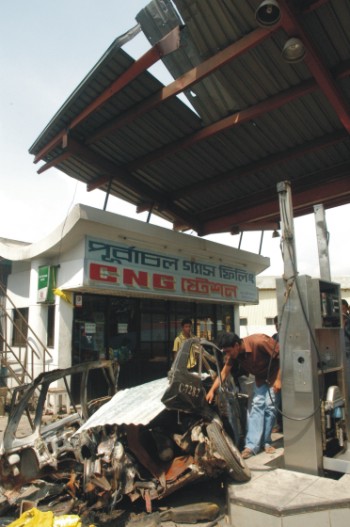
CNG cylinders need regular check up
Raihan Sabuktagin
The authorities' neglect of fitness monitoring of the CNG equipment installed in vehicles has resulted in fatal accidents in the city and elsewhere. Bangladesh Road Transport Authority (BRTA), Rupantarita Prakritik Gas Company Limited (RPCGL) and Department of Explosives usually deal with fitness of all kinds of vehicles and imported CNG equipment but none of these organisations are checking standard and fitness of the equipment after their installation in vehicles. Lack of monitoring by the authorities over the highly sensitive gas operation in vehicles has encouraged some ignorant and unscrupulous people to install low graded and non-CNG equipment in the CNG-run vehicles, posing risk to public safety. Recently, a CNG cylinder of a black cab exploded at a filling station in Mirpur while it was being filled. It was a non-CNG cylinder, which has capacity of only 1000 pounds pressure per square inch only, according to officials at the Department of Explosives. There have been several explosions in CNG-run vehicles since the government introduced compressed natural gas for vehicles in the country in 1996. Investigations by the Department of Explosives on those explosions revealed that all of them occurred because of the use of low-grade and non-CNG cylinders. A top official at the department told Star City that 'test pressure' of a CNG cylinder should have a minimum of 4,500 pounds per square inch and the maximum 6,500 pounds as the filling stations fill gas on a minimum 3000 pounds per square inch in the vehicles. He said: "Many unscrupulous CNG conversion workshop owners convert engines using substandard or faulty accessories, especially the cylinders. Some of these workshops install cylinders fit for acetylene or oxygen, which only increases the risks of explosion." He admitted that though the authorities certify the equipment after they are imported, none of them has any monitoring programme on the substandard cylinders. At present, the CNG conversion companies provide certificates for the equipment installed in the vehicles. Besides, RPCGL has requested the filling stations to check the fitness of cylinders during filling, said Shafiul Azam, director, operations of RPCGL. When asked why RPCGL has not yet initiated any monitoring system, Azam said that they have introduced a monitoring system on the safety through publishing circulars in daily newspapers and notifying the filling stations. But he admitted that all CNG equipment installed in vehicles need regular checking of fitness. BRTA could play a role in this regard, he suggested. At the moment, BRTA provides fitness certificates to the vehicles after checking the vehicle mechanism only. It does not have any facility or programme to check fitness of the CNG equipment installed in some of those vehicles. Number of explosions from low-grade cylinders of the CNG run vehicles will rise if the government does not take any step immediately, a top BRTA official told Star City. Compressed Natural Gas has become very popular as the cheapest alternative fuel among car owners following repeated increase in petroleum prices. According to RPCGL data, there are 56 filling stations and conversion workshops in Dhaka. Approximately 43,000 CNG converted vehicles are plying the city streets and the number is growing fast.
|