Alim-ur-Rahman Khan
An avid music connoisseur
Kavita Charanji
Explaining his passion for the Sur Bahar, also described as the bass sitar, former businessman Alim-ur-Rahman Khan says, "The instrument lends itself to complex melodies and is very introspective. You hold the notes for a longer time; you listen to it, you don't jump in joy but you can shed your tears."Inspired by his French wife, Colette, Alim pursues his hobby in full form. Though there have been breaks, he has never been out of the world of music. Initially reluctant to talk about his interest, he describes himself as an "amateur performer and organiser of music concerts." To him the agenda is a labour of love for classical music, which "is probably the most strong force." Alim's zeal for this genre goes back to his childhood. His mother played the sitar and his maternal grandfather was fond of classical music as well. At the age of about 15 he began singing. When he picked up the Sur Bahar, he realised that this was the music he wanted to play. Today Alim is a prominent figure in the revival of classical music in Bangladesh. Tracing the history of this genre, he points out that there have been dramatic changes in the post-Independence era. For one, there was the influence of conservative Muslim culture, which frowned upon music. At the time, few families listened to and appreciated North Indian classical music. Likewise, 30 years ago there were very few vocalists who could grip the attention of the audience; today there are around a dozen such singers. To some extent, the Indian government has also played a role in the resurgence of classical music through its music scholarships. Using the analogy of a tree, Alim says that in the sphere of North Indian classical music, he "nurtured the seedlings to grow into a tree." However, he says that the real credit for the renaissance of this genre should go to Shafiur Rahman and his wife. On the cards is a performance, hopefully this winter, of Sur Bahar for Rahman's Shuddho Sangeet Gosthi. The show is dedicated to Rahman and his wife who, as Alim says," despite all the odds have kept the lamp of classical music burning." Nevertheless, through the organisation Shadhona, a centre for advancement of subcontinental music (of which Alim is the chairperson), some major steps have been taken to popularise classical music. Currently, Shadhona strives to hold a concert of classical music every month. Though largely giving a platform to Bangladeshi vocalists and instrumentalists, the organisation plans to invite an Indian artiste to one of the concerts. "It is an expensive proposition to organise concerts and needs a lot of hard work," asserts Alim. "My hands are full," concludes Alim, who modestly describes himself as an "elitist" in the sense that he plays for himself and his circle of friends.
|
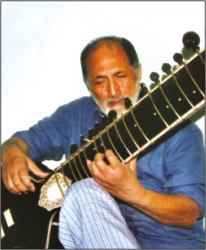
Alim-ur-Rahman playing his Sur Bahar |

