In Memoriam
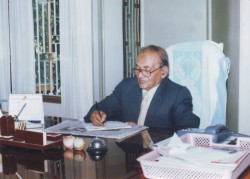
Professor Muhammad Shamsul Huq
Mahfuzur Rahman
Professor Muhammad Shamsul Huq passed away in the afternoon of Wednesday, September 12. He was 80. He died as he lived, without fuss. He lay seriously ill for over six weeks at Bangladesh Medical College. His medical condition got little media attention. He was unconscious most of the time; he would probably have cared little about such attention if he were not. Of humble origin, he rose through the ranks of academics and educationists. A brilliant student, he far outshone most of his peers in curricular examinations, joined Dacca University as a lecturer in Physics, was to become Vice Chancellor of the University, and ended his active career as Chairman of the University Grants Commission. A highly successful teacher, he earned enormous respect of thousands of students. Education was his preoccupation and as a teacher and administrator he not only left his mark on the minds of individual students but also contributed to debates on education policy in the country. His passion for education also earned him an advisory role in education policy in the second caretaker government of the country in 1996. It was also his lifelong involvement in education that led him to set up a private university after his retirement from active service. He set it up at a place to which he preserved a lifelong tie: Comilla. He felt he owed it to the people of his native Comilla to do something to make higher education available to them. A true educationist, he also knew that the education should be of the type that met the needs of the time. Sadly, his venture, University of Comilla, came to a tragic end he could not have foreseen. One can only wonder why it had to end this way. One wonders too whether the outcome would not have been different under a different regime. The shock of the failed venture, and the death of his beloved wife just over a year ago, was too much for him. He rose through the ranks but never forgot his humble beginning. On the contrary, he returned to it time and again. A simple, unassuming man, he enjoyed the company of ordinary people far more than that of the high and the mighty, whose company he had often to keep. The poor and the needy, particularly those among his relatives, were never far from his heart. He dispensed help even when it hurt his own family. He was sometimes taken for a ride by the unscrupulous. But he seemed not to mind. A deeply religious man who said his prayers five times a day, Professor Shamsul Huq was totally secular in his outlook. He was as completely at ease at a puja ceremony, or at a bhajan singing, as in a milad mahfil or at a singing of ghazal. In the long years I have known him I have often heard him deplore the rise of religious fundamentalism in the country. His secular views and ideology earned him the eternal enmity of religious fundamentalists and anti-liberation forces. It was those forces that had earlier made him and his family flee Chittagong in those dark days of 1971. He ended up in the Indian Punjab, teaching at Patiala University, from which he returned to liberated Bangladesh and to Chittagong University in early 1972. An unwavering support for the ideology behind the creation of Bangladesh, and a deep consciousness of the sacrifices involved, came to define his life and career ever since. I remember him too as a man who believed in conciliation and consensus rather than antagonism, in discussion rather than decision forced upon. As I write these lines, I recollect an image that will forever remain etched in my mind. This was a newspaper photograph of him, chairing and moderating a discussion on national policy issues, the exact nature of which now escapes my memory, and on one side of him was seated Sheikh Hasina and on the other side Khaleda Zia, the two national leaders. A few months later when I happened to meet him I quipped that in that picture he looked like a rose between two thorns. He said he never saw the photograph, expressed no interest in it, ignored the humour, and simply stressed the need for discussion and consensus. He is finally back where his life's journey began. He was buried at his ancestral home in Comilla. May his soul rest in peace. The author is a former United Nations economist.
|
|

