Omar Ali Chowdhury
An unsung maverick
Syed Badrul Haque
Omar Ali Chowdhury passed away at midnight on July 3 at his flat at Uttara in Dhaka city -- a far cry from the Nawab Palace at Bogra. It was hard to believe that his weekly column, As I see It, had appeared in Holiday only two days earlier before he shuffled his mortal coil from this 'joyless earth'. He virtually went unnoticed and unremarked by our media or the literary circle. Truly, his presence as an erudite writer could not be felt beyond the charmed clientele of the Holiday. He remained reclusive and withdrawn. His intellectuality and cosmopolitanism that was bred and nurtured in pre-partitioned days in Calcutta found little or no space in the provincial cultural milieu of Dhaka.Before he resumed writing regularly in Bangladesh after a long spell of his peripatetic existence at home and abroad, he worked in London for the famous left-wing weekly New Statesman for several years. Despite his severely impaired eye-sight that he had been enduring for the past 20 years, he never relented in his passion for writing. His mind and memory, however, was as receptive and sharp as ever. He chose the weekly Holiday as his vehicle to expose himself to the readers, albeit to the society, through his column. As I see it, under the pseudonym, Maverick. These columns, however, were only a fleeting glimpse of his many-sided talent, but were, I believe, the best written English language column on (or one of the best ...) on contemporary issues in the country. He had an amazing capacity to prove his mettle as a writer on a wide range of subjects such as music, theatre, criticism, history, serious essay et a1. He was painfully meticulous and his notes and other reference material were well organised on the table was a neat parade of books and journals. None of his writings were shallow or pretentious, he subjected himself to the discipline of writing. Engagingly exotic and equally impressive was his style of writing, his critical edge and wit. Given his potency as a writer, one may however despair that his literary output could have been much more than what he had delivered. He was distraught with the passing political scenario in the country, and never allowed his outlook to be frosted with the culture of political schism that currently divides the nation so perilously. As a writer he always obeyed objectivity to a fault. He belonged to a different class, the kind of which is a rarity. In his 139-page book 'Prelude to Bangladesh', Omar Ali convincingly delineated the historical events right from the year of the Partition of Bengal in 1905 till the emergence of Bangladesh in 1971 as a free nation. As one having lived in the thick of politics under three flags, his interpretation of historical events vis-a-vis history which is primarily a chronicle of events is illuminating. 'A historian can give his own interpretation as to the significance of these events, as he paints on a small or large canvas. Ultimately it is the reader who has to decide what to consider gospel truth, and what to take with a pinch of salt.' More to history, he also attempted to portray in fiction another side of the grim events of 1971, -- a human side in his book. A debonair-bachelor, he was warm and kindly with an aristocratic carriage. A restlessness shadowed him imperceptively in his romantic demeanour. He embraced the vicissitudes in his life in good humour that afforded him a savoir-fair to face the world that came his way. He would always blossom in the company of his friends and admirers. In later days, he was hugely cheated of his fortune that sent him nearly on the verge of penury. Not a sharp dresser, he was as stylish as in his casualness. He had a liberal bent of mind with a socialist streak. It was his love for the country that prevented him from leaving his shored when his English mother and brother nick-named Teddy had left for England to settle down. He was an ardent connoisseur of music. He knew by heart all the nine symphonies by Ludwig Van Beethoven. He had the rare paintings of old masters and historically important photographs hung -- rather incongruously--at his Uttara flat. Among the notable personalities Satyajit Ray, the film icon, was his good friend, to mention. My association with Omar Ali's immediate and extended families was, in a manner of speaking, a legacy that originated from the letters that were written to my father, Syed Ashraf Ali by his grandfather Nawab Ali Chowdhury, his father Nawabzada Altaf Ali Chowdhury, his uncle Nawabzada Hasan Ali Chowdhury, and his brother, former Prime Minister of Pakistan Mohammad Ali of Bogra (as he was commonly known). All of them were noted people in the society in their own right. I had occasions to meet Mohammad Ali of Bogra and Omar Ali at the Palace at Bogra. Omar Ali in his twilight days records with refreshing candour the delight he felt as an adolescent when he arrived Monte Carlo in Monaco with his parents. He charmingly writes: "It was early evening when we arrived, and the flowers in the spacious public gardens began to sparkle like jewels as the early street lamps were switched on." Relevantly, if his weekly pieces were compiled and published in a book that certainly would be an admirable enterprise on behalf of the inquisitive readers. I was much moved to know that Omar Ali appreciated the letter which was published in Holiday only a few months before he passed away. In my letter I requested him to write a comprehensive socio-political treaties on the emergence of Bangladesh as a sovereign nation since writing in this genre appear rather inadequate. Indisputably, he fitted the bill eminently. He was keen to contact me which unfortunately did not materialise. I was in tatters. Syed Badrul Haque is a former Public Relations Officer to the President.
|
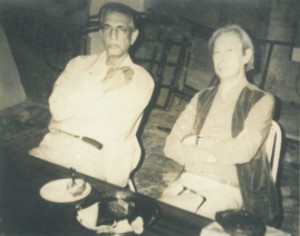
Omar Ali Chowdhury with Satyajit Ray |

