TechFocus
The unfamiliar world of Bionanotechnology
Ahsan Habib
"Everyone was so quiet watching this movie. It was amazing," said Clayton Teague, director of the National Nanotechnology Coordinating Office, during the presentation of a video clips created by Samuel Stupp, a materials scientist and director of the Institute for Bionano-technology in Medicine at Northwestern University. The video's protagonist was a mouse with a damaged spinal cord and it could only barely move using its front legs. Stupp's research involves engineering nanomolecules called peptide amphiphiles consisting of a hydrocarbon tail attached to a peptide into which is inserted amino acid sequences that stimulate neurons to seek new connections with neighboring neurons. As the video clip revealed, two months after the injured mouse received an injection of Stupp's peptide amphiphiles, it was able to move using all four limbs. Analyzing anatomical, molecular, and behavioral results from mice with spinal cord injury, Stupp and his collaborator, North-western neurology professor John A. Kessler, suspect that the amphiphiles, which form a gel when they self-assemble, prevent scar tissue from forming, thereby allowing initiation of the regenerative process in the injured spinal cord, a process that normally is blocked.The idea of Nanotechnology was first given by Richard Feynman in 1959 during his talk at the California Institute of Technology. “The principles of physics, as far as I can see, do not speak against the possibility of maneuvering things atom by atom. It is not an attempt to violate any laws; it is something, in principle, that can be done; but in practice, it has not been done because we are too big,” said Feynman. But Richard Smalley is considered as the “Pioneer of Nanotechnology” who won Noble prize in Chemistry in 1996 for discovering buckyballsthe all-carbon, soccerball shaped molecules that helped to push nanotechnology into high gear. Smalley, who died of leukemia in October at the age of 62, was one of the most vocal champions of the beneficial potential of Nanotechnology, which he argued was destined to solve major societal and medical problems. In many of his speaking engagements since his cancer diagnosis in 1999, he asked rhetorically, “Am I part of the last generation to die of cancer, or the first to be saved by nanotechnology?” Now there is a growing roster of biological nanotechnologists who are taking audacious questions like Smalley's to heart and to their laboratories. The word “Nanotechnology” conjures up the notion of human innovation and control over objects and processes on the nanometer scale. Mankind did not make any concerted effort to shape the atoms in manufactured products until medieval times, when alchemists sowed the seeds of the modern science of chemistry. During their search for the secrets of immortality and the transmutation of lead to gold, they developed methods for the willful combination of atoms. Chemical reaction, purification and characterization are all tools of the alchemists. Today, chemists build molecules of defined shape and specified properties. Chemical reactions are understood, and tailored, at the atomic level. Large quantities of pure materials are mixed and reacted, and the desired product is purified from the mixture of molecules that are formed. Nonetheless, chemistry is nanotech-nology- the willful combination of atoms to form a desired molecule. But it is nanotechnology on a bulk scale, controlled by statistical mechanics rather than controlled atom-by-atom at the nanometer scale. From Biotechnology to Bionanotechnology Biotechnology harnesses biological processes and uses them for our own applications. For instance, researchers routinely use purified enzymes to cut and paste genetic instructions and add this back into cells. Knowledge of the atomic details are not important, just as knowledge of the type of ink used to print this page is not important for understanding the words printed here. On the other hand, bionano-technology is a subset of nanotechnology: atom-level engineering and manufacturing using biological precedents for guidance. It is also closely married to biotechnology but adds the ability to design and modify the atomic-level details of the objects created. Bionano-machines are designed to atomic specifications, they perform a well-defined three-dimensional molecular task, and, in the best applications, they contain mechanisms for individual control embedded in their structure. Bionanomachines in nature As you read these words, about 10,000 different nanomachines are at work inside your body. These are true nanomachines. Each one is a machine built to nanoscale specifications, with each atom precisely placed and connected to its neighbors. Remarkably, many of these nanomachines will still perform their atom-sized functions after they are isolated and purified, provided that the environment is not too harsh. Already, these nanomachines have been pressed into service. Natural digestive enzymes like pepsin and lysozyme are so tough that they can be added to laundry detergent to help digest away stains. Amylases are used on an industrial scale to convert powdery starch into sweet corn syrup. Another example is the flagella that push bacteria around in pond water, driven by a motor that looks like it came from a mechanical parts catalog. Nanomachines: doctors of tomorrow! Scientists have built a tiny biological computer that might be able to diagnose and treat certain types of cancer. The device, which only works in a test-tube, is years from clinical application. But researchers hope it will be the precursor of future 'smart drugs' that roam the body, fixing disease on the spot. Instead of silicon chips and electrical circuits, the miniscule machine is made of DNA. And rather than being controlled by electrical signals, it senses changes in its environment and responds by releasing biological molecules. The biocomputer senses messenger RNA, the DNA-like molecule that helps create proteins from the information in genes. In particular, it can detect the abnormal messenger RNAs produced by genes involved in certain types of lung and prostate cancer. When the computer senses one of these RNAs it releases an anticancer drug, also made of DNA, which damps expression of the tumor-related gene, researchers report in Nature1. Billions of the computers can be packed into a single drop of water, so they could easily fit inside a human cell. "It is decades off, but future generations of DNA computers could function as doctors inside cells," says Ehud Shapiro from the Weizmann Institute of Science, Israel, who led the research. The idea is they could diagnose disease from within cells and dispense drugs as necessary. Prospects of Bionanotechnology in Bangladesh Food shortages and starvation will be a thing of the past if Bionanotechnology is perfected. Nanomachines will be able to turn any material into food, and this food could be used to feed millions of people world wide. Again, since the technology is self replicating, food produced by nanomachines will be low cost and available to all. As well as food, nanom-achines will be able to build other items to satisfy the demands of our growing population of consumers. Clothing, houses, cars, televisions, and computers will be readily available at virtually no cost. Furthermore, there will be no concern about the garbage produced by the new con-sumerist society because nanomachines will convert it all back into new consumable goods. Environmental problems such as ozone depletion and global warming could be solved with nanotechnology. The perfection of nanotechnology and the production of nanomachines could herald a new age for humanity. Starvation, illness, and environmental problems could quickly come to an end. In Bangladesh, the department of Biotechnology and Genetic Engineering, Khulna University, Khulna included the course of Bionanotechlogy in their Masters level. Though it is a modern technology and seems to be impossible at present in respect of our country, but I do believe we have merit and knack to handle the science of Bionanotechnology if we get proper opportunity and cooperation. The above article is extrapolated from several scientific papers.
References
1. Pilcher H. R. DNA computer diagnoses disease and dispenses drug. Nature, Science update (On line). 6 September, 2006. 2. Goodsell, D. S., Bionano technology ,Wiley-Liss publication, 2004. 3. Amato I, Nanotechnologists Seek Biological Niches. Cell 123, December 16, 2005. The author is a student of Biotechnology and Genetic Engineering Discipline, Khulna University
|
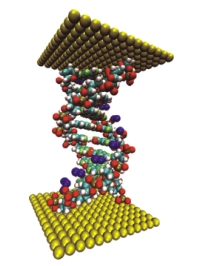
An engineered DNA strand between metal atom contacts could function as a molecular electronics device. |

