Book Review
Bringing Islamic intellectuals to the Bengali-speaking world
Afsan Chowdhury
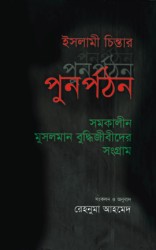
Islami Chintar Punorpothan, which deals with the challenges facing Islamic intellectuals globally, is probably the most significant book now available in the Bangladesh non-fiction market. Prof. Rahnuma Ahmed has carried out a stellar task in bringing together the high end intellectuals of contemporary Islam to the Bengali speaking world in a superbly produced book. It is all the more relevant because Islam as an intellectual process is overwhelmed by emotionality in Bangladesh leaving the intellectual space relatively deserted. Rahnuma Ahmed has completed this difficult task of collecting texts and writings on Islam thanks to the Internet - wth a great sense of responsibility. She has translated the gathered conversations successfully to make them very easy readings. The representation range from global personalities like Amina Wadud and Tariq Ramadan to the less known activists like Abu Zahza and Khaled Abu-El Fadl. It's now up to us to open the book and be introduced to the rainbow world of Islamic intellectuality. Discourses and challenges This volume provides opportunity to review the different streams of Islamic thought that has emerged in different parts of the world including those that are challenging established Islamic positions from within its own corridors. For example, El-Fadl who teaches law at the California University takes on the Wahabi claim that they have the sole right to interpret sharia. He insists that they don't even "understand laws". He goes on to say that Wahabism is "an autocratic dogma bereft of love and humanity". While he wouldn't be very popular with Wahabi theologians it also shows that the internal world of Islam is hardly monolithic. Amina Wadud, who created a global stir by leading a mixed gender prayer is also a scholar of high repute. She speaks with passion about the liberating influence of Islam and says that it's the post-modernity of the last 200 years that influenced her search within the Quran to locate the space for liberation of societies and individuals, especially women. To her, the right to lead a prayer is as fundamental as her interpretation of Islam as a faith of liberation. Amina Wadud contests the notion that only men have spiritual supremacy and she draws her reasoning from both the logic of Quran and early Islamic practices. Lily Zakia Munir, who comes from a long line of Indonesian Islamic scholars, says that there is a need for a sensitive interpretation of the Quran which goes beyond the simple legalistic one. "If one is to achieve the objectives of the sharia , then I would suggest that one needs to go beyond the sharia barring a few ritualistic and religious aspects and create a new tarikah(path)." It is these dramatic intellectual journeys in Islam that has been presented in this book and made it such a rich effort. Rahnuma Ahmed has gone to great lengths to make the book as comprehensive and reader friendly as possible. The notes at the end cover a large area of philosophical, religious and functional aspects. Each piece is introduced by a convenient biography and e-mail addresses are also attached in many cases. This is more than a book; it's a key to a world of knowledge which for many has remained distant despite links of faith. Readers must decide what they think of the scholars and activists and their idea about Islam. Tariq Ramadan of Freyberg university, Switzerland who has granted and then denied a visa to teach at an American university is also a explorer who represents the obvious conflicts in Islamic thoughts that have arisen as a result of ideological, generational and political clashes. It's a clash not just of civilizations but also of intellectual wars fought within civilizations. Faith and dogma are not in consonance with the exploratory space of religions. However, the attraction that intellectual subservience offers is also enormous. For a religion that its followers believe is the final one, and by extension the greatest, has issues that will put many thoughts in contest if not in confrontation with belief. This book presents those who are trying to chart a course in this endless and often very turbulent sea. By collating, translating and writing helpful notes on this fascinating world, Rahnuma Ahmed has opened a window that lets us see the armada that is sailing on the sea of Islamic intellectuality. It is a contribution which makes Rahnuma an intellectual activist of a very high order indeed. Afsan Chowdhury writes for a number of South Asian newspapers and magazines.
|