Leave your car at home, please
City Correspondent
Environmentalists demanded at least one car-free day in a month in the city, at a rally organised by Save the Environment Movement on September 22 to mark World Car-Free Day 2006, for the first time in the country. They urged the government have a ceiling on the number of licences issued for cars; impose higher parking fees, and the pass regulations to reduce the use of cars. Some areas should be made car-free, in addition to the increasing the tax on cars, they demanded. The number of cars is growing rapidly in the city resulting in inadequate car parking, pollution, accidents, illness, inequity, social alienation, while expense in fuel, vehicle maintenance, infrastructure and transport, and various other problems are increasing. It has been found that only three percent of Dhaka residents use a car, yet cars occupy 60 percent of space on the Mirpur Road. The vast majority of road users thus face great inconvenience in moving on the remaining road space. The number of cars in Dhaka at the moment amount to 1,50,000. This large number is causing problems not only for those without cars, but for drivers and car owners themselves. If this figure rises to five lakh in ten years, environmentalists wondered what the traffic situation would be. Since rickshaws have been controlled in the name of reducing traffic jams, action has to be taken to reduce private cars, as STP 2004, states that private cars occupy 2.5 times as much road space as rickshaws. In order to improve the transport situation for everyone, public transport and infrastructure for walking and cycling should be improved. At the same time, appropriate control on cars should be instituted. Parking should be banned along main streets and footpaths, and charges for parking increased to reflect the actual value of the space being used, the environmentalists said.
|
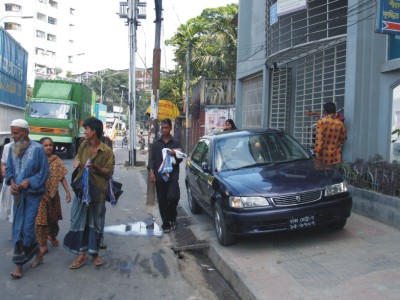
Cars blocking city footpaths is a common scene in Dhaka. PHOTO: STAR |

