Medical recommendations
Dr Md Farid Uddin
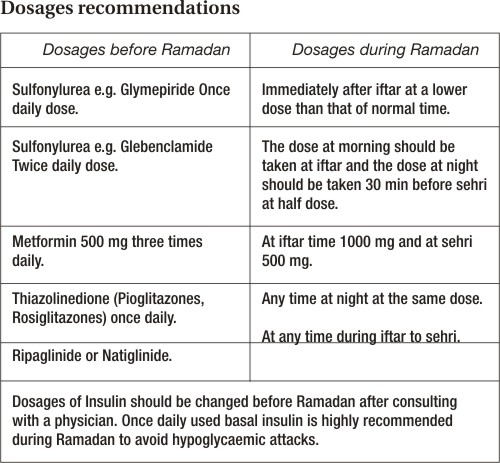
Diabetes mellitus is a global health problem including Bangladesh. Majority of the diabetics are Non Insulin Dependent and they usually try to fast during Ramadan.Recent study shows that about 50 million people with diabetes fast during Ramadan worldwide. Fasting during Ramadan are associated with some risks like hypoglycemia, hyperglycemic coma and dehydration. These risks are more who are on insulin or oral anti-diabetic agents which increases insulin secretion in our body. Those who are controlled with diet and exercise or on Metformin and Glitazone like drugs are in low risk. Risk increases when diabetic patients fast without consulting with their physician before and during Ramadan and not monitor their blood sugar regularly. Diabetic fasters can reduce all these complications if they obey the following medical recommendations. Monitoring recommendation - Patients should monitor their blood glucose level even during the fasting to recognise sub-clinical hypo and hyperglycemia and for dose adjustment. According to Muslim scholars it will not harm for the fasting.
- 2 hours post post-sehri and 1 hour pre-iftar are likely to pick sub-clinical hypoglycemia.
- 1-2 hour post iftar is likely to pick sub-clinical hyperglycemia.
- If blood glucose is noted to be low (<60 mg/dl), the fast must be broken.
- If glucose is not noted to be > 300 mg/dl, ketones in urine should be checked and medical advice should be sought.
The writer is an Associate Professor of Endocrine Medicine, Diabetes, Thyroid and Hormone of Bangabandhu Sheikh Mujib Medical University, Dhaka.
|
|

