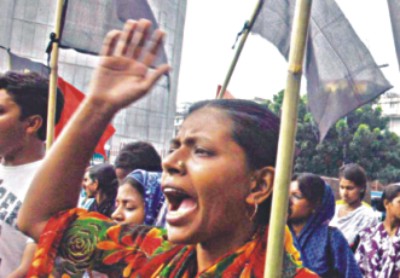
Workers reject new labour bill, threaten tough movement
Staff Correspondent
Terming the Labour Bill 2006 as unacceptable and most unfriendly to the workers, labour leaders rejected the bill saying that its implementation will stand against the workers rights movement. They said usually a labour bill considers the interest of workers in different sectors, but the bill which was passed in the parliament on Monday, reflects only stock holders' interests. The new bill also violates different regulations of International Labour Organisation (ILO), which Bangladesh ratified in 1972. Talking to The Daily Star, the labour leaders also urged the president not to sign the bill and to return it to the parliament for further discussion. Otherwise, they will embark on a movement including hartals, strikes, and other forms of demonstrations, they said. Wajedul Islam Khan, co-coordinator of Sramik Karmochari Oikyo Parishad (Skop), the largest labour organisation in the country, said, "The government passed the bill within a short time without any major discussion with the workers, which is unacceptable. " He urged the workers to come forward to prevent the bill at any cost. He said according to the new bill workers in state owned industries have to retire at the age of 57, which may result in an increase in unemployment. "As Bangladesh ratified the code of conduct of ILO, it cannot pass a bill bypassing ILO regulations," said Ray Romesh Chandra, president of Jatiya Sramik League. He said according to ILO regulations workers have the right to select their leaders, any worker can be a labour leader. "But according to the Labour Bill 2006, former or retired workers of the industrial sector will not be able to become a leader of the workers, which is completely in violation of ILO regulations," he said. According to earlier laws, the workers of industrial and service sectors could bargain with the management or owners of factories for settling their wages, working hours, overtime, and other related issues. "But the new bill only allows the workers working in the industrial sector to bargain with the management to establish their rights. Unfortunately, at the same time workers in the service sector will not be able to bargain with the management to get the same rights," Romesh said. Industrial and service sector workers have to work 10 hours a day if the new bill is enacted. According to the International Trade Organisation framework, any foreign company have the right to refuse to import goods from a company where workers have to work over eight hours a day, said Abul Hossain, a leader of the garment workers. "So, the provision of a 10-hour work day will ultimately hamper the country's industrial growth, especially it will stand as a barrier regarding compliance with international labour laws in the garment industry," he said adding, "If the bill finally becomes a law, foreign buyers might refuse to import Bangladeshi products in the name of compliance if they wish." Bangladesh Jatiya Sramik Jote President Shirin Akhtar said the new bill is completely against the interest of the workers. She criticised the process of passing the bill in the parliament. The government held 33 meetings to finalise the bill but unfortunately the demands of the workers are not reflected in the final bill, she said adding, "The government violated the ILO convention in preparing the bill which is absolutely contrary to the labour's interest." The minimum wage will be revised every five years, according to the new bill. "Where garment factory owners violated the earlier provision of revising the minimum wage every three years, how can we believe that the same group will revise it every five years," Shirin Akhtar said. She urged the prime minister to further discuss the bill in the parliament and to bring amendments to it. Najma Akhtar, another labour leader in the garment sector said the new labour bill is unacceptable and unfriendly to the workers. "We will call for strikes and tougher programmes against the bill," she said. Terming the new bill as 'not a bad one', Jafrul Hasan, general secretary of government backed Bangladesh Jatiyatabadi Sramik Dal, said the new bill will bring good things for the workers as a whole, although it has some bad sides. "Earlier we had 27 labour laws in the country. As a result, there was no perfect implementation of the laws as one law contradicted the other," he said adding, "The new bill simplified most of the complexities in the earlier laws so that implementation of the labour law can become easier." Garments Sramik Sangram Parishad called for a workers strike in the garment sector scheduled for October 1 as part of protesting the new bill. Bangladesh Workers Party, Bangladesh Textile Sramik Federation, Communist Party of Bangladesh, Garment Workers Unity Forum, and Sramik Karmochari Sangram Parishad also rejected the bill and demanded that the bill not be turned into a law.
|