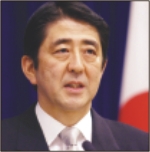
Abe takes office as youngest Japan PM
Vows to repair ties with China, advance alliance with US
Afp, Tokyo
Outspoken conservative Shinzo Abe took office yesterday as Japan's youngest prime minister, pledging to repair strained ties with China and advance the alliance with the United States.With a reputation as a foreign policy hawk but vague on the economy, Abe, 52, filled his first cabinet with trusted hands after the departure of veteran premier Junichiro Koizumi, who remains popular. Abe bowed four times to his fellow lawmakers after he was voted into office in a party-line parliamentary vote. He and his cabinet were later ceremonially received by Emperor Akihito. "As the first premier born after the war, I will lead firmly in the right direction. I will make Japan a country full of chances, kindness and dynamism. I will begin creating a new country," Abe told a televised news conference. Abe has vowed to rewrite the US-imposed 1947 constitution, under which Tokyo renounced the right to a military, and has been outspoken in his reading of the country's past, a strained subject among nations that suffered under Japanese imperialism. But Abe promised to "make efforts" to resume talks with China. "A peacefully developing China is the most important country for Japan," Abe said. Chinese President Hu Jintao refused to meet Koizumi because of the latter's repeated visits to a war shrine linked to Japan's militarist past. "In many senses, it was Koizumi and Hu Jintao who could not get along. But now we have a new prime minister, Abe, so as foreign minister I will make efforts to arrange a meeting between Abe and Hu Jintao," said Taro Aso, who kept his job as top diplomat. Aso said the summit may take place on the sidelines of an Asia-Pacific forum in Vietnam in November. The influential Japan Business Federation, in an unusually open public appeal, called in a statement for Abe to "strengthen relations of trust with neighboring countries including China and South Korea." China said warmer bilateral ties hinged on the Yasukuni war shrine issue. Asked if Hu would commit to a meeting with Abe, foreign ministry spokesman Qin Gang said: "For the moment the Chinese position hasn't changed." Abe is known to have views to the right of Koizumi on history but has not said if he will also visit the Yasukuni shrine, which honors war dead and war criminals alike. US Secretary of State Condoleezza Rice said she expected to see Japan move closer to China under Abe. "I think the Chinese will be receptive to that," she said in an interview with The New York Post. Abe has vowed that the United States and Japan will "break sweat" together, meaning they would promote joint peacekeeping operations abroad and share more of the security burden. Abe rose to prominence as a hawk on North Korea, demanding action against the communist state for its past abductions of Japanese nationals. He has established a new position in his cabinet at state ministerial level to handle the emotionally charged issue. It will be held by Yasuhisa Shiozaki, who is also chief cabinet secretary, the cabinet's number two post. He is a 55-year-old, Harvard-educated free trade advocate seen as part of a new generation of Japanese politicians. But most of Abe's appointments are ruling party stalwarts. Analysts said his line-up showed he would focus on political issues such as the constitution rather than the economy, which is recovering after a collapse in the 1990s. "Abe's choices are careful and not adventurous, compared with what Koizumi did in picking cabinet members," said Hideo Otake, a professor of politics at Kyoto University. "This is probably because Abe is young and he doesn't have enough contacts with politicians to decide personnel affairs completely by himself," he said. In a symbolic step, Abe, a wealthy third-generation politician, said he was slashing his salary by 30 percent. Abe also set up a ministerial portfolio to tackle income disparity, which critics said was a fallout of Koizumi's free-market reforms. Koizumi, 64, is one of Japan's most popular leaders in modern times and the longest-serving premier in three decades. Abe and staff at the premier's office offered him applause and flowers as Koizumi, who broke the mould in Japanese politics with his flamboyant style, chaired his final cabinet meeting. "Thank you all," Koizumi said. "We will help support Mr. Abe. Please take care of your health."
|