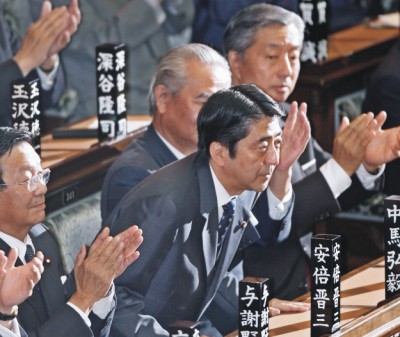
Abe 'committed to tearing up legacies of defeat'
Afp, Tokyo
Mild in his manners but passionate in his ideas, Prime Minister Shinzo Abe is the first Japanese leader born after World War II and is committed to tearing up the legacies of defeat.The 52-year-old, dubbed "the prince" for his elite pedigree, became Japan's youngest prime minister on Tuesday, fulfilling at an early age the ambitions of his family which has advanced conservative causes for generations. "The time has come for our generation, who did not experience the war, to take the responsibility" to lead Japan, Abe said during the campaign. Even though Abe is a political protege of his predecessor Junichiro Koizumi, his style is a stark contrast to that of his flamboyant mentor. Few could imagine Abe recreating the media-savvy photo ops of Koizumi, who jammed on an air guitar next to US President George W. Bush and showed up at the opera with a Olympic figure skater. About the most non-conformist aspect of Abe is pictures showing he prefers Macintosh to Windows computer systems. Unlike Koizumi, who is known for one-line soundbites, Abe always speaks in formal complete sentences. But Abe's calm, polite exterior belies a hawkish streak. In July, he stunned neighboring countries by openly mulling a theoretical pre-emptive attack on communist North Korea. He has also followed Koizumi's lead in appealing directly to the public rather than to backroom powerbrokers who traditionally call the shots in Japanese politics. He succeeded in becoming a household name by talking tough on North Korea after Pyongyang admitted in 2002 that it had abducted Japanese civilians in the 1970s and 1980s. His hawkish image may be softened by his wife, Akie Abe, a 44-year-old daughter of a prominent businessman who is known for her love of South Korean culture. The couple has no children. Abe's rise is all the more meteoric considering that he held his first cabinet position -- his last job of chief cabinet secretary -- for less than one year. One of his most passionate causes is revising the pacifist constitution, which was imposed on a defeated Japan by the United States in 1947, seven years before he was born into a leading political family. At a campaign rally, Abe vowed, "I want to write the constitution with my own hand." His conservative beliefs are also deeply personal. Abe's maternal grandfather Nobusuke Kishi served in the wartime cabinet and helped supervise the industrialization of Manchukuo, the puppet state Japan set up in northeastern China. After the war, Kishi was jailed by US forces as a top war criminal although he was not tried. Kishi later became prime minister, fighting leftists to build the new alliance with Washington. Abe has backed Koizumi's pilgrimages to the Yasukuni shrine, which honors war dead and war criminals. Koizumi's visits have infuriated neighboring countries haunted by Japan's aggression. But Abe's views tilt further to the right than those of Koizumi. Abe has rejected the legitimacy of post-war trials of war criminals and hinted he feels Japan has apologized enough for its past. His father was Shintaro Abe, a foreign minister, who never achieved his ambition of becoming prime minister due to a scandal and cancer, which cost him his life in 1991. Shinzo Abe took over his father's parliament seat -- and in little more than a decade, has fulfilled his goal.
|