All Time Greats
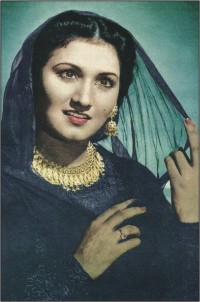
Noorjehan: The melody queen
Lahore, sometime in the 1930s: The followers of a local Peer (religious leader) had arranged a special evening of devotional music. Among those who were brought on to perform was a little girl who sang some naat. "Sing us something in Punjabi, little one", the Peer asked her. She immediately launched into a folk song; a line of which went something like: "may the kite of this land of five rivers touch the skies". As she sang, the Peer went into a trance and prophesied, "Go forth, young one, your kite will one day touch the skies". Born on September 21, 1926, the child whom her parents named Allah Wasai would later be known as Noorjehan -- an artiste whose voice made ripples in the subcontinent and captivated many a heart. Noorjehan received early music lessons under Kajjanbai (a singer between 1920 and 1930) who made her do riyaz up to 12 hours a day. In around 1930, she won a part in a silent feature film called Hind ke Tare made by Indian Pictures, Calcutta. Thereafter, the family moved to Calcutta, where she acted 11 silent films. During their stay in Calcutta, Mukhtar Begum (singing star in the 1930s), made a profound impact on Noorjehan. Later in life, she adopted Mukhtar Begum's style of performing. Noorjehan first attained stardom through the movie Khandaan in 1942. On the heels of its success, the diva immigrated to Bombay. There she garnered much attention with her vibrant voice. She went so far as to dethrone the then supreme singing star Khurshid with her popular song in Zeenat, called Bulbula mat ro yahan aanso bahane hain mana. The singer reached the pinnacle of success with Mehboob Khan's box office success Anmol Ghadi in 1946. The superhit songs in the film composed by Naushad gave her a firm status as a singer par excellence. The following year, she was paired with the then rising star Dilip Kumar in Jugnu. Noorjehan's last film in India was Mirza Sahibaan (1947). During the partition in 1947, at the height of her career (both as an actress and a singer), Noorjehan decided to migrate to Lahore in the newly created Pakistan. Three years after settling in Pakistan, Noorjehan starred in her first film in Pakistan, Chanwey (1951). The film was a runaway hit. Her second film in Pakistan was Dopatta (1952), which turned out to be an even bigger success. Some of Noorjehan's most challenging and beautiful songs belong to the 1950s. In Neend (1959) songs like Tere dar par sanam chaley aai, demonstrate how her voice had matured. Noorjehan's forte was film music, but her strong base in classical music gave her the liberty to sing the most difficult ghazals, both for film and non-film albums. This contributed to the strengthening of her iconic stature. Interesting titbits about the diva: Sour and oily food is death to a good throat. Yet whenever Noorjehan had a film song to record, she would have pickles quite ritualistically and wash it down with ice-cold water. She said her voice was enlivened this way. Noorjehan had a distinct look. Her hair would always be big and she believed in flashy, bold jewellery. Her trademark heavy make-up remained hers till the end. Nobody managed to carry off those colourful and gaudy saris like she did. Years after she left India, her impact remained undiminished. Apparently music composer Naushad asked Lata Mageshkar to "keep Noorjehan in mind" when singing Uthaye ja unke sitam for the film Andaz (1949). In 1996, Noorjehan recorded her last song in Pakistan, which was Ki dam da bharosa for the film Sakhi Badshah and stopped singing due to ailments and newer trends in music. On December 23, 2000, on the night of Laylat al-Qadr, Noorjehan died from heart failure, leaving behind thousands of immortal melodies for her fans. To this day she is revered as Malika- e-Tarranum (Queen of melody). Noorjehan's passion for music could best be conveyed through her own words. Once in an interview telecast on National TV, she was bold enough to say, "I would leave my husband, but not my music". Compiled by Cultural Correspondent
|