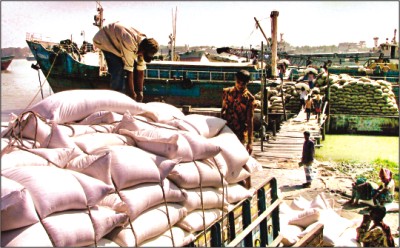
6 lakh tons of fertiliser smuggled out of country thru' Ctg a year
Abdullah Al Mahmud
Around six lakh tons of fertilisers are being smuggled out of the country through Chittagong every year, sources said.According to the agriculture ministry, the country needs around 28 lakh metric tons of urea fertilisers annually, said the sources. The government spends around Tk 1500 crore as subsidy in the sector. The government has to provide a subsidy of at least Tk 300 crore for the fertilisers, which are being smuggled out of the country, they said. Several syndicates, based in Chittagong, are engaged in the smuggling. The intelligence agencies here prepared two lists of such smugglers numbering over 20. A total of 18 lakh tons of urea is produced in the state-owned urea factories at a maximum cost of Tk 6000 per ton. The government here gives over Tk 180 crore as subsidy. After providing a subsidy ranging from Tk 900 to Tk 1200, the government sells this fertilizer at Tk 4800 per ton at the mill gates. To meet rest of the annual demand, the government imports seven lakh metric tons of urea at 273 US dollar (equivalent to Tk 18,500 or Tk 20,000 depending on the value of taka against dollar) per ton and purchase three lakh metric tons from Kafco at the same international market price, said the sources. While selling this 10 lakh imported and purchased urea fertilizer at Tk 4800 per ton, the government has to give subsidy of Tk 1300 crore. But, a huge chunk of this urea fertilisers is being smuggled to Myanmar or India to sell at higher price, revealed the investigation reports prepared separately by the intelligence wings of Rapid Action Battalion (Rab) 7 of Chittagong and the Detective Branch of Chittagong Metropolitan Police (CMP). The urea procured at Tk 4800 per ton from the state-owned mills is being sold in Myanmar at Tk 22,000 to 24,000 per ton, said the reports. Fertilisers produced at the state-run Chittagong Urea Fertiliser Limited (CUFL) are smuggled to Myanmar while being carried by trucks from Mazhirghat or by trawlers from CUFL jettyghat in the port city. Fertilisers produced at Zia Fertiliser Company Limited (ZFCL) are smuggled to Myanmar while being carried in trawlers to Brahmanbaria, Comilla, Chandpur, Habiganj, Netrakona and Kishoregonj from Ashuganj through the river Meghna. The fertiliser-laden trawlers are diverted to Cox's Bazar through the Bay of Bengal to cross the Myanmar border later. The difference between the estimated demand and actual demand creates the scope for smuggling, probe reports said. Besides, dealerships are given without examining the intended dealers' identity or eligibility and in many cases fertilisers never reach the warehouse of the concerned dealers to be smuggled later. The dealers in connivance with a section of dishonest officials place demand for fertilisers 20 to 30 per cent higher than the actual need. As such at least 6 lakh tons of fertilisers are left there for smuggling, said a Rab high official who carried out investigation on the production, supply and distribution of urea fertilisers. He said determining the actual demand of fertilisers was a must to curb the smuggling. To get dealership one must have under his possession a storehouse with a storage capacity of at least 100 metric tons of bagged urea and a sale centre at a busy market of his district or upazila town or at the upazila, said the sources. But, very often the conditions are ignored and dealerships are given to wrong persons. Sometimes dealerships destined for one district are seen as given to persons coming from other districts. Sometimes many of the enlisted dealers never show up to draw the fertilisers and sell the DOs at the mill gates. Most of the fertilisers drawn through the sold out DOs are diverted from the referred destinations and then routed for smuggling, said the sources. A high official under whom the CMP DB prepared a report on fertiliser smuggling said there are over 100 dealers in the port city where there is a little scope to use fertilisers. During the peak monsoon (December to March), the purchasers of such DOs also create artificial crisis and make a huge profit selling the fertilisers in the crisis-hit areas. The deputy commissioner or the deputy director of Agriculture Extension Department are supposed to be provided with the statement of the fertilisers issued and supplied against the names of the dealers in the district. But, sometimes they do not have the statements and do not go for the follow-up activities like monitoring and necessary inspection. In many cases the concerned agriculture officers certify the stock and sale registers of the dealers without examining them or visiting the warehouse and permit them to sell fertiliser, encouraging smuggling or artificial crisis, said the sources. Moreover, the upazila or district fertiliser monitoring committees also show reluctance in discharging their duties as expected, they said. The Rab report suggested formation of monitoring team comprising members from the factory authority, district administration, Bangladesh Fertiliser Association and concerned authorities of rail, road and water transports to supervise and monitor the daily production, supply and distribution of fertilisers. It also suggested legal and punitive measures against the sale of DOs at the mill gate and exemplary punishments to those involved in the smuggling.
|