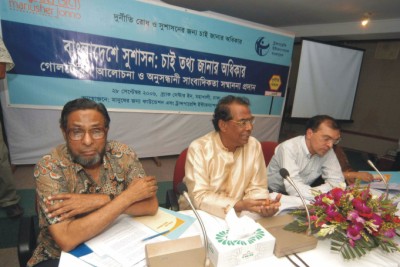
Form information commission to ensure good governance
Speakers tell dialogue
Staff Correspondent
Politicians, legal experts and civil society members at a dialogue yesterday suggested forming an independent information commission for proper enforcement of the proposed right-to-know law in order to ensure good governance and curb corruption.The head of the commission and its members, not more than five, should be prominent and knowledgeable personalities and it should have its own budget and recruitment system to avoid government influence, they said. Transparency International Bangladesh (TIB) and Manusher Jonno Foundation jointly organised the dialogue on 'Good governance in Bangladesh and the right to information' at the Brac Centre in the city to mark the International Right to Information Day. According to the draft law on right to information prepared by a few core groups under the supervision of Manusher Jonno Foundation, a judge of the appellate division of the Supreme Court should be the head of the commission. Speaking at the dialogue, Awami League lawmaker Suranjit Sengupta said the post should be open not only to judges but also to all professionals. "I strongly agree that the Right to Information Act is a must for ensuring accountability," he said, adding that it will bring about a massive change in the governance, as the law would require the government employees to provide information to the people. Appreciating the initiative, he said the law should be enacted on the basis of national consensus. Dr Atiur Rahman, chairman of Unnayan Shamunnay, said the law should have a provision that would require the public and the private institutions to provide, when demanded, the information when it comes to the question of survival. "We don't want an information commission like the Anti-Corruption Commission or the Election Commission, which are dependent on the government for its budget," he said. Barrister Tanjib-ul Alam, who presented the draft law, said that although the constitution does not clearly specify the right to know, a Supreme Court order has recognised the right to information. He suggested that the Right to Information Act should be given priority in case of any contradiction with any sections of the Official Secrets Act. The Right to Information Act and its enforcement are a precondition for ensuring good governance and curbing corruption, said Shaheen Anam, executive director of Manusher Jonno Foundation, who chaired the programme. The law can help reduce poverty and the people can contribute to the governance when they have adequate information, she said. Manusher Jonno Foundation initiated the drafting of the law on the basis of the working paper of the law commission and it is now gathering opinions of the stakeholders so that the people feel ownership of it, she added. AL lawmaker Col. (Retd.) Faruk Khan, former law minister Abdul Matin Khasru, former advisor to the caretaker government Hafizuddin Khan, Advocate Sultana Kamal of Ain O Shalish Kendra, National Press Club General Secretary Shawkat Mahmud, woman leader Maleka Begum, Ferdous Akter Wahida MP and columnist Muhammad Jahangir also spoke at the dialogue moderated by TIB Executive Director Iftekharuzzaman. At the programme, TIB Investigation Journalism Award-2006 was awarded to two journalists. Senior reporter of the Ittefaq Abul Khair won the award in print media category for his series reports on food adulteration, while NTV senior correspondent Ahmed Sagar got the award in electronic media category for his series reports on corruption in administration. The awardees were given Tk 50,000, a crest and a certificate each.
|