Finding life for the lifeline of the city
Md. Asadullah Khan
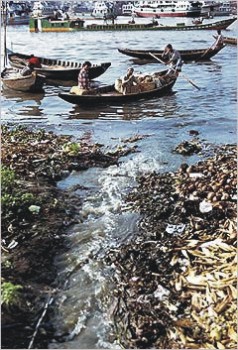
During the last two decades the country has experienced phenomenal urban growth. With rapid growth compounded by high concentration of population, the capital city has now become an epitome of urban squalor, poverty and environmental abyss. Despite the everyday trauma, exhaustion and rigour, people are endlessly attracted to the city for it seems to have work, livelihood and even prosperity on offer. During the last one decade, the pace of urbanization in Dhaka has only resulted in proliferation of population, poverty and pollution. At the same time, quality of housing, health and hygiene has gone down. In the meantime Dhaka city's population has swelled to over 10 million which implies increasing demands for basic city services -- the most important ones being the demand for safe and reliable water supply and effective sewerage system. Dhaka city's crumbling sewer network is almost a century old, put in place for a population of just a few lakhs in the post-partition days. Today it breaks down frequently under pressure of wastes of about eight million more people than it was designed for. The sewer lines lead to drains, which take the sewage, much of it untreated, directly into the river Buriganga and Shitalakhya on the northern part and Turag and Balu -- which are now almost dead -- on the western side of the city belt. In the city water pipelines run next to sewer lines with both lines being leaky in many places. Consequently the threat of contaminated water and disease is perpetual. In the recent past some dailies ran a series of reports indicating that Dhaka WASA's supply of water to vast areas stretching from Bangshal to Lalbgh to Mohammadpur to Pallabi in the city had become unsuitable even for household chores, let alone for drinking. Residents of Bangshal, Nazirabazar, Kasaituli, Begumbazar, Moulavibazar, Becharam Dewry, Imamganj, and Rahmatganj complained that WASA's supply of water was full of detritus and looked like coloured soup. Highly polluted water imperils human health and in most cases, rivers being the original source, it seriously imperils aquatic and terrestrial ecosystem on which life depends. There are evidences that we now face a fast-deteriorating situation occasioned by use of water that is full of harmful bacteria and hazardous wastes. There is a close link between economic growth, human development and good management of the natural resource base -- mainly water bodies and forests. Unfortunately socio-economic development appears threatened by environmental degradation, polluted water and extinction of forests. Despite an over-all improvement in the living standard, marked by fast-paced urbanisation, the outlook for sustainable development in such big cities as Dhaka, Chittagong, Rajshahi and Khulna is not encouraging. The gains are being offset by certain negative trends, such as the growing scarcity of fresh water and a rise in number of desperately impoverished people. Reports published in the dailies quoting WASA sources indicate that water of the river Buriganga, and even Shitalakhya has become polluted beyond redemption. Experts point out that the present dissolved oxygen level is well below 4 mg per litre -- the minimum requirement for the survival of any species of fish or any other aquatic life forms. Experts say that out of ten lakh cubic metres of effluents and liquid waste released in rivers, lakes and canals in the city, the river receives an estimated 4,50,000 cubic metres of waste water per day only through three points: Hazaribagh tanneries, Dolaikhal and Pagla sewage treatment plant. Experts further say that water discharged through these three sources consumes 40 tonnes of dissolved oxygen per day from the river water while in the teeming northern part of the city filthy water in choked drains stagnates for days, even months and years. Only about one third of the city has the luxury of an underground sewer system. In most areas it can be seen that human excreta flows directly into open surface drains that ultimately falls into the river. Even refuse dumped on the riverbanks finds its way into the Buriganga and Shitalakhya during monsoon rain. About 200 tanneries in the Hazaribagh area contribute the largest share of pollution load to the Buriganga. Survey revealed that the tanneries pump out about 16,000 cubic metres of hazardous liquid wastes whereas Tejgaon industrial area offloads about 4000 cubic metres of polluted liquid waste and other agencies about 3000 cubic metres of wastes into the river Buriganga every day. The amount of damage done by the effluents has far exceeded other sources. In most of the localities household waste drains connect to the sewer pipe, which also collect the road surface garbage. Consequently, the entire untreated mess then drains into the river that supplies the city with its drinking water. Contaminated even further by oil from barges and leaky vessels, the river is so polluted that the cleansing effect by surging rainwater has become almost impossible. In fact, the cleansing effect is no match for the 33000 cubic metres of solid and liquid wastes of all varieties dumped into the rivers and lakes of Dhaka city. The biggest onslaught has come from the encroachment of riverbanks and the river itself. Even markets, hotels and vegetable and fruit storage yards have been built intruding several hundred feet into the river. A vast chunk in the water area has fallen into the hands of the encroachers who enjoy political patronage. On the other hand, rampant pollution of the river water that has already killed aquatic life now threatens human life and human settlements on the riverbank. The volume of effluents is growing exponentially. Antique foundries, and related industries and tanneries are functioning with complete disregard for environmental norms. The factories continue production on the sly and continue to dump untreated wastes into all these water bodies. The tanneries, textile mills and dyeing industries are largely to blame for this sorry state of affairs. The tanning process, it is known uses scores of chemicals that are extremely hazardous to human health. The owners of these factories were hardly jolted into action any time in the past. Most shockingly, there were hardly any plan or initiatives to construct a common effluent treatment plant for any sort of industries. Dhaka WASA sources indicate that the infrastructure facilities available at the treatment plant can't cope with enormous wastes save about 50,000 tonnes now being done and eventually the polluted WASA pipeline water largely drawn from the Buriganga and Shitalakhya defies all solution. But solutions must be found the situation calls for taking some hard decisions about re-locating industries, re-examining industrial locations, and environmental policies. With a third of the country's population slated to live in the urban areas, the government in collaboration with the industries must mobilise funds for pollution treatment. Experts recommend tackling the problem at its source when permission to set up a factory is first granted. Most large units awaiting installation must submit an environmental impact assessment (EIA), a document that lists the effects a factory might have on its surroundings. What is absolutely necessary is a high-powered central pollution control board composed of experts on engineering, medicine, chemistry, and biological science, especially microbiology. They should explore or work on a zoning atlas, a massive nation-wide exercise that will eventually specify the kind of industry that a region can bear. Another decision has to be taken about small-scale industries. It should be made clear to all such entrepreneurs that these would not be allowed to enter certain fields, like chemicals, especially in the vicinity of the river bank. Because of the indiscriminate discharge of chemicals and other industrial wastes from some 115 factories, on both sides of the Shitalakhya river right up to Shimrail, Charsindur, Rupganj and Ghorasal, the Shitalakhya water has been seriously contaminated. However daunting the solution might be, the rivers Buriganga, Shitalakhya. Balu and Turag and all such water bodies like Gulshan-Banani-Baridhara lake and Uttara lake have to be saved to prevent an ecological disaster. Reports have it that the Directorate of Environment (DoE) while identifying key sources of pollution load of these water bodies mentioned discharges from Rayerbazar sluice gate, Dolaikhal, Pagla sewage treatment plant, Hazaribagh tanneries, Tejgaon industries and hanging latrines on the banks of these rivers as the main culprits DoE further identified about 120 installations for encroachment on the rivers mostly by influential persons and political leaders. What is most needed is the establishment of a 'Water Body Development Authority' invested with the power to evict illegal construction and settlements along the bank of the rivers and lakes of the Dhaka city and Narayanganj. The wide ranging power will include the task of river safety maintenance including setting up of a centralised effluent treatment plant as well as dredging the river to ensure its smooth flow. Admittedly, DWASA and Dhaka City Corporation lack the resources and technical and managerial expertise to deal with the trash and hazardous waste of an increasingly consumerist economy. There are landfills at certain locations of the city but these are hotbeds of disease with poisons leaking into the surroundings. As for sewage disposal system, sources say that DWASA at present has the capacity to treat sewage of about 40 lakhs population of the metropolis. So more than half of the fiscal load of the city ultimately finds its way into the rivers and lakes, totally untreated. The Buriganga, Shitalakhya and the adjoining lakes and low-lying areas of the city of Dhaka and Narayanganj have ultimately turned into giant sewers. In view of the present catastrophic situation, environmental levies may be charged and these levies can be used to fund woefully under-staffed regulatory services and support environmental fixes for specific industries. Maybe the government at such a critical juncture may not be able to do it alone but it must prepare an action plan and ask for societal help as in the case of the Tal Lake recovery project in Nainital and Lake Placid Recovery Project in the Uttaranchal Pradesh in India. That means citizens must join the big clean-up. At the same time, industrial societies have an obligation not only to re-cycle but also to reduce the waste they generate. Md. Asadullah Khan is a former teacher of physics and Controller of Examinations, BUET.
|