Sanitation scenario since SACOSAN 2003
Dr. Syed Ishteaque Ali Jinnah
The first South Asia Conference on Sanitation (SACOSAN) was held in Dhaka from October 21 to 23, 2003, and was organised and hosted by Bangladesh. This inter-governmental event was attended by state delegates including ministers from India, Pakistan, Nepal, Sri Lanka, Bhutan, the Maldives (the then Saarc members), as well as Afghanistan and Myanmar. This event has been considered a milestone in the sanitation sector in the region.The Second SACOSAN has been held in Pakistan last week as a step towards meeting the Millennium Development Goals (MDGs) related to sanitation in this region. The conference was originally scheduled to be held in November 2005, but because of the devastating earthquake that took place in Pakistan at that time, and subsequent internal rearrangements, it was rescheduled to be held from September 20-22, in Islamabad. The Dhaka Declaration recognised the fact that although much had been achieved in the last decade, the overall picture of sanitation in South Asia, with the practice of open defecation, unsanitary disposal of human excreta and other unhygienic practices by the majority of people in the region, still posed a serious threat to the quality of life, control of disease (specially affecting children under five years of age) and the environment. The participating countries stressed the need for pursuing common strategies under a common definition of sanitation, and to accelerate the progress of good sanitation and hygiene promotion in South Asia to improve the quality of life, reduce child mortality and morbidity, thus fulfilling the MDGs and the commitments made in the World Summit on Sustainable Development (WSSD) in Johannesburg in 2002. The conference noted that significant improvements in the situation of sanitation and safe water would have a positive impact on poverty reduction by increasing health and productivity. Therefore, this should have a central role in the countries' poverty reduction strategies, while noting at the same time that it is the vulnerable and marginalised population in urban and rural areas that suffer most from minimal access to sanitation facilities. It has been observed from the experiences of the last two decades that conventional, top-down sanitation programmes driven only by high hardware subsidy have not been able to bring about the desired improvements and sustainability, but that the use of direct and indirect subsidies for software are a must for sustainable sanitation promotion. The first SACOSAN underlined the commendable success achieved in providing basic sanitation (every household having access to a hygienic latrine and practicing good hygiene) through various government, NGO and small-scale private initiatives. The first conference agreed that the focus of proper sanitation and hygiene in the region should be based on a paradigm that is: "people-centered, community-led, gender-sensitive and demand-driven." Progress since the first SACOSAN
In a short span of time, i.e. from late October 2003 till date, there has been quite some progress in the sanitation sector in Bangladesh, specially in terms of policy decisions by the government. This, in brief, can be stated as the following: - Government has committed to achieve 100 percent sanitation by 2010
- Developed the National Sanitation Strategy (NSS) in early 2005
- Formed the National Sanitation Secretariat and made it operative
- Worked out the pro-poor strategy for water supply and sanitation sector
- For all sanitation related activities, entrusted the leadership to the Local Government Institutions (LGIs) -- Union Parishads in the rural areas and Wards in the Municipalities and City Corporations, in the urban areas
- Earmarked 20 percent of the Annual Development Programme (ADP) grant to LGIs for sanitation in order to involve the LGIs in the process of planning and implementation of the sanitation campaign
- Targeted the hard-core poor with government grant
- Provisions have been made for funds for hygiene promotion and community mobilisation
- Involved Gram Sarkars in the sanitation campaign
- Introduced special financial awards/incentives for areas with 100 percent sanitation coverage
- Special encouragement given to the Department of Public Health Engineering (DPHE) for latrine promotion among the hard-core poor
- Development of hygiene messages specially for areas that have already achieved the 100% latrine coverage
- Mass-media campaign being undertaken to create mass awareness
As a cumulative effect of all these positive factors, sanitation coverage as of March 2006, as per the reports of the National Sanitation Secretariat, has reached an impressive figure of 71.77 percent -- an increase by 38.54 percent points just in approximately three years (the baseline of 2003 found it to be at 33.23%). Critical observations
Despite the impressive advances that have been made so far, there have been some limitations in the sanitation efforts in the country as well. A brief account of those is as follows: The national sanitation coverage, as quoted by the National Sanitation Secretariat, is predominantly based on household latrine coverage -- the area of sanitation in public places like markets, haats, ferry-ghats, schools, railways, riverine transport, and even homeless or street people in urban areas have been overlooked. In addition, existence of latrines has been given the main focus, and not their proper/effective use by the population. This is a serious by-passing of the NSS'05 guidelines which clearly state that 100 percent sanitation means: there will be no open defecation, hygienic latrines are available to all, use of hygienic latrines by all, proper maintenance of latrines for continual use, and improved hygienic practice. Another area of concern is the fact that while the National Sanitation Secretariat has been putting forward impressive sanitation coverage figures for the country, there has hardly been any proper, neutral, third-party assessment to validate these claims. It appears that the government has presently set its target of 100 percent latrinisation first, which is to be followed by a second phase where the main focus would be on the promotion of hygiene to ensure proper and full use. This is a questionable outlook/strategy as, in many areas, many of the latrines constructed, but not used or maintained, might face the risk of damage or even destruction before the hygiene promotion phase in fact takes off. Though the government has shown its willingness/eagerness to support the hard-core poor in constructing their sanitation facilities through allocation of the 20 percent ADP grant, there are concerns that these funds are not necessarily reaching only them -- a certain amount is also being channeled to the middle-class and well-to-do people of the society. This is evident from some initial results coming out from one action research carried out by WaterAid Bangladesh in the Chittagong Hill Tracts, and Thakurgaon in the north-west (2006). While the government has commendably entrusted the LGIs to take the leadership in the sanitation drive in their areas, lack of capacity in many places has been a major stumbling block in this regard. Traditional apathy towards the NGOs and development partners has also posed a problem in creating fruitful partnerships among these agencies and the LGIs as a whole. As of now, the government is yet to come out with clear-cut views on the 'land tenureship' issue, in relation to the slums of the metropolitan cities, to work in a concerted manner with the various stakeholders regarding solution to urban sanitation problems. Way forward Some considerable progress in terms of sanitation coverage has been achieved during the past few years. At the same time there are issues which, if not taken care of, may pose problems in the successful achievement of our goal -- sanitation for all by 2010. The political commitment shown by the government in its drive for sanitation improvement till date has been remarkable. This has to be maintained in the coming days so that we do not lag behind. Sanitation has to be achieved in its totality, as laid out in the National Sanitation Strategy, and this puts the entire issue on a new footing that has to be dealt with accordingly. As a disaster-prone (mainly storms and floods) country, Bangladesh must have an adequately satisfactory disaster response strategy to ensure that people have access to sanitation facilities during emergency periods, as well as find readily available means and arrangements to cover up the damage quickly afterwards. Achieving 100 percent sanitation by 2010 in this country will largely depend on how we really face the challenges of sanitation in the urban areas, particularly for the slums of the metropolitan cities. In addition, strengthening the capacity of LGIs for sustainable improvements, and effective monitoring and evaluation of sanitation progress will be key issues for the government to achieve 100 percent sanitation. The writer is Director-Policy and Advocacy, WaterAid Bangladesh.
|
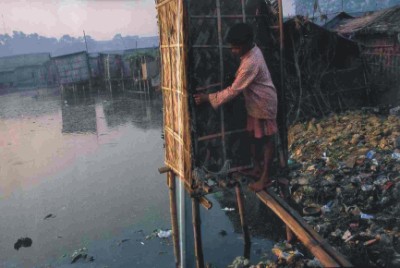
Still much needs to be done to improve sanitation scenario |

