Bush urges Pak, Afghan allies to unite in terror war
Ap, Washington
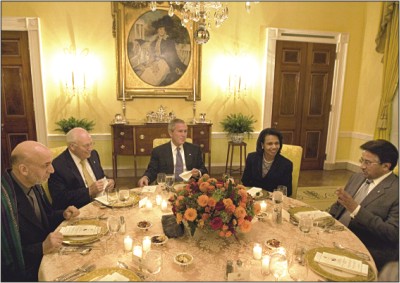
Before they sat down with President Bush for a peacemaking dinner at the White House, the bickering leaders of Pakistan and Afghanistan shook hands with their host but not with each other. Pakistani President Gen Pervez Musharraf and Afghan President Hamid Karzai, whom Bush considers key bulwarks against Islamic radicalism in a volatile region, barely looked at one another as Bush appealed for cooperation against the common enemy of terrorism. "I look forward to having dinner with friends of mine who don't happen to share the same faith I do but nevertheless share the same outlook for a more hopeful world," Bush said in a brief Rose Garden appearance before Wednesday's light dinner of soup, sea bass and salad. The meeting was a command performance for leaders who have joined their fortunes to Bush's anti-terror drive since the Sept. 11, 2001, attacks but who for months have picked at one another's efforts to fight terrorists along their long, remote, mountainous border. "These two men are personal friends of mine," Bush said. "They are strong leaders who have an understanding of the world in which we live. They understand that the forces of moderation are being challenged by extremists and radicals." After the private meal, the White House issued a bland statement that called the session a "constructive exchange" but outlined no new agreements or initiatives. The White House did not make any officials available for questions. "They committed to supporting moderation and defeating extremism through greater intelligence sharing, coordinated action against terrorists, and common efforts to enhance the prosperity of the people of Afghanistan and Pakistan," the statement from press secretary Tony Snow said. Bush's three-way dinner party, just weeks before the November congressional elections, comes as he is working to persuade voters that Republicans are best able to guide the US-led war against terrorism. He faces declining American support for both the US-led war in Iraq and the US military commitment in Afghanistan. Afghan officials claim that Pakistan lets Taliban militants hide out and launch attacks into Afghanistan. Musharraf says Karzai has bad information and notes that Pakistan has deployed 80,000 troops along the porous border. Karzai says Musharraf turns a blind eye to hatred and extremism being bred at Islamic schools in Pakistan. At one point, Musharraf said Karzai is behaving "like an ostrich," refusing to acknowledge the truth and trying to shore up his political standing at home. Right up to Wednesday night's White House dinner, they also have pointed fingers at one another over al-Qaeda's Osama bin Laden and other terror leaders. Each says bin Laden isn't hiding in his country and suggests the other might do more to help find him. The heated accusations had put the White House in the middle, and Bush clearly thought it was time to clear the air. Standing between the pair, Bush emphasized "the need to cooperate, to make sure that people have got a hopeful future" in both countries. The Afghan and Pakistani leaders stood stiffly on either side of Bush as he spoke without notes or a lectern. Musharraf was tightlipped, hands clasped awkwardly before him. Karzai nodded agreeably as Bush spoke. Neither of the foreign leaders spoke.
|