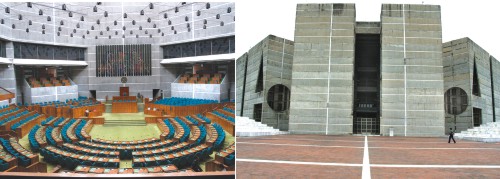
Opening Jatiya Sangsad Bhaban to public
Tawfique Ali
Authorities are planning to open the Jatiya Sangsad Bhaban to the public for organised visits by June next year with a view to project the architectural, historical and political value of this world famous building. "We expect to open the parliament building to the general public offering guided tours on a larger scale by next June," said Dr ATM Obaidullah, Project Implementation Specialist (PIS) of the SPD (Strengthening Parliamentary Democracy) project. "We have already talked to Bangladesh Parjatan Corporation to draw up plans and facilitate guided tours in the parliament building," he said. National Project Director of SPD, ABM Nuruzzaman said, "We are working on how we can open the building to public in an organised way." Making the Sangsad Bhaban more people-oriented is a component of the SPD project and it has already been approved at policy level, he said adding that the programme of public visits to the parliament building is aimed at "bridging the gap between public and parliament and dissemination of parliamentary activities." Once the guided tours start, a visitor will be able to enter the building buying a ticket at a nominal price to be determined by the parliament secretariat, Dr Obaidullah said. The Visit Cell at the parliament building will be strengthened to provide the general visitors with easy access to the majestic building. At present a visitor has to obtain permission from the Speaker through the parliament secretariat. "Government has approved strengthening and extension of the Visit Cell that will facilitate regular guided tours to the Sangsad Bhaban," said Nuruzzaman. Dr Obaidullah said, "Presently we are working on how many days in a week guided tours should be organised and on formation of an independent and extended Visit Cell." The UNDP-funded SPD project, being implemented by the UN Office for Project Services (UNOPS), will provide logistics to strengthen the Visit Cell. Special arrangements will be made for school and college students, teachers and students of architecture and history who may come to visit with academic purposes. Professional tour operators will guide the visitors. The visit will also include all the features of an organised tour like demonstration, information on CD, pre-tour briefing and film projection on the historical, political and architectural aspects of the establishment. Souvenir items and a comprehensive brochure highlighting the parliament building will be circulated among the visitors. The English-language brochure is now being printed. The PIS of the UNOPS may propose for adequate space at the old MP Hostel, now vacant behind the parliament building, for smooth functioning of the Visit Cell. According to a source at the parliament secretariat, the venture will be profitable even if public visits are conducted at a very nominal entry fee. Authorities are attaching top priority on how to develop and coordinate an effective and foolproof security check mechanism for the guided tours. Despite great interest of the visitors from home and abroad to know about the history and architectural splendour of the Jatiya Sangsad Bhaban, the government had all along been indifferent to the projection of the marvellous architectural work to public. Following criticism of its lack of enthusiasm in this regard, the government is now going to open the building to the public. Absence of easy access to the parliament building frustrates many enthusiastic visitors from learning about the Jatiya Sangsad Bhaban, designed by great architect Louis I Kahn. There is enormous interest among the general public, students of architecture and tourists to know not only about the grandeur of Kahn's work but also the history and tradition of Bangladesh aesthetically embodied in the building's architectural features. Architect Mubasshar Hussain, past president of the Instute of Architects Bangladesh (IAB), said, "Modern study of architecture is incomplete without studying the Bangladesh's parliament building by Louis I Kahn." "During my tenure as the president of IAB, I found many architects from across the world interested to visit the Sangsad Bhaban," he said. "Considering the architectural significance, we should have made this majestic building the symbol of Bangladesh like the Eiffle Tower of Paris," said architect Saif Ul Haque. One of the best aspects of the architecture is the way the entire building appears to be one huge structure from the exterior but is internally organised into several storeys and wings. Louis Kahn also designed the rest of the parliament building complex, which includes lawns, lake and residence for the members of parliament. The key design philosophy was optimum use of space but clearly representing Bangladesh's heritage and culture through architectural design.
|