Make education free from politicisation
Speakers tell roundtable
Staff Correspondent
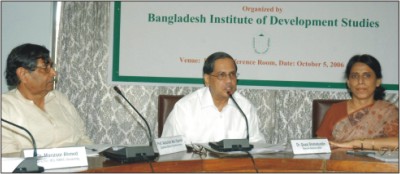
Speakers at a roundtable yesterday called for making the education sector free from politicisation.They also identified poverty as a major factor hindering the goal of achieving universal primary education. Bangladesh Institute of Development Studies (BIDS) organised the roundtable on 'Bangladesh in next five years: Strategies for reducing inequality in access to quality education' in the city. Education has to be freed from the grip of politicians, which was snatched from the hands of teachers, said Prof Abdullah Abu Sayeed, president of Biswa Sahitya Kendra. The representatives of political parties must be withdrawn from the school management committees to protect education from inefficient operators, he added. Presenting a paper, BIDS Research Director Dr Rushidan Islam Rahman said children from the households of the lowest income group have much lower school enrolment rate compared to the higher income groups. At present, the enrolment rate in the primary education is 85 percent for the lowest income group and 94 percent for higher income groups, while in the secondary education, it is 54 and 80 percent and at tertiary level, it stands at 8 and 14.2 percent. "Policies counteracting the negative force of poverty should be urgently pursued," said Dr Rushidan Islam. Besides, about 45 percent of the students do not get optimal support from schoolteachers and the teacher-student ratio stands at 1:60. Dr Mahmudul Alam, senior research fellow of BIDS, in his paper said though gender parity has been achieved in many respects during the period from 1997 to 2005, the enrolment of boys in primary education has fallen. He also said that performance in universal primary education is better in metropolitan areas and district towns than in rural areas. The speakers stressed the need for strengthening the local government and community monitoring to improve the performance of the rural schools. Manzoor Ahmed, director of IED, Brac University, suggested arranging special teachers' training on quality education and introducing inclusive education in rural areas. He also called for bringing underprivileged children and ethnic children under the primary education programme. The speakers also stressed the need for universality of education and quality education. They called for effective implementation of competence-based and result-oriented curriculum, recruitment of qualified teachers and better school environment and academic supervision. Shaheen Anam, executive director of Manusher Jonno Foundation, Dr Rasheda K Choudhury of CAMPE, Dr Kaisar of World Bank and Dr Zafarullah Chowdhury of Gonoshasthya Kendra also spoke at the roundtable moderated by Dr Quazi Shahabuddin, director general of BIDS.
|