Lasting modernism (not so Greek)
Dr. Nizamuddin Ahmed
"The errors of master plans and regional plans are that they are two dimensional or, in the best cases, three dimensional. What we need are four dimensional programmes."
-- Constantinos A. Doxiadis, Jan. 1959Sometimes we fail to comprehend what greatness has brushed our terrain, shaped our sense of aesthetics, groomed our design professionals and touched our soul. Such apathy to some of the biggest names in world architecture has been one of the banes of our cities and towns, of our buildings and parks (alas) that were. Constantinos Doxiadis is one such internationally acclaimed architect and urban planner who worked in the then East Pakistan, present Bangladesh. One dares to say he is from Greece because he has roamed the earth and set his footprint, most often innovatively, on many a city, making him truly a global citizen A soldier, an architect, an engineer, a planner, a teacher, a researcher, and an author on architecture, towns and villages, urban renewal, urban design, campus planning and urban crimes, Doxiadis' theory on ekistics (science of human settlements) revolutionised the concept of urbanization and helped to understand modern communities. In Bangladesh his creations exhibit ample sensitivity to local climate, culture and scale; organising starkly simple edifices around a courtyard encircled by a covered corridor being his hallmark. Architect Bayezid Ismail Chaudhury focuses on this gifted personality, whose handiwork remains as contemporary as they were half a century ago, so much so that younger users may confuse them to have been designed and constructed only the other day. Today's issue is a tribute to the Greek, whose architecture is readable, down to earth and appropriate or, in other words, not Greek at all. The author is Professor, Dept of Architecture, BUET and Consultant to the Editor on Urban Issues
|
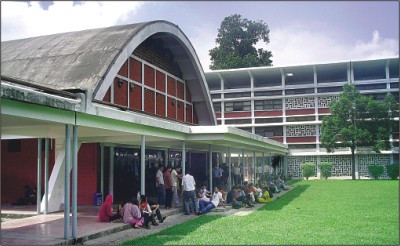
TSC |

