Latest Advancement
Fibroid? Worried about surgery? Ultrasound could treat it!
Tareq Salahuddin
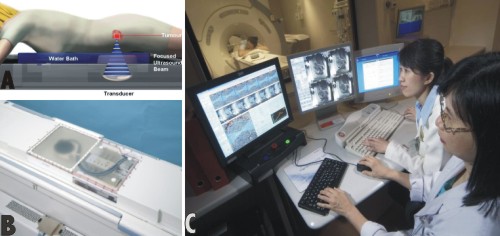
Operation like hysterectomy or myomectomy was the only option for the treatment of fibroids. A fibroid or uterine fibroid is a benign tumour in the muscle fibres of the uterus. It is a most common gynaecological tumour in women, affecting at least 20 percent of women above 35 years old. Until now, most treatment options are invasive surgical procedures like hysterectomy (removal of the uterus), myomectomy (partial removal of the uterus) and angiographic embolisation. There was no conservative approach for treating a fibroid that produced symptoms. Now doctors can offer simply an MRI (magnetic resonance imaging) guided ultrasound instead of surgery for the treatment of uterine fibroid (actually it is a very sophisticated procedure!).Women who previously had to undergo invasive and surgical interventions for treatment of uterine fibroids can now have their fibroids removed without going under the knife. MRI guided ablation of fibroid (a tumour of the uterus) by ultrasound is the only conservative therapy since ever. Women can now avoid surgery like hysterectomy for the treatment of fibroid. The treatment tested by the American Society for Reproductive Medicine has recently made its way into Southeast Asia with JCI accredited KK Women's and Children's Hospital (KKH) in Singapore. MR-guided focused ultrasound ablation provides a non-surgical treatment alternative without the need for anaesthesia, incisions and hospitalisation. During treatment, magnetic resonance imaging enables the doctors to see 3D images of the fibroid and surrounding organs. High intensity ultrasound waves are then used to heat the area where the fibroid is located, killing the cells. Sedation may be given to allow the woman to relax during the 3-4 hour procedure. "One major benefit of this treatment is that it preserves the uterus and cervix while sparing the healthy tissues nearby. There is no need for anaesthesia, incisions and hospitalisation. Most women are able to return their normal daily routine within one to two days. ..." said Prof David A Stringer, Head of Department of Diagnostic Imaging of KKH. As he delves into the intricacies of how the radiation system works, he recalls how his latest patient went shopping merely a day after she underwent the procedure. Dr Stringer informed that the procedure is done on an out-patient basis and woman can get back to their normal routine in two days. Moreover the 4 hour procedure is simple and leaves no scar behind. "It is speedy recovery without much pain. The MRI enables us to monitor the temperature of treatment at every second. Thus patients can control the sonnication or heat which is given for about 20 seconds at a time", said Dr Stringer. Suitable candidates - Family completed
- Dark (not bright) fibroids on T2
- Enhancing on T1
Benefits - Outpatient procedure i.e. no hospital admission
- Replaces surgery
- No radiation
- Next day return to normal activity
- Significant symptom relief in 80 percent
Woman who are keen on the new procedure should consult with their doctors for assessment to ascertain their suitability for the procedure. This correspondent has recently been to Singapore to attend Hospital Management 2006 conference. During the time, he visited some hospitals of Singapore on a tour organised by the Singapore Medicine.
|