By The Numbers
Prof Yunus and politics
ANM Nurul Haque
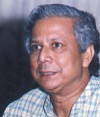
Nobel laureate Prof Muhammad Yunus, on the eve of his departure for Korea to receive the Seoul Peace Prize, said that he plans to be in politics and may float a new political party. He said this while replying to questions put to him, by the reporters at the airport, on the enduring political stalemate that has created wide-spread public despair in the country. He stated categorically that he would not agree to be the chief adviser of the caretaker government even if he is requested by both BNP and AL to do so.There has been speculation in the public mind that Prof Yunus would be chief adviser of the next caretaker government, and would utilize his position to remove all hurdles to holding a free and fair election acceptable to all. Prof Yunus has, however, reiterated his commitment to the clean and competent candidates campaign for the national election 2007. He said there has been a suggestion that the campaign for clean candidates will not be successful if its protagonists are not part of the political process. Prof Yunus's intention to float a political party evoked mixed reactions among political and civil society circles. But the common people were jubilant to know that Prof Yunus is planning to enter politics, and to form a new political party. Certainly, there is no denying that the country is trapped in a political maze, and that the people in general are held hostage by the mainstream political parties. The people are desperately looking for a way out. At least 60 percent of the people in Bangladesh find politics a shambles. A study, styled "Unbundling governance towards an annual report on governance in Bangladesh," by the Power and Participation Research Centre (PPRC), a local development research institute, revealed this unpleasant truth for the nation in a seminar held in the city on July 29. The survey found that about 36.4 percent of the people have "low trust" in the country's political parties while nearly 60 percent are pessimistic about improved politics and 39.6 percent are pessimistic about the future of the country. Only 5.5 percent of the people are highly optimistic about the future of the country while 31.3 percent expressed concern at the high insecurity in the political arena. On the other hand, more than 31 percent showed their low trust in politicians, and 33 percent showed their negative attitude about women's participation in politics. We have seen the immense damage done to the national economy by the endless spate of hartals that have been observed since the return of parliamentary government in 1991. The major political parties did not agree to find a substitute for hartals, even considering the huge damage caused by them, over the last fifteen years. The political parties, devoid of any ideology and tolerance, have pushed the country to the brink of disaster. The country is now facing a fatal combination of crises that are taking a heavy toll on the economy. Politics in Bangladesh is characterized by enormous odds. Politics of gaining power to plunder has destroyed all its intrinsic qualities. It has now turned into a dirty game that cannot be played without money and muscle. The nexus between crime and politics has given a boost to criminality in all the tiers of society. This particular political culture has engulfed the whole nation, making our lives utterly miserable. The manifest truth is that most of the people in Bangladesh have already lost trust in politics due to prolonged absence of charismatic leadership. There is hardly any politician who combines vision and statesmanship. As a result, the voters' verdicts are no more in accord with any particular party in the national elections. Voters are now very divided. Populism, as so often demonstrated by the political parties at their public rallies and showdowns, is mostly nothing more than a herd of hired people. As such, organizing a public rally now costs something in the range of Tk one crore. Votes are now bought, not won. Obviously, the stakes are high in politics. People at large are losing trust in the politicians due to these predicaments in our sham democracy. It has become customary for our politicians to promise a lot of things for the well-being of the people, and to forget all the pledges once they are sworn into public office. They will remember and repeat the old pledges again only when they lose power. It is a vicious cycle of hypocrisy that we are living through, and the good politicians are being driven out of the political arena by the bad ones, following Gresham's law, that bad money drives away good money. The people attained the independence of Bangladesh after colossal bloodshed in the fierce liberation war of nine months. They never expected such a failed leadership and ineffective national parliament. Both BNP and AL took to the recourse of boycotting parliament, often on any trivial grounds, while in opposition. Eventually, it is the nation which pays the price. The people are really tired of watching the same drama year after year. Bangladesh now needs a man of indomitable will, and dedicated leadership, to clean up its political mess. An individual with charisma and courage, like Prof Yunus, is quite fit for the purpose and can lift the nation from the abyss of despair. Yet, we urge him not to get involved in direct politics. It would be better that he take the role of the nation's conscience keeper to guide the nation in its hour of need. Nobel laureate scientist Albert Einstein was requested to become the first president of the newly formed state of Israel, but he declined the offer. History now reveals that he did the right thing. The winning of the Nobel Peace Prize has given Prof Yunus the stature of a pacifist. His words can be said to have acquired greater value and significance. He should now pioneer the campaign for clean and competent candidates in the forthcoming election. Until now, election has brought in leadership that lacks competence, does not consider itself accountable, and utterly fails to meet people's demands and aspirations. There are lots of examples around us where civil society played a vital role in restoring democracy. Prominent examples include the National Citizens' Movement for Free Election in Philippines that forced Marcos out of power. The civil society again succeeded in their campaign to oust Joseph Estrada for corruption. Very recently, the civil society in Nepal played an active role in the democratic upsurge against the feudal monarchy. In the process of elections becoming a game of black money and hooliganism, the civil society, as we know it today, emerged with a vision for Bangladesh and took an initiative to create pressure on the major political parties to nominate clean and competent candidates. The entire nation now looks forward to a free and fair election with honest and competent candidates. It would be much more in the keeping with the expertise of Prof Yunus if he pioneers the campaign for clean and competent candidates. ANM Nurul Haque is a columnist of The Daily Star.
|