Book Review
1971 and the agony of a Pakistani
Syed Badrul Ahsan
The Bangladesh War of Liberation has, in a good number of ways, served to give a boost to Pakistan's publishing industry. Not that the industry sprouted soon after the liberation of the Bengalis. The entirety of the 1970s and nearly the whole stretch of the 1980s were times when sensitivities in both Bangladesh and Pakistan, but especially in Pakistan, were raw, and therefore pretty disturbed. The embarrassment of political and military defeat in what used to be East Pakistan, symbolized by the emergence of Bangladesh as a free state in December 1971, as also the release of its founding father Sheikh Mujibur Rahman from Pakistani confinement in early 1972, has been a constricting factor for any Pakistani who has wished to dwell on the circumstances in which the crisis developed in the year General Yahya Khan unleashed his army against the Bengali population of Pakistan's eastern province. Beginning largely in the 1990s, though, a fairly significant number of Pakistanis, largely soldiers and to a certain extent civilians, have come forth with their own explanations of how and why things went wrong for their rulers in 1971. Without question, the trend had been set earlier by Siddik Salik, who had the rather unenviable role of being public relations man of the junta in Dhaka throughout the nine months of Pakistani military action in Bangladesh. His assessment, given the circumstances of the time when his book hit the stands, was generally considered reasonably fair, though he made it a point never to mention the atrocities the soldiers had committed against the Bengalis. After Salik, other men -- Rao Farman Ali, AAK Niazi, Hasan Zaheer, et al -- emerged with what one could consider their own mea culpa. The reasons they offered for Pakistan's collapse were unconvincing, for a couple of reasons. In the first place, most of these writers (except perhaps for Hasan Zaheer) tried to pin the blame for the defeat on anyone but themselves and their friends. In the second, they studiously ignored the awful repression that their soldiers perpetrated on the Bengalis in the final nine months of Pakistan in these parts. Given such inadequacies on the part of Pakistan's writers where dealing with the Bangladesh crisis is concerned, it is quite refreshing to come by Brigadier AR Siddiqi's assessment of the political problems which developed in East Pakistan in the two years, 1969-1971, during which time he was closely involved with the Islamabad military establishment as chief of inter-services public relations and press advisor to Pakistan's president and chief martial law administrator. That position placed him quite a few notches above Siddik Salik, who was mistakenly once thought by some (because of his work Witness to Surrender) to have been the main spokesman for the army during the Bangladesh war. Siddiqi, by dint of his seniority, remained close to the top brass in the army. It was his good, or bad, fortune to have watched the rise of Yahya Khan as Pakistan's military ruler in March 1969 when a tottering Ayub Khan failed to rally the army behind him for a second bout of martial law, under his leadership of course. Thereafter, Siddiqi's observation of politics in the country, especially in East Pakistan, constituted the focal point of what remained of his career in the army. He was in Dacca in the critical days of Mujib's non-cooperation movement, killing time with his fellow West Pakistanis at President's House where first the Mujib-Yahya negotiations, and then the Mujib-Yahya-Bhutto talks went underway, with eventually disastrous results. There is a kind of openness that Siddiqi brings into his reflections on the last days of Pakistan in Bangladesh. Early on the morning of March 26, he discovers General Hamid and General Tikka Khan happily sharing breakfast in the cantonment. Moments later, breakfast over, the two generals enter the drawing room. Tikka offers oranges to Siddiqi ("These are fresh from West Pakistan"), before Hamid asks the ISPR man what he planned to do next. Siddiqi's expected answer: "Switch on the radio transmission straight away, sir!" makes the chief of general staff happy. Not a bit of contrition about the genocide going on outside mars the good cheer in the barracks. Even civilians like Roedad Khan, then central information secretary, feel confidence about Pakistan's future rushing back into them. "Yar iman taza hogia (my faith stands revived)," Roedad enthuses once Yahya Khan finishes his address to the country on the evening of March 26. The killing of Bengalis has been underway for nearly thirty six hours, Sheikh Mujibur Rahman has been taken into custody, and the Awami League has been outlawed. The junta is in a state of ecstasy. Myopia has come into play. AR Siddiqi succumbs to the typical Pakistani attitude of staying away from a description of the actual nature of Bengali casualties in the immediate aftermath of the crackdown. That could be explained away as more of a difficulty in coming to terms with conscience than a deliberate ignoring of the reality. Over the months he visits East Pakistan three times, with each trip throwing up before him images of the looming disaster for the regime. Young army officers, as well as jawans, register a manifold increase in arrogance and busily strut about, with little understanding of how their actions are contributing to the gravity of the situation. Siddiqi calls it "trigger-happiness." Young officers, he noted, "were going about in full combat gear, the jawans twirled their moustaches and looked down disdainfully upon the Bengalis." As the media spokesman for the regime Siddiqi felt the full weight of the pressure brought to bear on him when foreign correspondents based in Rawalpindi bombarded him with questions of how things were going in Dacca. One of the few officers regarded as an intellectual in the Pakistan army, the brigadier obviously had a hard time balancing the actual reality and the lie. Matters were not helped either by what some putatively progressive politicians happened to be doing. Air Marshal Asghar Khan, for all his sympathy for the Bengalis and the Awami League, could not resist the temptation of fielding his Tehrik-e-Istiqlal candidates for the by-elections called by the army following the disqualification of elected Awami League lawmakers in East Pakistan. He was disappointed when he found his road blocked by the regime and its Muslim League and Jamaat-e-Islami supporters. And there were the Bengali collaborators of the army. Hamidul Haq Chowdhury could not conceal his delight at the way the Bengali nationalists had been put down. Professor GW Chowdhury, a confidant of the regime, reportedly prepared the White Paper the junta published as a way of discrediting the Awami League in August 1971 at the British Museum in London "with the help of foreign newspaper reports and stories." When Bengali Flight Lieutenant Matiur Rahman died in a crash in Karachi, along with West Pakistani Rashid Minhaz, the air force chief recommended to the president that Minhaz be conferred the gallantry award Sitara-i-Jur'at. Yahya went a step further: "Why only a Sitara-i-Jur'at? The boy deserves nothing less than a Nishan-i-Haider." Matiur Rahman, on the other hand, became yet one more Bengali "traitor" for Pakistan. Yahya, as Siddiqi notes, saw a Mujib in every Bengali. He was certainly not wide of the mark. And, thus, the pain that his country went through, for reasons of a self-inflicted kind, comes through in Endgame. General Abdul Hamid Khan rises to address officers in Rawalpindi once the surrender in Dacca has taken place. He is shouted down with protests, and a liberality of expletives. As the end for the regime nears, Air Marshal Rahim Khan animatedly suggests that his former boss Asghar Khan take charge of the truncated country. General Gul Hassan has the last word, of course. Arguing the case for Bhutto, he tells the group around him: "I am afraid that we are left with no choice but to try this joker, Bhutto. After all, he is now the leader of the majority party." A plenitude of ironies abounds throughout the work. For AR Siddiqi, it is something more. It is his country he sees falling into pieces before him. He offers no excuses, does not pontificate -- which makes the book a rather unputdownable affair. Syed Badrul Ahsan is Executive Editor, Dhaka Courier.
|
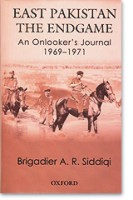
East Pakistan: The Endgame
An Onlooker's Journal 1969-1971
Brigadier AR Siddiqui
Oxford University Press |

