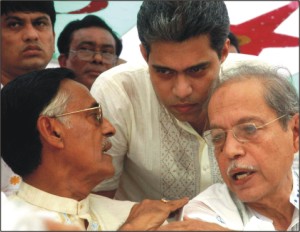
Emergence of a new challenger for BNP?
ABMS Zahur
Emergence of a new political party, Liberal Democratic Party, may be welcomed by the moderate thinking people of Bangladesh because such people are, truly speaking, frustrated by the activities of the largest political parties, namely Bangladesh Nationalist Party and the Awami League.Conscious people consider the present BNP as a conglomerate of people interested only in becoming rich quickly by hook or by crook. It has become an assemblage of opportunists. As it appears, they do not think much, either of their own party, or of the people, or of the country. This was certainly not the dream and desire of its founder, President Zia. He fought for independence of the country. He dreamt of a Bangladesh where people might live in peace, prosperity, prestige, and harmony. Though out and out a soldier, he could appreciate the value of people's freedom. Unfortunately, his strong desire to please everyone (civilians and non-civilians alike) cost him his life. In President Zia, the people of Bangladesh lost a true patriot and a great freedom fighter. His vision was not only a happy and prosperous Bangladesh, but also to establish peace and harmony in South Asia to ameliorate the economic condition of the sub-region where exists the largest concentration of poor people in the world. His assassination in 1981 could have ended the future of his party had his wife Khaleda Zia along with his cronies and well-wishers not tried hard to keep BNP alive against the onslaught of President Ershad who lured a large number of front ranking leaders from BNP. It was indeed an outstanding performance for BNP in forming the first democratic government after Ershad's abdication. Despite lack of experience, it may be said that overall performance of the regime (at least during the first half) was satisfactory. After its defeat at the polls in 1996, it appears, BNP concentrated more on grabbing power than in promoting its ideology as propounded by Zia. We were surprised to see that instead of pointing towards the follies of AL regime of 1996-2001 it started following them with a sense of vengeance. Thus after its victory in the election of 2001, it became a different BNP. The high command of BNP started concentrating on amassing huge wealth for the party and some of the leaders started making fortunes for themselves. Thus people started losing confidence in the front-ranking leaders of BNP. A peculiar political and administrative development has become conspicuous with the emergence of Hawa Bhaban, known as the seat of alternate government. It is said that without the blessing from the Bhaban, no big deal could be executed. Thus two sets of ministers are seen, one blessed by Hawa Bhaban and the other without it. Such an arrangement promoted corruption in the name of collection of huge commission from the big companies doing business in Bangladesh. It may be relevant to point out that huge investment in the power sector has been made in developing transmission lines and not in increasing production of electricity. What kind of development is this? Can we not conclude that such a farce can only benefit a few commission agents, suppliers, contractors, and concerned officers, certainly not the people? Another big corruption case is the ex-communication minister's CNG scam. In both these cases close involvement of Tareque Rahman has been reported in different newspapers of the country. In regard to Awami League, we may have to admit that it deserves credit mainly for attaining independence of Bangladesh. Its founder Sheikh Mujibur Rahman was a great leader. Despite some of his human failures, he is certainly the greatest of Bangladeshis. In fact, there cannot be any comparison with him with any other Bangladesh political leader. Awami League, as the oldest political party in Bangladesh, faced many problems since its birth in 1949. During the military regime of Ayub Khan (1958-68) its followers and supporters faced difficult times because it was the only political party which fought for the rights of the people, economic emancipation of the people, political independence of the people of the then East Pakistan. Due to some serious political blunders and lack of experience in running the administration of a war-ravaged nation Sheikh Mujib had to sacrifice his life in 1975. One of the greatest blunders (perhaps the greatest blunder) for Sheikh Mujib was the formation of Baksal regime in a situation when the economy of the country had still not recovered from the ravages of military rule and war. Before reconstruction and rehabilitation of the country could be completed, it was sheer folly to impose one party rule on people who love freedom of thought. After the assassination of President Zia, we were void of able leadership capable of leading a seriously problem-ridden country like Bangladesh. Thus an opportunity came before our armed forces and the then chief of armed forces Lt Gen Ershad grabbed power through a bloodless coup in 1982. Like many military dictators, Ershad formed a political party, the Jatiya Party, with almost similar manifesto as that of BNP. At its initial stage Ershad tried to attract as many front ranking politicians as possible. This caused maximum damage to BNP because of its lack of mature and seasoned politicians. During the Ershad regime, the members of the party remained mainly as a group of people loyal to Ershad who never liked to develop democratic practices in Bangladesh. It would rather not be realistic to expect an efficiently functioning democratic institution in the country which suffered military dictatorship for long 15 years. Despite lack of political and administrative experience and weakened party structure we may say that BNP under Khaleda could run the state rather satisfactorily because of sincere and dedicated support from some seasoned political leaders closely associated with President Zia (like Dr Badruddoza and Col. Oli). But the pattern of politics of BNP started since the later part of 2000 because of entry of a large number of new leaders. To them, concern for the benefit of the people became secondary. Because of the party's reliance on this class, the high command of the party started dreaming about becoming rich as quickly as possible (through means fair or foul). If the political elite of a party become too corrupt, with no moral or ideological compulsion, it is bound to lose control over administration. As such, it is no wonder that the BNP failed to control corruption in bureaucracy. BNP no longer depends on people's love or respect, it concentrates on purchasing of votes, and, where necessary, use of muscle power. To capture power again it has thoroughly politicized the administration, Election Commission, and, to a certain extent, the lower judiciary. Even the chief of the CTG is a BNP man. We are not yet sure as to whether there will be a national election as scheduled in January, 2007 because the 14-party alliance led by AL will participate in the election only if the following actions are taken by the CTG: - Reformation and reconstitution of Election Commission.
- Removal of identified politicized administrators and police personnel from critical positions.
- Correction of voter list to make it acceptable.
Apart from the above demands there are other demands of AL and LDP (submitted to the chief of CTG). AL has given ultimatum to the chief CTG to complete the task for implementing demands by November 10, else it will start countrywide blockade from today. In such a political scenario, we see the emergence of the Liberal Democratic Party with secular outlook. Though mainly composed of dissident BNP members, it has already been welcomed by the minority communities. It will energize and demoralize the BNP because of loss of members and supporters and the threat of exposure of corruption of some eminent members of BNP. All democracy loving Bangladeshis may welcome LDP as a democratic, secular party though it may not be possible to make any prediction about its future at this stage. However, following factors may be considered for its bright future. - Top order politicians of LDP are seasoned politicians.
- Genuine freedom fighters are showing increasing interest in the party.
- Some minority communities are responding positively because of its secular outlook.
- If it can undertake some positive actions against corruption in the society, it will attract attention of common non-party people.
ABMS Zahur is a former Joint Secretary.
|