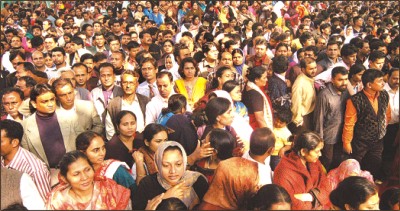
Dhaka Population swelling beyond control
Rizanuzzaman Laskar
Dhaka's population of a staggering 12 million people crowded into 2,000 square kilometres, projects around 10 percent of the country's total population, creating one of the highest urban densities in the world. Some of the country's leading environmentalists, urban experts and economists at a seminar on Urban Issues and Challenges in Dhaka arranged by the World Bank on Thursday expressed their concerns over the low standard of living in Dhaka owing to its enormous population density and inadequate civic amenities. At the seminar, held at Dhaka Sheraton Hotel, the speakers attributed the towering growth of population to the unplanned urbanisation and poor city management that plagued the capital with problems. Each year that passes, Dhaka garners an additional amount of 400,000 people, 73 percent of whom choose to migrate from rural areas in search of job. Economists and urban experts accounted the higher income prospects in the city for the mass growth of population. With income prospects being higher, Dhaka's population is growing much faster than the rest of the country owing to the mass migration from the rural areas. Dhaka's share of Bangladesh's total population has been steadily growing at about 3.2 percent per annum, as compared with 1.7 percent for the country as a whole. Urban experts feared that with the current growth rate, an amount of 22 million people would call Dhaka home by 2015, projecting around 13 percent of the country's whole population. Dhaka is currently the 11th most populated city in the world and by 2015 it will become the sixth most populated city, the experts said. This mass increase in population along with its pressure on the city's limited land and weak urban services makes Dhaka one of the most densely populated cities. According to a report submitted by the World Bank, the population density of the city is now believed to have reached around 34,000 people per square kilometre. People have been cluttering up in the city at alarming numbers as job prospects in the outlying districts have been drying up. With profits from farming and other traditional trades have declined, people look up to Dhaka for hope. The rate of this influx has risen by 50-90 percent in the last 20 years. The consequence is a rise to an overcrowded situation despite the fact that the city has expanded on every side. Areas like Uttara, Tongi, Gazipur, Savar and Demra are now considered major parts of the city, though even a few years ago they seemed like sparsely populated suburbs.
|