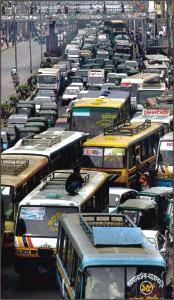
Road network and transport system need overhaul
Despite ban on major roads rickshaws continue to serve commuters
Durdana Ghias
Despite a ban on major city roads for one third of the population rickshaw is the primary mode of transport, discussants at a seminar said on Thursday.At present the estimated number of rickshaws in the city is 400,000 of which 320,000 are unauthorised. But for millions of commuters the problem in the city transport lies mainly in its road infrastructure, is grossly inadequate for the commuters. "A city needs 25 percent of its area for roads but only Dhaka has only 8 percent network of roads," said Tanwir Nawaz, architect and managing director, Urban Habitat Limited at the seminar on Urban Issues and Challenges in Dhaka organised by the World Bank at the Dhaka Sheraton on Thursday. "We have 4000 buses which are used by forty four percent of the riders," said Nawaz adding that multi-modal transport is needed in the city. "Though rickshaws are environment friendly and play a great role in relieving unemployment it slows down motorised traffic and the fact is we are very much dependent on rickshaws," said Nawaz. "Almost sixty percent of the road surface is occupied by private transport which carries only eight percent of the total commuters. This is a big problem," he said. The number of private cars is increasing but buses or public transport is not increasing according to the need. Private bus service is quite disorganised. Many drivers are getting licence by bribing and driving recklessly on the street. Some routes have too many buses while others have no direct buses. For instance, if someone wants to go to Baily Road from Mohammadpur there is no direct bus service for him. He will have to resort to human haulers like maxis. Footpath is encroached by hawkers and this is one reason pedestrians walk on the street obstructing flow of vehicles. To solve the growing problem of traffic and transport Government of Bangladesh has commissioned a twenty-year Strategic Transport Plan (STP) 2004-2024 at the cost of US$5.8 billion, prepared by 31 advisers. "In the paper we proposed to widen the footpaths for the convenience of the pedestrians and physically challenged and free it from the grip of shops," said the expert and one of the advisers of STP. "If the metro rail can be introduced it will transport estimated 3 million people per day and it will cost $2.4 to $2.8 billion," he said adding that the implementation should start from 2010. It will take 15 years from now to construct the three metro-rail lines. STP planned to make 52 new roads within and around the city and it will cost $1.8 billion in twenty years. It selected three roads dedicated to the public buses. The three metro rail lines are planned from Uttara to Syedabad, from Mirpur to Syedabad and a circular road connecting Gulshan, Kamal Ataturk and Manik Mia Avenue. There is also a plan for a circular waterway through Turag and Buriganga. The fund to implement STP would come from government, donors and private sectors. This mammoth plan was submitted to the government this year but it is now gathering dust at the communications ministry. It has scant hope of seeing daylight if money is not procured.
|