Dhaka limping, but for how long?
City Correspondent
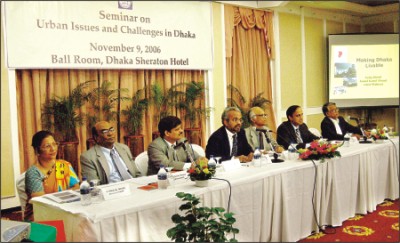
Dhaka as the world's fastest growing city is facing severe constraints in the process of growth in terms of overwhelming population influx, inefficient service delivery systems and corruption in centralised urban governance, said urban experts. Dhaka ranks as one of the least liveable cities not only in the world but also in the south Asian region, said the environmentalists, economists and architects at a seminar on Urban Issues and Challenges in Dhaka organised by World Bank at a city hotel on Thursday. Visionary sector-wise reform strategies are imperative to establish liveability in Dhaka, the speakers said. "Dhaka city has grown into a mega city from a provincial town, as the nerve centre of the country's entire economy," said economist Prof Wahiduddin Mahmud, who chaired the seminar. "Dhaka 's economy vitally contributes to the growth of the whole country. "But the city's governance system has developed more by default than by design," said Prof. Mahmud. The speakers, dwelling upon a wide range of issues, underscored the need for a holistic change and a fundamental rethinking of the city governance to make the city liveable. They underscored that challenges of reforming Dhaka should be a national priority. Sadiq Ahmed, a World Bank sector director of poverty reduction and economic management in South Asia Region, said, "Poor city management, low efficiency and large corruption in service provisions are exacerbating the problems in Dhaka." Water and air pollution caused by poor management of waste and traffic pose serious health hazards, he said while presenting a paper at the seminar. According to the UN City Development Index (CDI), Dhaka scores 48.4 out 100 to measure quality of life and ranks below Bangalore, Colombo and Lahore in the South Asia region with Stockholm ranking the top scoring 97.4, said Ahmed. According to Ahmed's paper, exorbitant price of land is at the root of Dhaka's housing problems. Dhaka's land price is comparable with that in suburban New York or London. The average income of the people in Dhaka is however 50 to 100 times lower. "As a result, private sector has stepped into filling the vacuum, developing housing for only the rich and affluent class," Nawaz said. Slum dwellers that constitute 37 percent of Dhaka's population have no housing or tenure on land, he said. High systems loss in electricity, which is around 20 to 30 percent, and overwhelming power disruptions have marked the dilapidated state of the city, said Sadiq. Dhaka Electricity Supply Authority (Desa) and Dhaka Electric Supply Company (Desco) buy electricity from the Power Development Board (PDB) and distribute in the capital. Bribery of Desa officers and visiting the Desa offices repeatedly are major problems with the service, said Ahmed quoting a World Bank-Proshika survey. Per capita power consumption in Dhaka is 45 kw/hour and demand is growing at 12 percent per year, he said. Dhaka water and Sewerage Authority (Wasa) supplies water to some 70 percent of Dhaka's 12.5 million population. The total consumption is over 2000 million litres if per person consumes only 16 litres per day. The daily per capita normal requirement for water is 40 litres, said Tanwir Nawaz. Dhaka Wasa is able to supply 1,700 million litres of piped water per day. Normal shortfall of water is 250 to 300 million litres per day at low rate of consumption. Wasa obtains most of its water from an over-exploited aquifer. According to Nawaz, problem with Wasa is that the demand for water increasing at the rate of 7 to 10 percent per year and the daily demand for water per day will be 3700 million litres by the year 2024. Dhaka's groundwater table is rapidly depleting due to over-use and dropped 20 metres in last decade. Development of surface water sources is in danger because of pollution. An estimated 3, 200 metric tons of solid household waste is produced per day, said Sadiq Ahmed, adding that only 50 percent of that is collected by the city authorities. "There is no sanitation facilities at all for 30 percent of the city's population," said Salma A Shafi, managing director of Sheltech Consultants Limited. "In reality, Dhaka city is going on without a plan."
|