TechFocus
Unraveling physics mysteries
Md. Mushfiqur Rahman
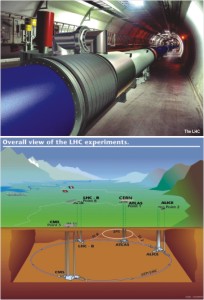
At last after 20 years of preparation the mysterious ring is almost ready with its 1232 superconducting magnets to guide the protons at almost the speed of light. Yes, I am talking about the world's most powerful particle accelerator, LHC- the Large Hadron Collider, which is scheduled to switch on this month at CERN (European Centre For Neucler Research), the world's largest particle physics laboratory, situated just west of Geneva on the border between France and Switzerland. Physicists will then combine results from the LHC experiments with insights from their theoretical investigations to explore phenomena whose effects are only detectable at small distances and high energies. The theory known as the Standard Model of particle physics describes all known matter and the forces through which it interacts. Experiments have thoroughly tested the Standard Model, and its basic ingredients are almost certainly correct. But the Standard Model cannot be the final word: it leaves open important questions about the origin of elementary particle masses and puzzles such as the relative weakness of gravity. The LHC will help to resolve these mysteries, and scientists all over the globe are busily preparing experiments they hope will provide answers to these questions. Perhaps the most exciting proposal for extending and completing the Standard Model involves additional hidden dimensions of space beyond the three dimensions with which we are all familiar: up-down, left-right, and forward-backward. The premise underlying particle physics is that elementary particles constitute the building blocks of matter. Peel away the layers, and inside you will always ultimately find elementary particles. Because of Einstein's E=mc2 equation, which states that energy (E) is equal to mass (m) multiplied by the square of the speed of light (c), we need high energies to create particles with big masses. The LHC will produce enormous amounts of energy that can then be converted into particles we would never find in any other way. The LHC
The collider is contained in a 27 km circumference tunnel located underground at a depth ranging from 50 to 150 metres The tunnel was formerly used to house the LEP an electron-positron collider. The 3 metre diameter, concrete-lined tunnel actually crosses the border between Switzerland and France at four points, although the majority of its length is inside France. The collider itself is located underground, with many surface buildings holding ancillary equipment such as compressors, ventilation equipment, control electronics and refrigeration plants. The collider tunnel contains two pipes enclosed within superconducting magnets cooled by liquid helium, each pipe containing a proton beam. The two beams travel in opposite directions around the ring. Additional magnets are used to direct the beams to four intersection points where interactions between them will take place. The protons will each have an energy of 7 TeV, giving a total collision energy of 14 TeV. It will take around 89 microseconds for an individual proton to travel once around the collider. Six detectors are being constructed at the LHC. They are located underground, in large caverns excavated at the LHC's intersection points. Two of them, ATLAS and CMS are large, "general purpose" particle detectors. The other four (LHCb, ALICE, TOTEM, and LHCf) are smaller and more specialised. Our achievements
21st century physics is still facing some burning questions. Physicists believe that they will be able to answer many of those questions through the experiments which will be taken place in LHC. So the LHC is going to find: Is the popular Higgs mechanism for generating elementary particle masses in the Standard Model violated? If not, how many Higgs bosons are there, and what are their masses? The Higgs boson is a hypothetical massive scalar elementary particle predicted to exist by the Standard Model of particle physics. It is the only Standard Model particle not yet observed, but plays a key role in explaining the origins of the mass of other elementary particles, in particular the difference between the massless photon and the very heavy W and Z bosons So it a particle of great importance. Will the more precise measurements of the masses of baryons (In particle physics, the baryons are the family of subatomic particles which are made of three quarks. The family notably includes the proton and neutron, which make up the atomic nucleus, but many other unstable baryons exist as well.) continue to be mutually consistent within the Standard Model? Do particles have supersymmetric ("SUSY") partners? Supersymmetry means every boson has a fermionic super partner Bosons are particles those transmit forces (photon,W,Z & graviton) and fermions makes up matter (electron,quark etc). Why are there violations of the symmetry between matter and antimatter? Are there extra dimensions, as predicted by various models inspired by string theory, and can we "see" them? What is the nature of the 96% of the universe's mass which is unaccounted for by current astronomical observations which is called dark energy and dark matter and dark energy? Why is gravity so many orders of magnitude weaker than the other three fundamental forces? Is it disastrous for earth and universe?
People both inside and outside of the physics community have voiced concern that the LHC might trigger one of several theoretical disasters capable of destroying the Earth or even the entire universe. These include: Creation of a stable black hole (a place of high gravitational intensity from where nothing can scape). Creation of strange matter that is more stable than ordinary matter. Creation of magnetic monopoles that could catalyze proton decay In physics, a magnetic monopole is a hypothetical particle that may be loosely described as "a magnet with only one pole". In more accurate terms, it would have net magnetic charge. Interest in the concept stems from particle theories, notably Grand Unified Theories and superstring theories that predict either the existence or the possibility of magnetic monopoles. CERN performed a study to investigate whether such dangerous events as micro black holes, magnetic monopoles could occur. The report concluded, "We find no basis for any conceivable threat." For instance, it is not possible to produce microscopic black holes unless certain untested theories are correct. Even if they are produced, they are expected to be harmless due to the Hawking radiation process (particle-antiparticle pair to appear close to the event horizon of a black hole. One of the pair falls into the black hole whilst the other escapes. In order to fill the energy 'hole' left by the pair's spontaneous creation, energy tunnels out of the black hole and across the event horizon. By this process the black hole loses mass, and to an outside observer it would appear that the black hole has just emitted a particle). Perhaps the strongest argument for the safety of colliders such as the LHC comes from the simple fact that cosmic rays of much higher energies than the LHC can produce have been bombarding the Earth, Moon and other objects in the solar system for billions of years with no such effects. However, some people remain concerned about the safety of the LHC. As with any new and untested experiment, it is not possible to say with utter certainty what will happen. In academia there is some question of whether Hawking radiation is correct So, the LHC is on its way. Its costing not too much, only US$ 8billion. We hope it will not be diasterous and will make mankind the lord of the mysterious ring by smashing open the mysteries. References: LHC homepage at CERN (www.cern.cg), In search of god particle-BBC, symmetry magazine, April 2005, The longest journey: the LHC (www.cerncourier.com)
|