The Arnolds and Empire (Concluding Part)
Bernard Bergonzi
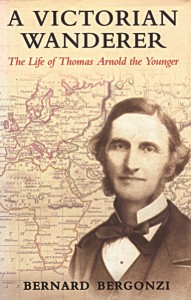
Tom Arnold's first child, Mary Augusta, was born in 1851. In later years she became famous as the novelist, Mrs Humphry Ward. Other children followed; he enjoyed his work, which took him all over the island, and he seemed poised for a successful career in the rapidly expanding educational system of the Australian colonies. But the smooth course of his life was disrupted by a religious crisis. At Oxford Tom, like his brother Matthew and their friend Arthur Clough, had drifted away from his father's Broad Church Anglicanism. They adopted what one might call the default position of many Victorian intellectuals: a reverent theism, humanitarian sentiment, and devotion to a non-supernatural concept of Jesus. For a time, Tom was distressed by his abandonment of his father's ideals, but after a few years he was content for religion to play little part in his life, even to the extent of being indifferent to the christening of his children. But in 1854 he suddenly decided that he was returning to Christian practice and belief. This was a matter of satisfaction to his mother in England and his wife in the colony. He adopted a mode of evangelical Anglicanism; but that proved to be only a transitional position. A few months later he announced that he was going to become a Roman Catholic. This was distressing news for his wife, who was fiercely anti-Catholic, and a matter of scandal to public opinion in the colony. The intense hostility to Catholicism that permeated British culture, in which Protestantism was an integral element, rejected any idea of a Romanist being in charge of public education. The authorities did a gentlemanly deal with Arnold, giving him eighteen months' leave on half-pay in England, on the assumption that he would not return.Tom Arnold, his wife and three children, arrived in England in the autumn of 1856. He found work as a professor at the Catholic University which John Henry Newman had set up in Dublin. His direct personal involvement with the Empire was at an end, apart from the special case of Ireland, where he spent much of the rest of his life, but it was still to concern him, if less directly. In Tom Brown's Schooldays, Thomas Hughes had referred to the various careers followed by Dr Arnold's pupils, whether "under the Indian sun, or in Australian towns and clearings." Tom Arnold had pursued the latter, but his younger brother William went to India. He was born in 1828, and was five years younger than Tom; like his brothers he was educated at his father's school and at Oxford. But he left without taking a degree, and joined the army of the East India Company as an ensign. He fought in a war against the Sikhs, and left a disenchanted account of his experiences in his novel, Oakfield, or Fellowship in the East; it appeared under a pseudonym in 1853, and under his own name in a second edition a year later. It is a work of more historical than literary interest. Despite its many autobiographical elements and references, it is as much an expository moral story as an autobiographical novel in the usual sense. William Arnold has very little to say about the native population, who are no more than shadowy, occasionally menacing, figures in the background. His main concern is with his hero, the eponymous Oakfield, who tries to lead a Christian life in the army, in line with Dr Arnold's teaching, among his crude, insensitive fellow-officers. He allows himself to be insulted without fighting a duel in response, as military convention demanded, and is henceforth despised as a coward. He is described as having a "painful, anxious, darkling search after truth" (the word `darkling' tends to appear at crucial moments in nineteenth-century texts). Arnold was a fluent but uneven writer, very interested in ideas, so that he holds up the narrative with page after page of quasi-platonic dialogue, in which Oakfield holds forth on life, religion, and India, a country which, like his author, he deeply disliked. Kenneth Allott, in his excellent introduction to the 1973 reprint of the book, said that it "combines cumbrous plotting with genuine psychological and moral insight." Unlike his brothers Matthew and Tom, William continued to follow his father's mode of Christian belief and conduct. G.M.Young has remarked, "Oakfield seems to me to convey most completely the effect that Arnold made on those who came under his influence." William Arnold came back to England after some years of military service, then reluctantly returned to India to take up a good position in the educational service. But the climate destroyed the health of both William and his wife. She died in India, and he at Gibraltar in 1859, on his way back to England; his death was poignantly commemorated by Matthew in his poems, `Stanzas from Carnac' and `A Southern Night.' In Hughes's less interesting sequel to his famous school novel, Tom Brown at Oxford (1861), Harry East returns from India, having fought in a colonial war rather like Oakfield's (and William Arnold's). He has been badly wounded but recovers at home and then goes out to New Zealand as a settler. Hughes shows East as recapitulating--deliberately, I imagine--the experiences of two of Dr Arnold's sons in respectively torrid and temperate areas of the red-spattered globe. At one point in Oakfield, the hero thinks of New Zealand as a good place to be, in contrast with the uncongenial Indian environment; William may well have been influenced by Tom's letters from the southern colony. Imperial adventures were directly responsible for the death of an Arnold in the next generation. Tom Arnold had a large family, and his son Arthur was born in 1856, shortly after his return from Van Diemen's Land. Arthur was a difficult boy, who grew up to play the role of the black sheep to be found in many Victorian families. In his late teens he was sent off to Tasmania in the care of his mother's family to see if he could make a living there. But he did not, and by the time he was twenty he was back in England, without any particular competence or goals in life, apart from a vague desire to be an actor. He was a financial burden to his father, who was always short of funds, and there were distressing signs that Arthur was a liar as well as a sponger. The colonies were always the ultimate resort for black sheep and Arthur was shipped off again, this time to the Cape; his father paid his fare and opened a bank account for £40 in his name in Capetown. When he arrived in South Africa, early in 1878, Arthur became not an actor but a soldier, joining a unit called the Diamond Fields Horse. He was soon in action against the Basutos. On 14 May 1878 he sent his parents a Hentyesque account of the fighting, describing how the soldiers had dismounted at 500 yards from the enemy and commenced firing, doing a fair amount of execution at that range. Tom Arnold, who retained some of the early radicalism that Clough had attributed to Philip Hewson in his poem, was outraged by Arthur's account. He wrote, "The brutal murderous state of mind which can think with satisfaction and relate with complacency the 'execution' which his corps performed on a mob of wretched half-armed Kaffirs, is shocking enough; but such a temper is hardly, for most men, separable from military life, therefore one must not make too much of it." But the half-armed Kaffirs had the last word: a few weeks later Arthur was killed in action. His death closed a chapter in the Arnolds' long engagement with the Empire. Tom Arnold's life passed through a variety of phases after his return from Australia. He taught for some years at the Catholic University in Dublin, then became a master at the Oratory School which Newman had founded in Birmingham. In 1865 he was afflicted with one of the spiritual crises that hit him every ten years; he gave up Catholicism, returned to the Church of England, and moved to Oxford where he became a free-lance tutor. Then in 1876 he returned to the Catholic Church and left Oxford for London where he made a meagre living as an examiner for the Civil Service Commission. Eventually, after Newman pulled some strings, he got his old job back as Professor of English at the Catholic University, now University College Dublin. Although he lacked the intellectual distinction of his brother Matthew, he was an accomplished scholar of medieval literature and history, and a pioneer of academic English studies. English Catholics in Dublin had a difficult time of it, as Newman found in the 1850s, and Arnold's professorial colleague, Gerard Manley Hopkins in the 1880s. They were regarded with suspicion, and sometimes hostility, by Irish Catholics and nationalists. By 1882, when Arnold returned to Dublin, nationalist activity and the agitation for Home Rule were becoming pronounced. Looked at one way--the Unionist way--Ireland was an integral part of the United Kingdom; indeed many Irishmen were engaged in developing and running the empire; looked at another way, Ireland was a colony which had been oppressed by England for centuries. By degrees Tom Arnold became assimilated to the nationalist perception of Ireland, and by implication of the Empire. His wife died in 1888, and shortly afterwards he married Josephine Benison, a Catholic Irishwoman (a convert from an Ascendency family), whom he had known for many years, and who seems to have long been in love with him. Josephine had moderately nationalistic opinions which Tom was happy to share, and the Arnolds were accepted in Dublin life as a Catholic couple of the professional classes. Although he was becoming conservative in his social and intellectual attitudes, his old radicalism was still alive. The Boer War, which broke out in 1899, prompted him to a final strong statement of his hostility to such imperial adventures. He described it as "an unjust and abominable war" in a draft letter to a magazine, protesting against an attempt to make French-Canadian students celebrate the relief of Ladysmith, saying that these students "naturally object to becoming Jingoes under compulsion." A few months later, in November 1900, Tom Arnold died. In the course of his life he had learnt, from personal experience and from reflecting on his times, that the Empire was a more contradictory and vulnerable entity than Dr Arnold or Thomas Hughes had envisaged. Bernard Bergonzi is emeritus professor of English at Warwick University, UK. This article was first submitted to the now defunct literary journal Six Seasons Review.
|
|

