Booknotes
A study in contrast
Farhad Ahmed
The two volumes of poetry under review here, though both are by women, and both by poets who live and work (or have worked, past tense, in one case) in Dhaka, however, are a study in contrast. To an extent this difference may be structural, since Rubana (no surname supplied) writes in English, and Ruby Rahman writes in Bengali, and thus the two volumes spring from the different socio-cultural imperatives embedded in the use of these two languages in our society. Therefore, while both poets are Bengali, and women, the sensibilities, and the form that sensibility takes, are radical departures from each other. One wonders whether in this day and age this need be so to such an extent. Or if it is an index of our provincialism, where old distinctions are still being maintained to an extraordinary degree. Rubana's efforts are not what by traditional measures would be called poems; they tend to be confessional notes scribbled at high speed: Breakfast at 8, lunch at 2, a cuppa at 5, Dinner at 9: It's as if food's running out on us. Wee never skip meals and simply eat To the routine alive The routine of routinely complaining about Weights and looks The routine of routine blaming Atkins and our thyroids.... Where traversing continents is nothing, merely the condition of modernity, and form is malleable to the dictates of a global village: Time's standing still On a dusty, dry den of Manhattan, With a tamarind tequila in hand Between the 33rd and the 34th.... Nothing could be farther from Ruby Rahman's poems than a Manhattan den serving tamarind tequilas or blackberries (the latter a title of one of Rubana's poems, and no, it is not about fruit and if you have to ask you are already way behind). Ruby Rahman's poems have been crafted very much from within a tradition; they come not from some whirling self but from a still center, whose universe may be small and domestic but is certainly more rooted: 
The blurb in Rubana's book terms her work as "free verse with flexible punctuations," and quite a few of her efforts run the risk of being seen as slapdash slapping on of paint and calling it art. The English language is certainly tested to its limits in some of her poems. The obverse may be true of some of Ruby Rahman's poems, in that its rhythms and images can at times skirt the edge of cliché and banality. The trick, and a considerable one it may be, may lie in how to avoid the traps of both modes. Farhad Ahmed is a free-lance contributor to the literature page, The Daily Star.
|
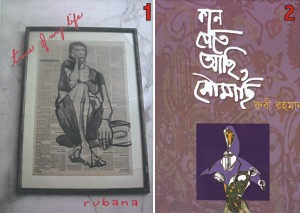
1) time of my life by Rubana; Dhaka: writers.ink; 2006; Rs. 200.00; pp. 104.2) Kaan paytay achi, moumachi by Ruby Rahman; Dhaka: Iftakhar Amin Banglabazar; 2006; Tk. 60.00; pp. 62. |

