All Time Greats
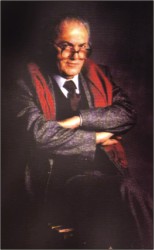
Federico Fellini: The inimitable storyteller
Life and dreams were inputs for famous Italian director Federico Fellini's films. His native Rimini, some characters and the Gambettola farmhouse of his paternal grandmother featured in several films. Likewise his travelling salesman father Urbano Fellini figured in his well-known La Dolce Vita (1960) and 8 ½ (1963).Born on January 20, 1920, his mother Ida Barbian was from Rome and accompanied him there in 1939. He enrolled at the University of Rome. Interested in the image of reporters in American films, he tried out the real life role of journalists and won approbation from several editors with his caricatures and cartoons and then began turning in articles. Several articles were recycled into a radio series about newlyweds Cico and Pallina. Pallina was played by acting student Giulietta Masina, who became his real life wife from October 30, 1943, until his death half a century later. The young Fellini had a passion for vaudeville and was befriended by leading comedian Aldo Fabrizi. As it happened director Roberto Rossellini wanted Fabrizi to play Don Pietro in Roma, citta aperta (1945) and established contact through Fellini. The latter worked on that film's script and is on the credit for Rossellini's Paisa (1946). On that film, he ventured into the editing room, observed how Italian films were made (a lot like the old silent films with an emphasis on visual effects, dialogue dubbed in later). In his mid-20s, Fellini had found his life's calling. Fellini made it into the top echelons of filmdom. Among his later films were Tivu di Fellini, La (2003), Voce della luna, La (1990) and Intervista (1987). One of his directorial works, La Dolce Vita stands out in the memory. Says a film critic, "Few films have indelibly defined society as caustically and honestly as Federico Fellini's La Dolce Vita." In the film, Marcello Rubini (Marcello Mastrionni), a frustrated writer, is reduced to tabloid journalism in order to make ends meet. His encounters with a wide variety of characters form the backbone of the film. One of Fellini's leitmotifs was the theme of a soul torn between the heart and mind. Take the case of the moving masterpiece La Strada. Then there is the propensity to recount the misery of existence and the triumph of the human spiritas for instance with La Notti di Cabiria (1957). A touching, humorous and poignant film, Fellini presents the story of an endearing prostitute searching for love and happiness. Fellini's life came to an end on October 31, 1993. Yet his presence still looms large as one of the greatest filmmakers of his time. Compiled by Cultural Correspondent
|
|

