Annan's farewell swipe
Imran Khalid
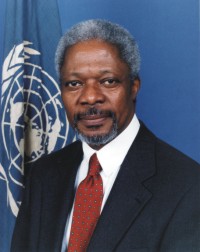
The last few days of Kofi Annan's long stint as the seventh secretary general of the United Nations have seen an unprecedented, frantic war of words between him and the Bush administration. During his long innings, Annan had never tried to veil his disapproval of the Bush administration's hegemonic and adventurous global agenda, but it was not expected of him to make an extremely caustic, farewell swipe at the Bush administration just few days before leaving the stage. On December 11, while addressing the gathering at the Truman Presidential Museum & Library, Missouri, Mr. Kofi A. Annan made one of the most pricking and pragmatic talks of his career. Seldom do we see a diplomat of his stature come up with such a candid evaluation of the global political scenario, and the role of one super-power in enforcing its own dictation while bullying the world body. In the speech, Mr. Annan talked about five lessons he learnt during ten years as UN secretary general. But his speech can be viewed in many different perspectives. One view could be that, being a relatively "flopped" secretary general who failed to arrest the growing erosion of the influence of the UN in putting the brakes on Washington's hegemonic tendencies, Annan simply wants to justify his failure by putting all the blame on the bullying strategy of Washington and using the populist theme of Bush-bashing. The other interpretation could be that Kofi Annan is genuinely concerned about the Bush administration's misadventures, and its negative impact on the evolution of the United Nations as a truly world body to effectively monitor the functioning of global system, and that he sincerely wants to divulge his frustration when he has nothing to lose at this stage of his career. Ostensibly, regardless of the actual motivation behind his acerbic swipe at the Bush administration, the fact is that Kofi Annan has bared his heart. The five lessons -- that he asserts he has learnt in one decade as UN secretary general -- revolve around collective responsibility of all the nations for each other's prosperity, security, development, respect for human rights, the rule of law, individual governments' accountability to domestic and international community and democratization -- and re-organization -- of the international institutions like the UNO. This sounds like perfect academic material. But it was the explanation of the background of these lessons that contained really caustic stuff for President Bush his coterie. For example, while assessing the role of the US leadership in ensuring respect for human rights across the globe, Annan said: "Human rights and the rule of law are vital to global security and prosperity. But that lead can only be maintained if America remains true to its principles -- including in the struggle against terrorism. When it appears to abandon its own ideas and objectives its friends abroad are naturally troubled and confused." So, without mentioning Guantanomo Bay and the Abu Ghraib prison, he has divulged everything that a responsible UN secretary general should have boldly said -- though not at the end of his career. This also reflects the helplessness of a UN secretary general who was unable to use his influence as the leader of the world body to force the United States to abstain from human rights violations in its much-touted war against terrorism. His main focus of attack was perhaps the Bush administration's handling and execution of the war against terrorism. He used some very piercing words to castigate the Bush administration's war against terrorism. "That is why secret prisons have no place in our struggle against terrorism…Leading promoters of human rights undermine their own influence when they fail to live up to their own principles," is how Annan expressed his frustration in his speech. He also indirectly criticized the US-led invasion of Iraq to topple Saddam Hussein, and to destroy the weapons of mass destructions there. He seriously argued that no nation could legitimize its military actions against any other nation without convincing the world that the use of military power was justified, and for "broadly shared aims in accordance with broadly accepted norms." He further warned the United States that the security of each nation was the collective responsibility of all the nations, and no nation can alone tackle the threats like weapons of mass destruction and biological weapons of. "Against such threats as these, no nation can make itself secure by seeking supremacy over all others. We share the responsibility for each other's security," said Annan. He indirectly instigated the American people to take note of their leadership's hegemonic tendencies that have been negatively affecting the complexion of global political structure. "As things stand, poor and weak states are easily held to account because they need foreign aid. But large and powerful states, whose actions have the greatest impact on others, can be restrained by their own people," he said. Obviously, such straight-forward comments have invited a vitriolic response from the Bush camp, which is now trying to find fault with the performance of Mr. Annan. So much so that Henry Hyde, the outgoing chairman of the house international relations committee has directly accused Mr. Annan of presiding over "rampant financial and moral mismanagement at the UN." This shows the limit of sensitivities of the Bush administration which has opted to retaliate with a series of counter-allegations and highly personalized mud-slinging. Even Condoleeza Rice labeled Annan's speech as a missed opportunity by completely neglecting and disregarding the existence of cooperation between the United States and the UN. Nonetheless, Kofi Annan has sparked off a chain reaction, and now he has to face it. Though it is quite difficult to trace the real motive behind Annan's onslaught of words against the Bush administration at this juncture, one thing is certain that, despite being well aware of the "real cause" behind the UN's failure to evolve into an effective institution, Mr. Kofi Annan also failed to dispel the clouds of desperation and wretchedness that have enveloped the world body during the last one decade. But the real concern is, despite the diagnosis being known these clouds are getting thicker, with no remedy in sight.
Imran Khalid is a freelance contributor to The Daily Star.
|
|

