The star of Bethlehem
Syed Ashraf Ali
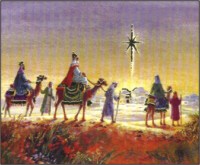
Stars occupy a very important place in the history of homo sapiens. Although Whitman claims, "I believe a leaf of grass is no less than the journey work of the stars," people in various ages have always believed in the maxim: "The stars rule men, but God rules the stars." Stars indeed have haunted the imagination of saints and seers from time immemorial. To many, stars have been symbols of high ideals and great hopes. Poets have eulogised stars in their poems, patriots have depicted stars on their flags, stars in songs have provided inspiration to the tormented souls of the lovers and the imprisoned. For thousands of years stars have also been used as religious symbols. The ancient Babylonians believed that the stars and the gods were closely related. Ancient writings testify to the fact that the Chinese used to worship the constellations and the whole heavens. The Black-foot Indians of North America believed that every star was a human being. When a person died his spirit rose to the heavens to become a star. From the days of yore, the six-pointed star of the Shield of David has been a symbol of Jewish faith. But it is the Star of Bethlehem, the symbol of the Christian religion, which has the unique distinction of attracting the attention of people both in the realm of science and in the world of religion.The Star of Bethlehem is that unique star following the light of which three wise men found Jesus in Bethlehem on Christmas Day. The Christmas Story, as told in the Bible, describes how the wise men from the East followed a bright star to the stable in Bethlehem where Jesus was born. A silver star in the great cathedral in the village has the simple inscription: "Here, of the Virgin Mary, Jesus Christ was born." And each year, thousands of Christians make a pilgrimage to Bethlehem on Christmas Day and the Silver Star reminds them of the unique Star of Bethlehem which guided the three wise men on the first Christmas Day. More than two thousand years have shaded themselves with the past since Jesus was born, but the Star of Bethlehem still remains a mystery not only to the devoted followers of Christianity by also to historians and astronomers in this twenty-first century. It seems that the miraculous star was not just a divine apparition. Scientists in various corners of the world have been pondering for years over all known documentation of a supposed number of recorded sightings of the period. As a result many a theory has been put forward. Some claim it to be a regular bright star, others opine in favour of an exploding Nova-Star or a comet. There are still others who advocate in favour of a conjunction of planets. The only place where the three wise men are mentioned in the Bible is the Apostle according to St Matthew. It is clearly mentioned that Jesus was born at Bethlehem at the time the three wise men following a star came from the East looking for the newborn King of the Jews. The Star of Bethlehem is shown clearly in famous paintings like Phillipe Lippi's in Florence or Jerome Bosch's in the Madrid Prado. But scientists tried to find proof of the existence of the BRIGHT OBJECT in the sky both historically and astronomically. One hypothesis claimed that it could be an exploding Nova-Star which normally produces unusual brilliance in the sky and overshadows even the Morning or the Evening Stars. But, argues the renowned astronomer Nigel Henbest, "Everyone in the Middle East would have been astounded by such a sight. Yet, according to St Matthew's gospel, neither King Herod nor his advisers had seen the Star. When the Magi turned up in Jerusalem demanding, 'Where is he that is born King of the Jews?', Herod, with his authority in danger of being undermined, enquired of them diligently what time the Star appeared." What is more, Chinese astronomers used to record with meticulous care their own observations of the sky at the time. But they did not report any brilliant supernova. The supernova or the exploding star hypothesis can therefore be ruled out. Another hypothesis claims that the Star of Bethlehem could have been the famous Haley's Comet which swings close by the sun roughly every 76 years. An unforgettable view of Haley's Comet in 1301 so inspired Giotto di Bondone, the Italian Renaissance painter, that he used it as the model for his 'Star' in a famous Nativity scene. But the records of the Chinese astronomers testify that they saw Haley's Comet in 12 BC, which was undoubtedly too early for the birth of Jesus. But the Chinese astronomers saw another celestial visitor, which they called 'broom star' in 5 BC, on the borders of the constellations Aquarius and Capricornus. Some astronomers claim that it was a nova -- an explosion of a dwarf star. But Colin Humphreys, a scientist at Cambridge University, firmly believes that it was a comet. He also opines that this 'tailed wonder' was the Star of Bethlehem. The Chinese astronomical records also claimed that the 'broom star' was visible for 70 days -- long enough to guide the Magi to Bethlehem. If this is true then Jesus was born in the spring of 5 BC. Most astronomers believe that a comet does not fit the bill. The Magi were not kings, but Babylonian astrologers. They were not used to observing the sky closely and logging unexpected events such as comets. They simply calculated the position of the Sun, Moon and planets, and their relations to each other. With this knowledge they could "predict" events months or even years in advance. So, argues Henbest, the Star of Bethlehem must have been something much more arcane and subtle so that it would not be evident to those without astrological (or astronomical) knowledge. A third hypothesis goes in favour of a rare triple conjunction of three planets. This happened when King Herod decided to massacre all children under two years of age in his attempt to kill the King of the Jews. But the British astronomer DW Hughes, of Sheffield University, claimed in 1976 that his research and calculations clearly showed that this coming together of Venus, Jupiter and Saturn occurred in 7 BC i.e. seven years before the presumed birth year of Christ. Although Michael Molnar, the famous American astronomical historian, has of late come up with even more spectacular astrological perspective, this claim of the triple conjunction is supported by the majority of modern astronomers. This claim of Hughes does not, however, surprise the historians since the exact date of Jesus' birth is not known. "To track down the real Star of Bethlehem", says Henbest, "we need to know roughly the date of Jesus' birth. Jesus was not born in the Year Zero (which does not exist), or even in the Year One. According to Luke it is associated with a census which was held in 6 AD. It is also stated that Jesus was born in Palestine during the lifetime of Herod the Great whom the Romans had appointed to rule as King of Jews. Herod died, soon after an eclipse of the Moon, definitely in 4 BC and Jesus must have been born earlier than that. Vincent Taylor also admits in The Jesus Report that the date of birth of Jesus could be as early as 8 BC; since Herod's degree, set in motion by the news of Jesus' actual or imminent birth, that all newly born infants in Bethlehem should be slaughtered, obviously must have preceded Herod's death. The historians point out that although the Christian Calendar is dated from what was supposed to have been the year of the birth of Jesus, the people who worked out the Calendar made a mistake in the date. It was in the AD 500s that the monk Dionysus Exiguus, who introduced the present custom of reckoning time by counting the years from the birth of Christ, miscalculated and his reckoning was four to seven years later than the actual date. The calculations of Hughes, with the suggestion that the star of Bethlehem was a rare triple conjunction of planets, testify to the fact that Jesus indeed was born in 7 BC and vice-versa. This interesting episode attracts both the astrologers and the astronomers. Jupiter, as the king of the gods, symbolises Royalty, and in Jewish astrology Saturn, representing both Palestine and the principle of justice, protects Israel. Pisces, the zodiacal sign of the Jewish people, is also in Spring time, the birth of a new age. The Magi, looking at their astronomical charts, would have interpreted the conjunction as a sign that a Jewish Messiah would soon be born. Hence the birth of the King of Jews as recounted in St. Matthew. In this case, since the Star of Bethlehem, the rare triple conjunction of Venus, Jupiter and Saturn, appeared in sky in the year 7 BC the world should now be passing through 2013 and not 2006 as we all inadvertently believe.
Syed Ashraf Ali is former DG of Islamic Foundation Bangladesh.
|
|

