No Nonsense
Flirting with bigots: BNP vs AL
Dr. Abdullah A. Dewan
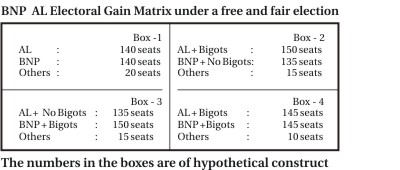
No sooner was my defense of objective journalism archived before I found myself faced with an opportunity to prove the even-handedness of my column. Sheikh Hasina's attempt to sugar-coat the Bangladesh Khelafat Majlish (BKM) deal by insisting that the 5-point MOU was "well-intentioned" felt more like salt in the wounds. If it is well intentioned then why is no one, other than the BNP-Jamaat alliance (BJA), rejoicing with champagne and caviar? Instead of defending this action time and again, the AL leadership should have scrapped the MOU forthwith and apologized for its misadventure. The minorities spent many sleepless nights in fear because of the intimidation during BNP-Jamaat's five years of repressive rule, and looked towards the AL leadership for relief from their nightmare -- only to be slapped squarely at the end. At a time when the world is striving for the harmonious coexistence of different faiths, our politicians are turning the clock back to the dark days of rule by scripture. Much recent scholarly Islamic literature argues that: "The doctrine that religion and politics can't be separated in Islam is a later historical construct, rather than the Qur'anic doctrine. It is a human construct, rather than the Qur'anic doctrine. It is human construct rather than a divine revelation." The basis of modern secularism is, of course, separation of religion from the state. While the state shouldn't interfere with religious freedom, religious authorities shouldn't intercede in the affairs of the state. The Indian ulamas had accepted this doctrine with good scruples throughout the freedom struggle, and it was on this basis that they became allies of the Indian National Congress. With the exception of Turkey and Malaysia, the Muslim majority countries of the world lack a history of democratic struggles of the people; many of these nations are still preserving their feudal past. Therefore, one shouldn't look for causes exclusively in religious teachings, but also in the socio-political history and family lineage of the people of those countries. Furthermore, most of these countries have very small religious minorities, and they, too, have historically accepted the religious hegemony of Islam. But there is strong pressure mounting, and human rights movements are up-and-coming in all these countries. In these countries globalization may not be desirable, but can't be put off for long because the information revolution precipitated by the Internet is fostering conditions for close interaction among various cultures and political systems. One may wonder why it is that the major political parties are making ideological concessions to religious parties for the sake of forging an alliance with them, even though they don't have a winnable standing amongst the voters. Why not convert them instead of being converted? The clue is: their partnership is rewarding now, and will continue to be so in the future. There are about 15,000 Qawmi madrasas under the Private Madrasa Board, in addition to about 9,000 state-registered ones, with numerous more yet to be registered or enlisted. Over the period 2001-2005, the student population in general educational institutions grew by 8.64%, while the madrasas witnessed a 10.12% growth in enrolment. Although madrasas have made negligible contribution toward producing skilled human capital in the country, increasingly a larger and larger religiously indoctrinated voting block is being spawned in these institutions. While no party can sensibly ignore such a growing block of voters, deal-making with BKM by denigrating party ideologies is simply unacceptable. Politics in Bangladesh has shaped up as a two-party system, with both having nearly equal strength. But either party needs the support of many smaller parties to tilt the balance. With all the collusions (or alliances) with smaller parties that were consummated, the politics in the country may be classified as a duopoly (like a two-firm oligopoly) similar to the current American political system, often cited as a paradigm of duopoly in politics. The question as to why both the alliances are flirting with the bigots can be explained using a game theoretic "electoral gain matrix," analogous to the problem of "prisoner's dilemma" which is almost always presented in describing oligopoly firms' interdependence in price-setting behaviour. Box - 1: Shows that without any alliance with bigots, both BNP and AL have equal chances of winning 140 (or majority) seats in the parliament. Box - 2: Shows that if the AL allies with the bigots (with BNP contesting by itself) it wins the majority in the parliament handily. Box - 3: Reverses the scenario presented in Box-2. Box - 4: Both AL and BNP form alliances with the bigots and are, once again, evenly matched up (that is, equal probability of winning the majority). Under the prevailing political milieu, the outcome in Box-4 is inevitable and cannot reverse any of the scenarios that preceded it, unless the bigots break up the alliance with one of the two parties, or with both. Either party risks loss of seats if it extricates itself from alliance with the bigots. The outcome in Box-4 is the Nash Equilibrium, named after the famous mathematician John Nash, who formulated it and shared the 1994 economics Nobel Prize. Note that the distributions of seats in the boxes are constructed to make the point that flirting with the bigots is a natural political expediency. Both AL and BNP will continue to be allied with bigots for the foreseeable future (Box-4), and both will yield to their nagging demands to get religious cover. This being the fait accompli, what we can do, though, is enlighten the bigots through intellectual discourse. An international forum for secularists of Islamic societies has been scheduled at St Petersburg Hilton, St Petersburg, Florida over a two day period, March 4-5, 2007. This forum was organized in response to calls for a "reformation," a new enlightenment, or a secularization and liberalization of Islamic thought and practice. The summit is intended to bring together Islamic thinkers and activists in an ongoing cross-cultural forum to formulate and share "no-nonsense" strategies and disseminate them to the public worldwide. So, why not send some of our religious scholars to participate in the forum at state expense? Dr. Abdullah A Dewan is Professor of Economics at Eastern Michigan University.
|