Saving Lauachhara
Cackle of red jungle fowl now heard louder
Wildlife makes a comeback after community involvement in conservation
Pinaki Roy
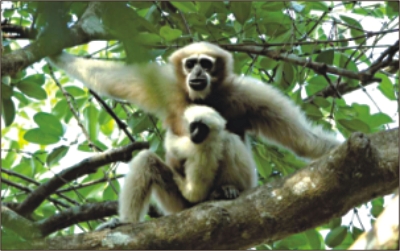
Community participation in the conservation process of the Lauachhara forest has seen a remarkable improvement in the overall condition of the forest including an increase in wildlife.The illegal practice of tree felling is now strictly controlled in the forest. The significant increase of wildlife indicates an improving forest health since the Nishorgo Support Project of the Forest Department started some two years back. In addition, less human intrusion in the forest also contributed a lot in the process, people concerned with the forest told The Daily Star during a recent visit there. A small patch (only 1250 acre) of evergreen and semi-evergreen forest in Srimangal, Lauachhara is noted for it's rich flora and fauna. While conducting a bird census, Dr Monirul Khan of Jahangirnagar University found that the number of some indicator birds, like red jungle fowls and puffed throated babbler, has increased compared to the previous years. "We found that the number of those birds have increased by 20 percent this year. It proves that the health of the ground forest and the midlevel forest has improved," Dr Monir, who led the census team in 2005 and 2006, told The Daily Star. "Now we want to monitor the conditions of other indicator bird species like red headed trogon, hornbill and hill myna," he added. The last two censuses found the number of other indicator species almost the same, Dr Monir said adding that they will start the survey in next February again. The experts see the improving forest health as a positive indication for the hoolock gibbons, the key species of the forest, as well. Petra Osterbgerg, a researcher from the Oxford University, recently conducted a census on this species and found that there are 59 gibbons in 16 families at Lauachhara and its adjoining forest. According to experts, the rich biodiversity of Lauachhara includes 20 species of mammals, of which six are of non-human primates, 246 species of birds, four species of amphibians, six speeches of reptiles, 17 species of insects and 167 species of plants. In addition, hoolock gibbons and other species like slow lorises, barking deers, capped langurs, hooded pittas and kalij pheasant and different kinds of orchid are the main attractions of this forest. The hoolock gibbons are treated as the world's most critical 25 mammals in 2006-2008 by the International Union of Conservation for Nature (IUCN). Found in four countries of this region -- Bangladesh, Myanmar, China and India -- the total number of this endangered apes stands at only 700. Of them, around 300 are in Bangladesh, Prof Anwarul Islam, prominent biodiversity expert of the country, said. "We have been conducting surveys at all habitat forests of the hoolocks, including the Lauachhara. We are also planting fruit trees for them and trying to mark their fruit and sleeping trees, so that those are not felled," Dr Anwar, also the chief of the Wildlife Trust of Bangladesh, added. Since hoolocks are the "umbrella" species of Lauachhara, if they can be saved, the forest will be saved as well, he observed. Good news is that the number of this key species of the Lauachhara forest is growing gradually. The local tour guides and wildlife experts from the department of forest said that they have sighted a new family of hoolock gibbons at the Chautali, the adjoining forest of Lauachhara. "The number of barking deer has also been increased recently," Shymal Devbarma, an indigenous youth working as a tour guide at the Lauachhara, said. "I can estimate their increased number by their barks and their dung," he added.
|