Rise all the brave warriors of sal forest
Pavel Partha
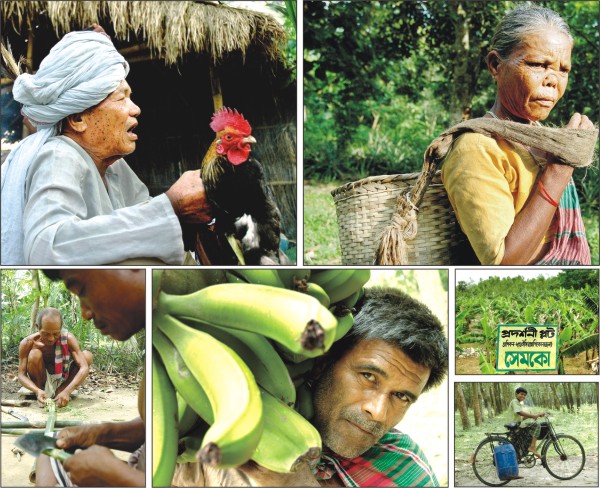
Once there was no chu in habima's (motherland) Mandi locality in the natural sal forest. Chu is the traditional drink (liquor) of the Mandis. Aged Mandi women make chu in their houses from varieties of cooked rice. When the state was yet to ban jum cultivation and habahua was a common practice, chu made from mi.middim rice was best for drinking. In Mandi society mangmangkhiris (sal forest insects) first made chu in their hives. Collecting chu from mangmangkhari was very difficult. Mandis wandering in the deep forest prayed to the deities Brara-Dugni to lessen the difficulty of collecting chu and reveal an easier way. Then chu was made available from the lower part of the ears of snengnagora (insect). That was also not an easy source to get chu from. Then they got to learn that it could be produced from mi.mandi. Chumanthi (yeast) was produced from different parts of medicinal plants. Gangeng Nokma Dujongrachchha was the first Mandi to produce chu in his house which was first used in a rugala (Mandi ritual) in the house of Randibima Rai Michchik. Chu was first served at a mass gathering in the house of Jarem Nokma, the first Mandi Song Nokma (village head). After years of experimentation, Mandi women learned to use many medicinal plants of sal forest in making chu. Many days have passed since then. The Mandis do not have access to their traditional habahua in Madhupur sal forest anymore, and Mandi jum rice varieties like mi.middhim, mi.gengem, mi.khochchu, mi.sharengma are no longer piled up in their mizams (granary). Under the development policy, planning, and support of Consultative Group on International Agricultural Research (CGIAR), having its secretariat in the World Bank headquarters in Washington, many local genetic resources from all over the world are collected for so-called agricultural projects. Many local and indigenous rice germplasms from different countries, including Bangladesh, have been the victim of bio-piracy by International Rice Research Institute (IRRI). Jum rice varieties like mi.middim, mi.sharengma, mi.gengem are no longer found in Madhupur sal forest, but they are available at the germplasm centre of IRRI based in the Los Banos University in Philippines. IRRI has assigned a germplasm accession number to all these jum rice varieties without informing Mandis. In the bargain, the internationally accepted strategy of free, and informed, consent of the indigenous people has been ignored. Although Bangladesh has signed and approved the Convention on Biological Diversity (CBD 1992) which contains articles on not using resources without acknowledging the involved community, IRRI might have already modified the varieties genetically, or other companies might have patented the gene and introduced a "new," modified seed and embarked on a monopoly business with this "new" corporate seed. This is exactly the case with BR-29. Swiss company Syngenta is currently involved with the business of the seed produced from the rice varieties of Bangladesh. Now we will launch into a fairy tale. Once upon a time there was a sal forest. Her name was Madhupur. The indigenous Mandi people used to call her habima (motherland). In their language they called the sal forest "bolsal bring." There, in a Mandi village Joinagachha, Sailo Snal and Nezen Nokrek's son, was growing up like most of his Mandi counterparts. While coming of age he got to know that the leaves shed from sal trees, or the fuel wood, or forest yam, or the medicinal plants that they collected from the forest had to be gathered, even at the risk of being killed, since the Forest Department was the official guard. In the fairy tales he heard, from his achchu-ambi (grandmothers), of a princess being guarded by the rakshas-deo-shokso-soitan. The sal forest was another such captive princess for him. He dreamt of freeing the princess from the rakshas. He wished to be the warriors Digge-Bandi and Sheranging. Time went by. The Forest Department was never short of bullets in its guns. How did they manage so many bullets? Who gave them money to buy bullets? He could never find an answer. Meanwhile, the Forest Department continued to declare their ancestral lands as reserved and protected forest. By proclaiming the entire forest a "national asset" the rights and claims of the indigenous people who live in close proximity to the forest were nullified and ignored. Within the "reserved forest" a bombing and firing range for the air force was established, by-passing conservation; a rubber plantation project and acacia monoculture, in the name of social forestry funded by Asian Development Bank (ADB), were implemented, destroying the natural forest. Bihen Nokrek was shot dead by the Forest Department. Geedita Rema, Adhir Dofu, Nityonath Hadima, and Sentu Nokrek were among the indigenous people murdered one after another. The natural sal forest was handed over to the Bangali settlers in the name of social forestry. Long, inherited linkage to the land and to natural resources, and the very existence of the Mandis, were put under threat by commercial and industrial plantation. Pineapple was imported first. Then it was replaced by deadly banana gardens. Corporate profit seekers like Syngenta, Bayer Crop Science, and ACI, who donate to CGIAR, finalised Madhupur as the production ground of banana mono crop. The Mandi boy had to spend his days as an ordinary day labourer in the corporate controlled banana gardens. Rising early he had to go to the garden to spray chemicals (insecticide, pesticide, and hormones), cut bunches, and load the trucks with bananas. When that Mandi boy became panthi (adult) he married Sheeta Nokrek. These days Mandi youths no longer become nokrom (a matrilineal practice of shifting to the bride's house after marriage). By then only BR-28 and BR-29 rice varieties were used to make chu. The Mandi youth also used to work in these rice fields in nama or baid areas (low land) with others. Syngenta's chemical fertiliser and seeds had already made their way into these lands also. Once again the rakshas attacked in 2003. Indigenous people identified the Forest Department as rakshas, and this time the attack came in the form of an eco-park. The Forest Department has been attacking in various ways since 1962. Its first attack was in the name of implementing Madhupur National Park Project. Keeping away from his regular work, the Mandi youth also participated in the anti-eco-park movement. It was January 3, 2004. Eating up the chemicals from banana leaves the winter dew was tumbling on dellang (a ritual for the dead) as if it was doomed to die of corporate poisoning. About 10,000 men, women and children of Mandi-Koch-Borman from Jalabada, Chunia, Sadhupara, Joinagachha, Sataria, Gaira, Rajabari, Jolchhotro, Gachhabari, Joloi, Edilpur, Sainyamari, Telki, Beduria, Kegai, Pegamari, and even some Bangalis, assembled to save their princess. At the gathering those village people said "no" to the eco-park. On the other hand, the Forest Department, perhaps smelling the blood of indigenous people, dared to open fire at the procession at Jalabada Rajghat area. A Mandi adolescent, Utpol Nokrek of Beduria village, stood in-between the rakshas and the princess to save her, and his body was riddled with bullets. That Mandi youth stood up to the rakshas the cost of his life. At this point the story is very dissimilar from the fairy tales. That Mandi youth could not be united with the princess. The bolshal princess is still held captive by the rakshas. Multi-national development rakshas, including ADB, have already devoured the natural sal forest. Only a small patch of the forest remains. The Forest Department always keeps the princess cataleptic with its deadly guns and forest laws. It wants to make her an eco-park, encircling her 3,000 acre core area with boundaries. That Mandi youth shed his blood to free her from such rakshas. The Forest Department killed the youth and lodged a case in Tangail court naming him top accused. His helpless children, Ratri Nokrek and Utsho Nokrek, cannot understand why their father never returns home and what befell him. His wife Sheeta is acquainted with such phenomena. Now she knows the destination of a Mandi girl -- extracting fuel wood or forest yam in the face of torture, guns and forest laws, or working as a day labourer in banana gardens, or carrying out orders in the missions, or engaging in jobs as a housemaid or beauty parlour worker (if fortunate enough) in Dhaka. Our story never ends. The name of the youth in the story is Piren Snal, the first martyr of anti-eco-park movement in the world. The story might have a happier ending if the state cancels the Madhupur National Park development project. If the responsibility for conserving nature remains with the indigenous people living in the forest, and the colonial forest laws are removed and corporate-controlled commercial crop cultivation is stopped, the princess could be saved from the rakshas. After Piren, Sisilia Snal of Sataria village was also murdered. A divisional forest official of Tangail has once again issued a tender notice, recently published in the daily Inquilab, for Madhupur Park development project. The Forest Department once again wants to destroy the forest by constructing a 14,000-feet long boundary wall. This death sentence has already triggered a wave of protests, and will continue to do so. Piren and Utpol are the inheritors of the brave Mandi heroes Diggi-Bandi. Utpol will stand tall again. He will fearlessly question the tender again. We are all his fellow- warriors today. We are, today, the blakba (brave warrior) of the sal forest, and we will rise. Simsakboo bolshal bring ni blakba, simsakboo (Rise all the brave warriors of sal forest. Rise.) Pavel Partha is an ethno-botany and bio-diversity conservation researcher.
|
|

