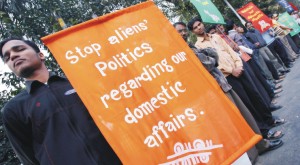
Political bankruptcy: A threat to state sovereignty
Matiur Rahman
Our major political parties, only because of their lust for power, have thrust the nation into a state of emergency. Their arrogant behavior, stubborn policies, and senseless actions over the last several months have not only caused indescribable sufferings to the millions of innocent citizens at home, but have also raised a huge uproar in the international community. Therefore, some citizens heaved a sigh of relief at the promulgation of emergency by the president, hoping for an end to the unrelenting blockades, hartals, and street violence that had resulted in the loss of many lives and complete paralysis of normal life in most cities, including Dhaka. Others, however, are concerned about the suspension of certain constitutional rights and freedom due to the imposed state of emergency. The current situation in our country is the product of our two major political alliances, led by none other than the two most inefficient, corrupt and arrogant parties in our political scene today. Their ineptness is ruining the democratic institutions and bringing the country close to an economic disaster. Their political bankruptcy is not only hampering our progress toward the path of democracy and good governance, but is also threatening our state sovereignty in a subtle way. Western diplomats in Dhaka have recently been so openly engaged in our political arena that many of our conscientious intellectuals seriously questioned their role in our domestic matters, while some others found it justifiable in order to "protect and promote democracy" through "free and fair elections." When the political turmoil turned into a national crisis, the western diplomats started well-publicized visits to the palaces of all three major stakeholders for state power -- one former president and two former prime ministers -- in order to make them agree on a solution to the crisis, apparently. While it may be argued that the intervention of foreign diplomats was necessary in order to overcome the impasse that had existed, there are other consequences of this issue that need to be seriously considered. Furthermore, just a few days before the declaration of emergency, when the grand alliance led by Awami League declared its decision to "boycott and resist at any cost" the parliamentary elections slated for January 22, all of the powerful western players, such as US, UK, EU, and even UN, announced almost in one voice, and rightly so, that elections in such a situation would not be acceptable to them as legitimate. Additionally, they also threatened that if the government of Bangladesh went ahead with a "one-sided" election in the face of boycott by Awami League et al, they would cut off trade and other vital transactions with Bangladesh. Moreover, the highest world body, the UN, threatened that Bangladesh's participation in the prestigious Blue Helmet peace-keeping mission would be jeopardized unless "free and fair elections with participation of all parties" were ensured by the government of Bangladesh. For a country that is still largely dependent on foreign aid and favorable trade relationships with the West, such a threat was unnerving for the government and the BNP-led alliance, but very comforting for the grand alliance, for obvious reasons. The justification given by the western diplomats for such a stance is that in today's intertwined world of economy, politics and national security, a democratic Bangladesh is in the interest of their governments, hence their intervention in our politics is not only legitimate, but also necessary, to make sure that their "tax-payers' money" was not wasted. This simply means that what the West is doing with respect to our political shebang is for the protection of their legitimate interests only, and not meddling in our internal business. If that is true, then who can blame these diplomats who are out there to protect and promote their own interests on behalf of their people? That's what they are bound to do, they say and we agree, and they are doing it very truthfully from the perspective of their national interests, no matter if some of their actions go against the interests of others. Ever since the beginning of the system of posting of emissaries to foreign nations, diplomats of the rich and powerful nations have meddled in the politics of the weak and poor countries, and manipulated the leaders of the host countries to their advantage. However, until recently, such foreign interference in domestic affairs of the host countries used to be carried out in a very covert way under the curtain of diplomacy. But, nowadays, the principles and realities of "global economy," "global trade," "global terrorism," and "global community" have given the rich nations an avenue for direct and overt "pre-emptive interventions" in the otherwise domestic matters of the host countries. Since the powerful countries of the West consider such interventions not only legitimate but also necessary for their own national interest, and for a healthy world community, they have been quite successful in convincing the most influential world bodies such as UN and EU. And the weak and poor countries now have only two choices -- to obey the powerful masters or face political and economic death penalty. While the ever-expanding interdependence of countries, in trade, technology, communication, international diplomacy and global cooperation to combat terrorism, is understood to be a necessary aspects of world politics today, this well intentioned interdependence, however, does not at all mean that one nation has to depend on another for managing its own internal politics. But both of our major parties are relying on foreign assistance to ascend to state power -- they are openly courting the West, and practically competing against one other to earn the favor and blessings of the western diplomats to fulfill their selfish goals. Since nothing is free, and in this world of give-and-take bargains, our political parties have to give their foreign benefactors something in return. But, what do our political parties have that they can give to the foreign countries, except trading our national interest for their own political gains? Nothing else could be more treacherous, shameful and pitiful to a nation, and nothing else could bring a more dangerous threat to state sovereignty than this. It is only our bankrupt political parties, not the foreign powers, which need to be blamed, because it is they who have brought us down to the position we are in now. It is our mindless politicians who have brought the nation to its knees to beg for foreign help to end our political feud. The leaders of both rival political groups have been the heads of our government in the recent past, but have they ever dared to send their own ambassadors to the Democratic and Republican parties in Washington, or to the Labor and Conservative parties in London, to mediate in their political differences? If they had ever tried that, their ambassadors would certainly have been immediately kicked out and sent back home. Now, does this say something to our politicians about what sovereignty and intervention in domestic affairs mean, and what the self-respect for a nation, and its leaders in lofty political positions, actually imply? Will they ever understand what damage they are doing to our country, or do they even know what they are doing? Territorial integrity of a nation is just one aspect of state sovereignty, but the internal political anarchy in our country is causing slow but sure erosion of our practical sovereignty, and may jeopardize our territorial sovereignty one day if we are not cautious and watchful now and always. Polity, by virtue of its enormously important role in a state, requires that the political parties have broad vision and farsightedness in order to guide the nation toward the right direction, and to consolidate its progress and prosperity. Therefore, the heavy responsibility on the leaders of political parties needs no elaboration. In order to fulfill that responsibility properly and successfully leaders must be equipped with broad knowledge, wisdom, farsightedness, honesty, integrity, patriotism, objective judgment and, of course, other personal qualities of leadership. Without such qualifications and qualities in its leaders a nation can only expect chaos, anarchy, poor governance and corruption, which we have always been seeing since our independence, and which we will continue to see in future, unless and until we choose our leaders wisely, and reorganize our political parties thoughtfully. The questions before the nation now are: are our politicians doing what they are supposed to do to protect and promote our interests at home and abroad? Do they even care about the interests of the masses, and put the nation above themselves and their parties? Can we trust these headless leaders and their parties to run our country anymore? If the answer to the above questions was not an overwhelming "yes," then what should we really do to fix our broken house? Do we need a complete overhaul of our political system, or do we keep the same old political parties, and their offshoots, with outdated ideas and no vision for the future? The nation has heard both leaders parroting empty rhetoric for too long already, and seen them breaking their promises in broad daylight too many times. So, can we still realistically expect these parties to transform themselves, and their leaders to change themselves to become worthy of our trust and respect, without Aladdin's magic lamp? We have seen our leaders and their activists fighting in full riot gear against the people's interests on the streets of Dhaka and elsewhere we have seen them keep the nation hostage for their own political ambitions, we have seen them not behaving like civilized human beings until a state of emergency was imposed on the nation. We have seen them fighting endlessly until their foreign masters told them to stop, we have seen them selling our national interests like mad traders for their personal gains, we have seen them wasting our country's meager resources like drunken gamblers. What else does the poor nation need to experience before we tell them "goodbye," respectfully, and send them to a happy retirement? Dr Matiur Rahman is a freelance contributor to The Daily Star.
|