President Bush's irreconcilable attitude on Iraq
Mohammad Amjad Hossain
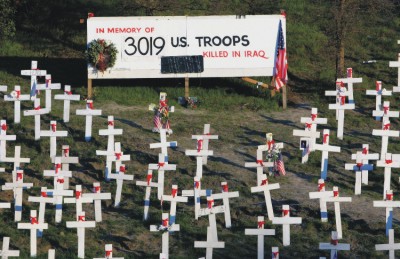
I cannot resist the temptation to offer my hats-off to the president of the United States, George W Bush for his steadfast and unshakeable determination to continue the course in Iraq, whatever might be the consequences. This has been reflected in a nationwide televised speech on January 9, when the president signaled to send an additional 21,500 soldiers to Iraq to stabilize the situation there. It is really amazing to note the decision of the president at a time when commanders in the field, like General John Abizaid and General George Casey, are not in favour of sending more troops to Iraq. In this case, the president has deviated from his previous rhetoric that he would listen to commanders on the ground when it comes to troop levels. Instead of listening to the advice of his commanders or reports by the Iraq Study Group led by James Baker, former secretary of state under his father and Lee Hamilton, former chairman of Senate foreign relations committee, the president is going ahead to escalate the fluid situation in Iraq. While admitting a flawed strategy after three and a half years of invasion of Iraq, President Bush proposed to send additional troops to bring stability in Baghdad and Anbar province. He also urged the puppet Iraqi administration of Nouri al-Maliki to make serious efforts to take security measures and reforms. But the president indicates no timetable for the withdrawal of troops. This is ridiculous indeed. The speech, however, gives some impression that President Bush took the report of the Iraq Study Group seriously as he planned to add $414 million to expand provincial reconstruction teams, $400 million for quick response fund, and $350 million for field commanders to solve local problems. On the other hand, President Bush is going to take diametrically opposite actions against Iran and Syria despite the Iraq Study Group's recommending having dialogue with Iran and Iraq to defuse violence in Iraq. In the speech, the President promised to step up operations to interrupt the imaginary flow of support from Iraq's two neighbours and to seek out and destroy networks providing weapons and training to US enemies in Iraq. It is more interesting to note that the president does not care about the verdict of the voters in the November congressional elections that handed power to the Democratic Party in 12 years. The verdict was loud and clear: end the war in Iraq and leave. The unabated violence and killing of American troops has turned majority of the Americans against the President. It has been projected in the polls conducted by Washington Post-ABC News immediately after the speech that 61 percent of the Americans opposed the president's plan to send additional troops. This report appeared on January 10. The decision to send additional American troops to Iraq, despite strong opposition from Congress and Americans, including anti-war groups, has evoked a negative response from the leadership of Democratic Party, which now controls the Congress. Speaker Nancy Pelosi, of the House of Representatives, along with Senate majority leader Harry Reid, have made it clear that the president will not have blank cheques to pursue his uncharted mission or hidden agenda in Iraq. Senator Edward Kennedy, meanwhile, has given the impression that without further authorization from the congress, no additional troops will be allowed to move to Iraq to fight civil war. Possibly, the best response came from Congressman Chris van Hollen, who has been appointed new chairman of the Democratic Congressional Campaign Committee. Congressman Chris is reported to have said: "By calling for the rapid escalation of American troops in Iraq, the President rebuffed his commanders, thumbed his nose at the Baker-Hamilton commission, and worst of all, ignored the will of the American people.'' Interestingly, some Republican senators and representatives are not in agreement with the president on the Iraq issue. Republican Senator Chuck Hagel, for example, is of the opinion that ''the plan would be the most dangerous foreign policy blunder in the country since Vietnam -- if it is carried out." Republican Representative Ric Keller said injecting more young American troops into the crossfire of an Iraqi civil war is simply not the right approach. This being the scenario in the Congress and considering the pressure from anti-war groups, the president will face undoubtedly tough days ahead. Since the commanders on the ground did not subscribe to the president's grandiose idea to surge troops after three and a half years, they are being fired. Despite the lowest rating approval of handling the situation in Iraq and a negative response from the Congress, President Bush's decision to continue the course is really praiseworthy. His strategy in the new bottle is his last card to win in Iraq. It appears that President George W Bush was not born to accept defeat like other war presidents.
|