National Museum
Extending knowledge on world civilisations
Wahida Mitu
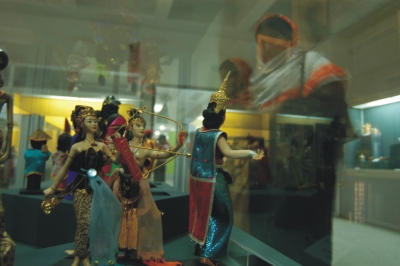
The National Museum has inaugurated a World Civilisation Gallery featuring famous paintings and artifacts from around the world, with the aim of spreading knowledge of the globe's diverse cultures and their achievements.The galleries on the third floor of the National Museum building have been reserved to display the heritage of different countries and civilizations, using reproductions of famous paintings, portraits of famous historical personalities as well as ancient relics and symbols from across the world. "The aim is to bring novelty and variety to the museum," said Quazi Akhtar Hossain, director general of the National Museum. In one gallery, housing portraits of world-renowned historical personalities, visitors get a chance to see the images of world famous personalities painted by Bangladeshi artists. The portraits include those of Socrates, Abraham Lincoln, Vasco da Gama, Galileo, Charles Darwin, Maxim Gorky, Leonardo da Vinci, Leo Tolstoy, Christopher Columbus, Florence Nightingale, Johan Wolfgang von Goethe, William Shakespeare, Isaac Newton, and Allama Iqbal. Brief information about their lives and contribution to the world are provided both in Bangla and English. Visitors to the gallery said they were happy to have the chance to see the world-renowned personalities, however several were disappointed not to find any Bengalis among the paintings. "The portrait of Rabindranath Tagore should be included in the gallery as he is Bishwa Kobi. Among the great world renowned personalities one portrait of such a great Bengali would encourage us and make us proud," said Shojib Hossain, a student of Dhaka University. On the right of the entrance of the new exhibition, are the Korean, Chinese, Iranian and Swiss sections. The South Korean embassy set up the Korean heritage section with the help of the Korean national folk museum. The letters of the Korean alphabets, both old and new, are on display with visual images of the fonts displayed on a digital screen. Visitors can listen to traditional Korean music with traditional musical instruments, masks, potteries, costumes, sculpture and paintings also on display. In the Swiss corner the country's embassy has re-established an exhibition of art and crafts that was first displayed in the museum in 2004. After having traveled to over 20 countries, the Swiss art and crafts found their final resting place at the Bangladesh National Museum as the Swiss embassy handed them over as a symbol of friendship, informed Jahangir Hossain, keeper in charge of the Department of Contemporary Paintings and World Civilisation. The folk art and crafts include masks, ceramic-wares, dolls, musical instruments, churning machines, cowbells and other objects that show the traditional lifestyle of the Swiss. In the Chinese gallery there are sculptures in terracotta, traditional costumes, musical instruments, paintings, decoration pieces, wooden screens and flower vases, while the Iranian corner shows a glimpse of ancient Iran, displaying replicas of statues, armlets, plates, calligraphy, pottery and other artifacts. In a gallery called western paintings, visitors have the opportunity to see world famous western paintings. The paintings are digital reproductions, meaning they look the same as the originals. Leonardo da Vinci's 'Mona Lisa' and 'The Last Supper', Michelangelo's 'The Last Judgement' and 'Holy Family' and Raphael's 'Women with Unicorn' and 'The School of Athens', and Vincent Van Gogh's 'Sunflowers' are on display. Among others, visitors will also be able to see famous paintings by Pieta Brughel, Albert Moore and Comille Pissarro. "This is a very good initiative by the national museum authority. Here we can see great works by world famous painters," said Tamanna Afrin, a student from the National University. Another interesting corner at the gallery is the 'dolls' section. Gunitta Tayeb, a Swedish woman who married a Bangladeshi, donated her personal collections of dolls to the museum before her death. She collected 119 traditional dolls from 36 countries during a lifetime of extensive travel. The dolls represent the traditions and customs of the countries where they were bought. Another area of the gallery shows the gifts received by the state during visits to different countries by the President and other state officials. The gifts have been accumulated from the treasury of Bangobhaban. In this section visitors can see exhibits from different countries, including the unknown head of a Pharaoh and a small piece of a Pyramid from Egypt, relics of Gandhara, an ancient Buddhist kingdom now located in Pakistan, and pieces of tiles from Hiroshima and Nagasaki, burnt during the explosion of atomic bombs over the cities. The director general said he is trying to collect a single specimen of a mummy from Egypt as it would be very popular and attract visitors.
|