Polls only after basic reforms
Eminent citizens outline challenges of interim govt, ask for roadmap with specific timeframe
Staff Correspondent
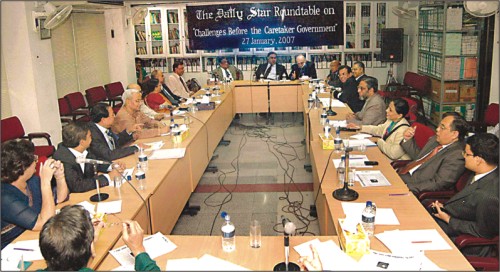
The Election Commission (EC) needs to be reconstituted within the shortest possible time so it can assess and announce a time limit for carrying out the electoral reforms essential for holding a free, fair and credible election.The polls must be held in line with the Representation of the People Order (RPO) and soon, but only on completion of fundamental reforms like reconstitution of the EC, correction of the voter roll and introduction of voter ID cards, eminent citizens told a roundtable yesterday. But the interim government should not take too much time for the reforms and the state of emergency should not be in force for long either. Organised by The Daily Star at its office, the roundtable was on 'Challenges before the Caretaker Government'. The speakers said the new chief election commissioner (CEC) should be a person with a clean record who can withstand pressures from the political parties. It is rather the EC, not the caretaker government, that will hold the election and so it must start its work forthwith.  They proposed that for the sake of transparency a depoliticised mechanism should be used to make appointments to the constitutional bodies like the EC, Anti-Corruption Commission (ACC) and Public Service Commission (PSC). Later, those could be ratified by parliament. They proposed that for the sake of transparency a depoliticised mechanism should be used to make appointments to the constitutional bodies like the EC, Anti-Corruption Commission (ACC) and Public Service Commission (PSC). Later, those could be ratified by parliament.
The discussants stressed that rule of law that has taken a dip must be restored immediately, and demanded that the caretaker government (CG) enact the Right to Information Act. Some of them recommended involving the local government and members of the armed forces in the voter list correction job. Ways to hold a free and fair election, reforms of the political parties, and depoliticisation of the administration were among the issues talked over at the roundtable moderated by The Daily Star Editor Mahfuz Anam. Dr Kamal Hossain, Dr Rehman Sobhan, TIB board of trustees Chairman Prof Muzaffer Ahmad, former caretaker government advisers Dr Akbar Ali Khan, CM Shafi Sami, Lt Gen (retired) Hasan Mashhud Chowdhury, Sultana Kamal and Yasmeen Murshed, Awami League (AL) Presidium Member Tofail Ahmed, former law minister Moudud Ahmed, Badiul Alam Majumder, Lt Gen (retired) Harun-ur-Rashid, Jatiya Party (Ershad) Presidium Member Anisul Islam Mahmood, barrister Tanjib-ul Alam, economist Dr Atiur Rahman and Dhaka University teacher Asif Nazrul, researcher Dr Mustafizur Rahman and Sharmeen Murshid of Brotee took part in the discussion.
AUTHENTIC VOTER LIST Former adviser Akbar Ali Khan noted that having separate voter lists for males and females is discriminatory, and they [rolls] create room for confusion. He said a voter list must be based on a national database and so developing one right from the grassroots level should be one of the main priorities. He added that the voter roll prepared in 2000 should be updated in accordance with the Supreme Court directives. The EC had already violated the constitution by having three voter lists instead of one, he observed. The list must be published before the unveiling of the election schedule. Prof Muzaffer said the biggest challenge for the EC lies in preparing voter rolls in Dhaka and Chittagong. "A lot of problems could be overcome if the list is updated during local elections," he added. Noted jurist Dr Kamal Hossain said the process of preparing or updating the voter list is massively defective since the agents who collect, check and register names on the list have been openly partisan. Badiul Alam Majumder, Secretary of Shujan, an NGO working for good governance, proposed that local government could be engaged in voter roll correction. Outlining a model, he said, "A four-member committee headed by ward commissioners can complete the revision task at the union parishad (UP) level. Going from door to door with one of them taking photographs of the prospective voters, they can have the job done in four to five days." After scrutiny, the list could be sent to the upazila level where 60 computer operators working in shifts will enter the data into 30 computers. The draft list with the photographs pasted on it will be returned to the UP level up for public display and for making necessary correction, he said. "The entire process that might cost up to Tk 175 crore, and take 75 days to be completed will stop duplication of voters," he said, adding that the computers can be used at the UP offices later. Shujan chief Muzaffer Ahmad said a software developed by his organisation could be used for preparing the voter database. Barrister Tanjib, however, pointed out there is no provision of attaching photographs to the voter lists and the RPO needs to be amended for this. Former army chief Harun-ur-Rashid said the list can be prepared in 75 days. "Members of the armed forces can assist in the job with their expertise and experience in data entry, and I think it will make the list more credible,'' he said. The database should be prepared in a way so it can be used later for preparing national ID cards, he added. AL Presidium Member Tofail Ahmed proposed that the government declare a two-day holiday and ask the people to remain in their houses to make sure their names are on the voter roll. Brotee Executive Director Sharmeen Murshid said the civil society members and NGOs could monitor the voter list revision.
EC REFORMS AND AUTONOMY
Akbar Ali asked for reconstituting the EC immediately so that it can assess and inform the people of the time needed to carry out the electoral reforms. He called on the government to appoint immediately a CEC who would be capable of running the commission independently and effectively. He said the EC, not the government, should decide on the feasibility of introducing the voter ID cards and also inform the public of the estimated time the process might take. Akbar described the EC as the "most wasteful" of all government institutions and regretted that Tk 70 crore from public purse has gone down the drain due to the discredited voter list prepared by it. Muzaffer said the CG and EC should always be open to civil society proposals like the one for a special audit into the EC expenditures to see how Tk 200 crore was reportedly wasted. He mentioned at that point failures of the past voter ID projects. He underscored the need for a bipartisan approach in choosing a CEC while a neutral approach in recruiting poll-related other officials. DR Kamal, meanwhile, said that the EC must have a secretariat independent of the Prime Minister's Office (PMO), as it is now. He said successive governments have unjustifiably meddled in the work of the EC, and rendered it partisan. The EC, Dr Kamal said, should be immediately reconstituted to flush out those who are partisan to the core. "You (CG) need not consult Awami League or the BNP; please appoint someone [as the CEC] who is competent and who can withstand pressures from both the parties," said Tofail. Moudud Ahmed echoed the view of Tofail. He said the EC does not need too many commissioners when two will suffice. He admitted that the voter roll prepared during their term is flawed. He said there's nothing wrong with introduction of the voter IDs if that could be done in three months. However, it will not be right to stretch the tenure of the interim government on this pretext, he added. To make the changes meaningful, the other institutions should also be reformed, said Tanjib-ul Alam. The EC must be strong enough to be tough on the electoral rules violators including those who submit false statements, he noted.
ELECTION EXPENSES
As the discussants put their heads together on stopping the use of black money in elections, Prof Muzaffer urged the ACC, NBR and EC to find a solution together to the black-money crisis in elections. Proper implementation of the RPO can stop all irregularities but due to certain decision makers, the RPO was not implemented and most cases were summarily dismissed, he said. With the politicisation of the EC and National Board of Revenue (NBR), the government already lost the first line of defence against the corrupt and black money holders, said Akbar Ali. It is not impossible to prevent the corrupt from getting nominations, and a better result is possible by eliminating even 10 percent corruption, he said, asking for making the ACC functional to bring the black money holders to book before they have the opportunity to run for elections. Kamal Hossain, however, said it is not just the black money but a whole set of corrupt practices related to election process, which is harmful. He said bribing election officials and buying off blocks of poor voters should also face the full application of criminal law. The Tk 5 lakh cap on election expenses seems to be a joke as in practice Tk 5 crore is spent, he said, adding that the challenge is how to close this gap. "Criminal law has to be applied properly to stop the use of black money." Those who are not willing to violate the law are withdrawing from politics, said Dr Kamal, adding that this has disenfranchised and dis-empowered honest candidates in elections. "If the results reflect money and muscle, how can you hope to elect an honest person?" he said. Harun-ur-Rashid said members of the armed forces can be engaged in enforcing election rules. The political parties turn to black money holders and loan defaulters as they need Tk 500 crore to 1,000 crore for electioneering, said Anisul Islam Mahmood said, proposing state funding for the candidates to check the use of black money. He said the government can set aside Tk 200 crore a year that will add up to Tk 1,000 crore for spending during the election. For making election propaganda free of black money or excessive use of money in general, Dr Mustafizur Rahman proposed installing billboard at specific points, fixing special points for holding rallies, and allocating airtime on television and radio.
ELECTION TRIBUNAL
Dhaka University professor Asif Nazrul pointed out that there is a provision in the RPO for seven-year jail for violating election rules, which, he said, is not followed properly. Both CM Shafi Sami and Asif Nazrul noted that the EC inquiry committee cannot debar a candidate from contesting election even after finding him/her ineligible. Echoing the view, Yasmeen Murshed proposed formation of an "election disqualification commission" with this power. Asif Nazrul proposed cutting of lawmakers' parliamentary privileges that delay disposal of election and post-election disputes in the court. Besides ensuring transparency of the presiding officers, returning officers and the polling centres, Shafi Sami stressed the need for improving law and order to stop capturing polling booths to much extent. Prof Muzaffer suggested raising the number of High Court benches for dealing election disputes. Barrister Tanjib pointed out that the judiciary needs to be strengthened to deal with the cases and it should be ensured that the politically biased people cannot influence the judiciary.
REFORMS OF POLITICAL PARTIES
Tofail Ahmed said people have very high expectations from the politicians, but politics has no longer any place for honest and sincere people. He said regardless of the faults of seasoned politicians "these days people no longer need to be experienced in politics to become members of parliament or reach high places in politics." Akbar Ali Khan suggested that a candidate must have primary membership of the party for three years before one can seek nomination for polls. The RPO is not sufficient and should be amended for proper registration of the political parties, he noted. He asked political leaders to resign in case of their not agreeing with their party decisions. Kamal Hossain criticised the current political situation where politicians who play foul are rewarded and those who follow the rules are disadvantaged. He urged the political parties to develop a code of conduct to which they will voluntarily adhere, and the policymakers to prosecute the violators of those codes. He said the ACC should be given the mandate to prosecute those, who abuse their power for private gain, by immediately disqualifying and severely punishing them. A national referendum would reject these politicians as their representatives, he suggested. The MPs turn into local administrators without neglecting their real duty of making laws, said Harun-ur-Rashid, adding that half the problems would have been solved if the local government had its due power and authority. Moudud Ahmed and Badiul Alam Majumdar proposed dissolving the student wings of the political parties to get politics out of the educational institutions. They also asked for ban on hartal through a consensus among the political parties. However, Tofail said student politics has a long history in Bangladesh and it is the corrupt state of politics that has to be eliminated so that student politics can assist in running the educational institutions. He said he is in favour of reforms in the political parties. "It is up to us, the political parties who have failed, and we really need to think where we went wrong and where we are going wrong," he added. The political parties can be reformed through the RPO, Asif Nazrul said, proposing a change to the RPO for inclusion of information on political parties' income and expenditure, and holding of party councils. Former cabinet secretary Hafizuddin Khan said, "The lawmakers are busy in everything other than lawmaking...Both the major political parties opposed to registration." Moudud and Tofail voiced agreement on political parties' registration.
APPOINTMENT TO CONSTITUTIONAL POSTS
The discussants agreed about bringing clean and competent people to constitutional posts in the EC, ACC and PSC and recommended formation of panel for appointment to the posts. To ensure that competent and neutral persons come to the posts, decisions taken in the depoliticised mechanism can later be ratified by majority of the ruling and opposition lawmakers, some of them suggested. The political parties give appointment to the constitutional posts considering who will serve their interest best, Atiur Rahman said, adding that the PSC has become a den of corruption. His proposal for a panel of non-controversial persons to make recommendations regarding appointments to the constitutional posts was supported by several other discussants. Mentioning the failure of the ACC, Moudud asked the CG to reconstitute it with honest and courageous persons. "One who has 10 years' experience in law practice can be a judge. But we appoint those who are like-minded," he said.
DEPOLITICISATION OF ADMINISTRATION
Rehman Sobhan noted that the corruption of social and political systems has forced people to manipulate procedure in the administration, judiciary and even the security forces. He also lamented what he termed the manipulative nature of the two major political parties in Bangladesh. Moudud Ahmed said goodwill of the political leadership is needed as political interference in administration, judiciary or the armed forces cannot be solved only through legal provision. While Rehman Sobhan pointed out that in the past, non-controversial people would be appointed to the posts, Moudud said: "We all are to be blamed for spoiling that culture." Government officials should be promoted through a collegiate system, should not be given extensions or forced into retirement, and there should be a provision that they will not enter politics within three years of retirement to develop a culture of neutrality in administration, Shafi Sami said. "This is the caretaker government's honeymoon period. The fact that they haven't done much with the EC has raised questions among the people," said Tofail. "Tough days are ahead for us," he said, adding, "We [Awami League] understand that there has to be quick elections, but with the proper reforms." Sultana Kamal said, "I think people are happy to see the caretaker government's use of the state of emergency up till now. I would like to see the state of emergency used to prepare the voter list." Out of basic moral accountability, the CG must show that they will rehabilitate the slum-dwellers who have been evicted, Sultana said, while also urging the government to look into extra-judicial killings by certain law enforcement agencies. Dr Kamal said BTV should be made autonomous immediately, while the CG must also set an example of efficient resource allocation for future governments. Former adviser Lt Gen (retired) Hasan Mashhud Chowdhury said the primary challenge for the caretaker government is to perform a delicate balancing act between holding elections as early as possible and people's expectations to put things right. He urged the CG to keep up the momentum of reform, but also stressed the need for setting a timeframe to provide people a visible yardstick of the CG's success. The CG should be given some space to breathe, so they can try to achieve some of their objectives without overwhelming pressure, he added. The CG should not stay in power for over 90 days and should have only one agenda to run day-to-day office work and assist the EC in holding the election, Moudud Ahmed said. "It [CG] should not take any decision regarding policy making and must announce a timeframe. I think holding an election is possible in three months," he said, adding that state of emergency and democracy cannot go together. Since it is impossible for the CG to fulfil all expectations of people, it should find out the doable and fix agenda accordingly, Harun-ur-Rashid said, adding, "There may be advisory committee for each prioritised issue and other people should assist them." Yasmeen Murshed proposed formation of a 6-8 member national task force including one to two advisers for finding the doable in a specific timeframe.
LAW AND ORDER
Instead of going against the weak and the vulnerable, the armed forces should find the biggest violators first, Dr Kamal said, adding, "Let Bangladesh know that law and order has been restored. That no one, no 'bhaban' is above the law." The punishment should be commensurate with the crime and electoral fraud should be dealt with severely, he said.
OTEHR IMPERATIVES
Saying that the previous government failed to separate the judiciary from executive and form Human Rights Commission due to 'political reasons', Moudud Ahmed hailed the CG for its initiative and asked it to form the Human Rights Commission, sign in UN anti-corruption charter and to cut weekly holidays to one day. He also urged formulating ACC rules.
|