Asean moving ahead
Imran Khalid
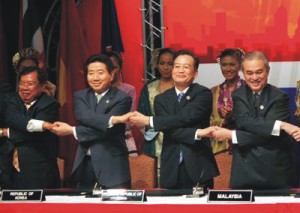
At least for one aspect, the 12th summit of Asean (Association of Southeast Asian Nations) in the central Philippines city of Cebu was certainly different from all the previous gatherings of the 39-year old association. Aside from the routine business of pompous declarations and ostentatious resolutions, which have increasingly become the trade-mark of this regional club, the Asean summit, for the first time, took an emphatic step towards its graduation from a "talk shop" to a politically and economically integrated bloc -- ostensibly with an EU-style complexion. Since 1967, when the five founding members established this club with a one-point agenda of applying the brakes on the spread of communism in the region, the organization has passed through many phases of structural and strategic evolution. But, despite creating a rather glamorous image for itself, Asean has so far failed to play a palpable role in the political, social and economic coherence and elevation of the lives of 570 million inhabitants of the Asean region. Factually speaking, visa-free travel is perhaps the only tangible benefit that Asean citizens are enjoying at the moment, other than this, they have not yet developed a "feel" about the bloc. This is the major dilemma of Asean that, even after the passage of four decades, it is still struggling to make its presence felt among its citizens. Unlike other similar regional associations, which have over the years generally evolved into robust platforms for the political, social and economic integration of their respective regions, Asean, owing to its adherence to non-interference in the internal affairs of the member states and a "softly, softly" approach towards other contentious issues, has never been able to assert itself in global politics as the political and economic voice of the region . However, for the past several years, the changing global scenario and instability in global economy have been compelling the Asean leadership to transform this forum from a mere discussion house for exchange of goodies to a genuinely effective regional body. And at the just-concluded Cebu summit, the Asean leaders have finally agreed to draft their first ever charter, with the ambition to transform the bloc, known for managing matters by consensus and for staying out of the internal affairs of member states, into a coherent, rules-based institution along the same pattern as that of the European Union. All the leaders mutually agreed to formally give consent to the proposal put forward by the group of "eminent persons" from all ten members. The proposal asks for the initiation of the economic integration, and for turning Asean into a unified market similar to the European Union. Accordingly, a task force has been commissioned to draft the charter in this direction. The basic outlines of the blueprint favour the retention of existing decision-making by consensus wherever possible, but it also gives the opportunity to the members to vote on issues where agreement could not be reached. At the same time, the charter also empowers the club to impose suspension or withdrawal of membership in case of serious breaches of the charter by any member states. Obviously, all this boisterous talk about EU style integration and operating regulations sounds pretty good for an organization that has so far evaded the question of regional integration because of the existing economic and political diversity of its members. Though the first draft of the charter, which is scheduled to be presented for discussion at the next Asean gathering in Singapore later this year, is not likely to be as stiff as that of the EU on the operating rules and regulations there is every reason to expect some drastic recommendations towards the creation of a free-trade zone by 2015. The Asean region encompasses very divergent political and economic textures; on the one hand, the ten-member cluster is a mix of monarchy like Brunei, military dictatorship of Myanmar and democracy like Singapore, while on the economic front there is huge variation among the member states, ranging from Singapore's per-capita GDP of $28,000 to Laos's $2,000. On the face of it, unlike the European Union's somewhat homogenous political, economic and social composition that made the integration a relatively easier job, the Asean bloc has inherited fairly deep political and economic disparity among its members that will certainly make it very difficult for a swift and smooth economic integration in less than a decade, as is being projected by the Asean technocrats. Regardless of such congenital anomalies, the positive thing is that, after decades of directionless, benign and soft politicking, the Asean leadership has at last taken the first step towards a tangible process of integration -- perhaps the most strategic move by the club to remain compatible in the coming days. Dr Imran Khalid is a freelance contributor to The Daily Star.
|