Shortage of Skilled Manpower 4
Garment factories in dire need of skilled manpower
Durdana Ghias
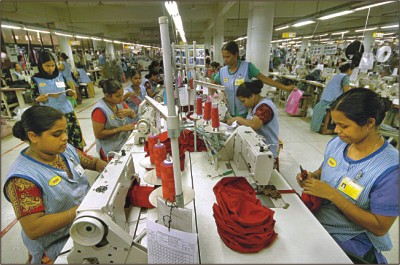
Readymade garment sector that earns more than three-fourths of the total foreign currency is suffering from an acute shortage of skilled manpower. Bangladesh Garment Manufacturer and Exporters Association (BGMEA) sources said around 22 lakh workers are working in the garment and related factories most of which lack skilled people at managerial level. According to BGMEA, there are 3,093 apparel manufacturers, 115 textile, knit and fabric suppliers, 368 accessories suppliers and 632 buying houses in the country. Two-thirds of the factories are located in Dhaka. Most of the people working at managerial level do not have formal training. They only get some on-the-job training, said BGMEA sources. Factory owners employ quality controllers and merchandisers both from locals and foreigners, but the salary of the foreigners is much higher than that of the locals due to the difference in skill level. Foreign merchandisers get on average $1,000 a month while only 8 percent of the local merchandisers get that amount. Thirty percent of them get $600 to $700 a month and the rest of them less than $500, said sources. Quality controllers working in foreign buying houses get over Tk 15,000 a month and those working in local buying houses get Tk 4,000 to Tk 12,000. According to owners, in a garment factory the role of a manager is very important and he/she should have both formal education and working experiences. But most of owners while recruiting a manager prefer those who have experience in production process and quality control. Lutfar Rahman, second vice-president of BGMEA, said the merchandising section, fashion designing, quality control, machinery management and production supervision have severe shortage of skilled manpower. The BGMEA Institute of Fashion Technology (BIFT), the only registered institute in the country offering courses on studies of managerial level at the garment sector, is located in city's Uttara area. BIFT offers 2-year MBA, 4-year honours, one-year diploma, 6-month certificate and 6-week short courses on different garment-related jobs. Since its inception in 2000, a total of 13,13 students passed certificate courses and since 2004, only 23 obtained diploma certificate. The number of seats in honours level at this institute will be increased from 120 to 275 from 2007, BIFT sources said. Forty-four students passed the honours course in 2004, 67 in 2005 and 55 in 2006. Kazi Shamsur Rahman, assistant professor, BIFT, said there are around one thousand garment buying houses and buyers' offices in the city which also need skilled managers. Dr Nazrul Islam, principal, BIFT, said the shortage is of two types; one is the shortage of skilled workers. The other is the shortage of mid-level managers like skilled machine operators, quality controllers, merchandisers and production managers. The readymade garment sector of Bangladesh earns around $8 billion foreign currency per year, but the productivity of the 22 lakh workers is much lower than in Sri Lanka and China. The reasons are lack of skill, poor management, poor working environment, poor health, low motivation and job satisfaction. There is no study in Bangladesh on job ethics and the reasons behind the lack of motivation and job satisfaction of the garment workers, he said. But poor salary might be one of the reasons, he added. "One problem is they do not get any formal training. It is like a driver who does not know how the engine works. They can work but if faced with a small technical glitch they cannot solve the problem," said Dr Islam. The problem of 'on-the-job' training is that it hampers the productivity of those giving informal training to the new recruits. "Many owners are hiring managers from countries like Sri Lanka, India, Korea and China. But the lifeline of our economy cannot depend on foreign recruits. It is not safe also because there can be a conflict of interest when a Bangladeshi company with an Indian manager and an Indian company vie for the same customer," he said. Dr Islam it is hard for BIFT to get good students, as garment sector is not the first choice of their students. "A university graduate would rather remain unemployed then working in the technical line of garment sector," he said. "Some donors are interested to assist BIFT but the institute wants government support to survive, grow, compete and win because our rival countries' governments are investing lots of money in this sector. If we cannot do the same, we will be struggling for survival," he said. Lilyma Khanom, managing director, Paramount Knitting Limited, said lack of interest among educated people to work in the technical side is a big reason for shortage of skilled manpower in this sector. "Educated people do not want to do something tough or offbeat and shy away from technical jobs. After passing masters everybody wants to maintain 'status' and wants to be called 'sir' in his workplace. But in the garments sector it is not possible," said Lilyma, who started from the job of a quality controller and now owns a factory.
|