TechFocus
Introducing digital jewellery
Edward Apurba Singha
In the near future jewellery will enhance your outlook in a quite different way and at the same time enable you to make phone calls and control devices. Yes, it is not a dream but an amazing reality of this digital age. Basically, jewellery adorns the body and has little significance in real life activities. Researchers realised this setback and with the help of information technology they are trying to conquer this limitation. As a result, they created prototypes of digital jewellery that incorporated several hi-tech facilities. Researchers took this initiative because computing power nowadays gradually increase whereas size goes down day by day. Today, manufacturer can place millions of transistors on a microchip, which can be used to make small devices that can store massive amount of data. International Business Machines (IBM) and other manufacturers already created some prototypes of digital jewellery. In this article, I have highlighted several digital jewellery prototypes that will give an extraordinary flavour to the jewellery lovers. Ultra modern cell phone
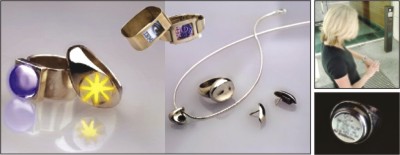
In future cell phones will not appear in their traditional form instead they will be broken up into some basic components and packaged as various pieces of digital jewellery. Each piece of jewellery will contain a fraction of the components found in conventional mobile phones. Collectively these components will function like a conventional cell phone. IBM has developed a prototype of a cell phone that consists of several pieces of digital jewellery that communicate with each other through Bluetooth technology to perform any particular function. Basically earrings, necklace, ring and bracelet are the building blocks of ultra modern cell phone. Speakers embedded into these earrings will be the phone's receiver and user will talk through the microphone embedded into the necklace. Ring is the most interesting part of the whole set-up. The ring contains light-emitting diodes (LEDs) that flash to indicate an incoming call. It can also be programmed to flash different colours to identify a particular caller or indicate the importance of a call. Bracelet equipped with a video graphics array (VGA) display; this wrist display could also be used as a caller identifier that flashes the name and phone number of the caller. During dialling a person will use his/her bracelet that integrates keypad and dialling function. On the other hand voice-recognition software will be used to make calls, a feature that is already commonplace in many of today's cell phones. Simply pronounce the name of a person you want to call and the phone will dial that person. IBM is also working on a miniature rechargeable battery to power these components. High-end display
All of us are accustomed with CRT or LCD monitors. These technologies are most common at this moment and gained huge popularity. But in real sense they do not give you mobility. Precisely speaking, you cannot instantly carry your monitor at particular location, there are always laptops and palm tops, but that's another story. Several companies, including IBM and Charmed Technology are working on ways to create a head-mounted display. IBM is also working to shrink the computer mouse to the size of a ring and create a wrist-worn display. IBM is working on mouse-ring that will use the company's TrackPoint technology to wirelessly move the cursor on a computer-monitor display. You're probably most familiar with TrackPoint as the little button embedded in the keyboard of some laptops. IBM Researchers have transferred TrackPoint technology to a ring, which looks something like a black-pearl ring. On top of the ring is a little black ball that users will swivel to move the cursor, in the same way that the TrackPoint button on a laptop is used. This TrackPoint ring will be very valuable when monitors shrink to the size of watch face. In the coming age when ubiquitous computing will dominate the computer world, displays will no longer be tied to desktops or wall screens. Instead, wearable display will be available like a pair of sunglass or a bracelet. Researchers are overcoming several obstacles facing these new wearable displays, the most important of which is the readability of information displayed on these tiny devices. Charmed Technology another manufacturer of digital jewellery outdistances IBM by marketing its digital jewellery, including a futuristic-looking eyepiece display. The eyepiece is the display component of the company's Charmed Communicator, a wearable, wireless, broadband-internet device that can be controlled by voice, pen or handheld keypad. The Communicator can be used as an MP3 player, video player and cell phone. The Communicator runs on the company's Linux-based Nanix operating system. Java ring
In recent time security is a big concern for us. Naturally we bound to take different measures in order to ensure security. These create hassle in our daily life. Dallas Semiconductor is developing a new Java-based, computerised ring that will automatically unlock doors and log on to computers. Java Ring, unveiled at JavaOne Conference, has been tested at Celebration School, an innovative K-12 school just outside Orlando, FL. The rings given to students are programmed with Java applets that communicate with host applications on networked systems. Applets are small applications that are designed to be run within another application. Java Ring is a stainless-steel ring, 16-millimeters (0.6 inches) in diameter that houses a 1-million transistor processor, called an iButton. The ring has 134 KB of RAM, 32 KB of ROM, a real-time clock and a java virtual machine, which is piece of software that recognises the Java language and translates it for the user's computer system. Java Ring programmed to store information that is utilise to pay for lunches, automatically unlock doors, take attendance, store a student's medical information and allow students to check out books. All of this information is stored on the ring's iButton. Students at Celebration School simply press the signet of their Java Ring against the Blue Dot receptor, and the system connected to the receptor performs the function that the applet instructs it to. Mobile computing redefine the present computing trend and give us freedom. Digital jewellery is a new form of mobile computing and in the next age of computing, we will see an explosion of computer parts across our bodies, rather than across our desktops. The underlying reason to invent digital jewellery is to break the dominance of personal computers and as well as make computer elements entirely compatible with the human form. Reference: howstuffworks.com
|