Ekushey Boi Mela
Rafi Hossain
Just like previous years, the Ekushey Boi Mela is also being celebrated this year in full flow. But unlike other years, the arrangements of the fair are quite different this time around -- a change dictated by the times. The first thing about the fair that catches the eye is the enormous queue of visitors that stretches from the fair entrance all the way to the National Museum at Shahbagh. Over the last few years, due to security-related issues, the queuing process has become orderly and organized. This year the strict security controls have made it quite impossible for people to break the queue or insert themselves somewhere in the middle, and this is something quite unusual for Bangladeshis to adhere to. As unusual as it may be, people are lining up properly to enter the fair. Even people who have grown up with the mindset of a life free of authority, like poets, artists and other rebellious beings, have expressed some discontent about the strict rules, they have also accepted this way of doing things. I finally got in after waiting in line under a scorching sun. As soon as I entered, a group of people dressed in yellow greeted the entering visitors by saying, "Apni ki janen, je aaj Himur Biye?" (Do you know that today is Himu's wedding?) It took me some time to comprehend what was actually going on. Then I realized that they were publicizing the publication of Humayun Ahmed's new book, "Aaj Himur Biye." Soon I saw that the line of fans in front of Annyo Prokash to purchase the new book was almost as long as the line of people who had queued up to enter the fair. The stall minders, who were all dressed in yellow, seemed to make the whole atmosphere very festive; it seemed to me that a gaye holud ceremony was going on at the stall! In terms of sales, as has been seen in the past few years, the publishers of Humayun Ahmed's books seem to prosper the most. After Humayun Ahmed come writers such as Mohammad Zafar Iqbal, Anisul Haque, and others. Even though the overall sales figures of Bangla Academy publications is impressive, their sales consist mainly of dictionaries. Which brings up the question: why are other books published by the academy not being sold? The Bangla Academy authorities should publicize their diversified range of publications so that people are informed and get interested in the many different kinds of books that are published by Bangla Academy. I think it's high time that Bangla Academy thought this issue over, so that many more people are benefited by their work, and so that they actually contribute to the general welfare. After all, they should not publish books for the sake of publication only! Current trends indicate that while people buy a lot of fiction, especially novels and poetry volumes, other types of books (serious academic works, nonfiction, intellectual enquiries) are not being written, published or sold as widely as the former. Our culture has not groomed us to read books that inspire us to think more intellectually. I think the Ekushey Boi Mela should focus more on how to change this trend and inspire Bengalis to take an interest in such books also. Bangla Academy, publishing houses such as Mowla Brothers, University Press Limited, and some others always publish a few such titles/volumes along with works of fiction, and the sales of Mowla Brothers and UPL are quite commendable in this regard. With the exception of Bangladesh Shishu Academy, Muktodhara, Tonatuni and a few other publishers, there have not been too many notable publications of children's books. Even though this area is important, it has not developed significantly in recent years. We cannot ignore the needs of young, growing minds. It is somewhat heartbreaking to note that though the young ones are one of the most enthusiastic groups to visit the book fair, they return home almost empty-handed. It's quite interesting to leaf through the going-against-the-tide publications at the 'Little Magazine' stalls, from where many avant-garde ideas and concepts come to the forefront. The assortment of authors and writers who produce their defiant materials and manifestoes form quite an intriguing scenario. They give birth to a lot of controversies, which, however, they view as quite normal. One thing, however, that struck me is how corporate advertising has taken over everywhere. They have penetrated into almost every field. Advertising and corporate houses are trying to promote DJuice culture. What is this culture? The advertising language has become an odd mixture of two languages, and the blend I believe is ruining the beauty of both Bengali and English languages. Where will this eventually lead? Should we not think before we start flowing with this tide? Even one of these 'Little Mag'-counterculture stalls has published a magazine called "Djuice little mag." If advertising can penetrate even the field of revolutionaries in front of our very eyes, then we cannot afford to be idle and let it happen. It is time to wake up! The setting of the stalls was a bit haphazard. It's very easy to lose your way while traipsing through the lanes and to keep track of the whole layout of the fair. The organization of the stalls needs to be more precise so that people can roam about more comfortably; the fair, for example, can be structured into suitable quadrants according to genres, or sizes, et cetera. Also, this year quite a few books are behind on their publishing schedules, and titles that have been advertised word-of-mouth have failed to arrive at the mela even a week after its start. The best thing that marks this year's book fair is the long-overdue sculpture that pays tribute to the martyrs of the Language Movement of 1952. It stands at the heart of the fair pavilion, as erect and as strong as our dedication to our beloved mother tongue. All in all, the fair is very inspiring since it brings together the nation onto a field which overflows with knowledge. This festival is not just for any distinct sector or group; rather it is for all the citizens for the country. We hope in the years to come that good books, and not of just fiction and poetry, are properly promoted and displayed, and that the fair keeps on thriving and adapting with the times. Rafi Hossain is a staff member of The Daily Star.
|
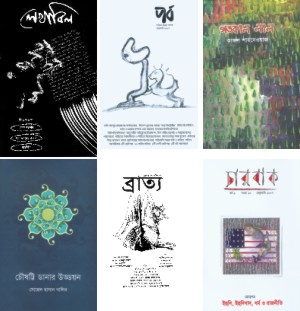
Some items from the Little Magazine chottor |

